OpenAI today officially opened global access to its latest generation GPT‑5.6 series of models. The relevant models have moved from the “limited preview” stage that was previously only available to a few trusted partners to full release for all users. The GPT‑5.6 series includes three models with different positions: the flagship GPT‑5.6 Sol, the balanced GPT‑5.6 Terra, and the lightweight and cost-effective GPT‑5.6 Luna.
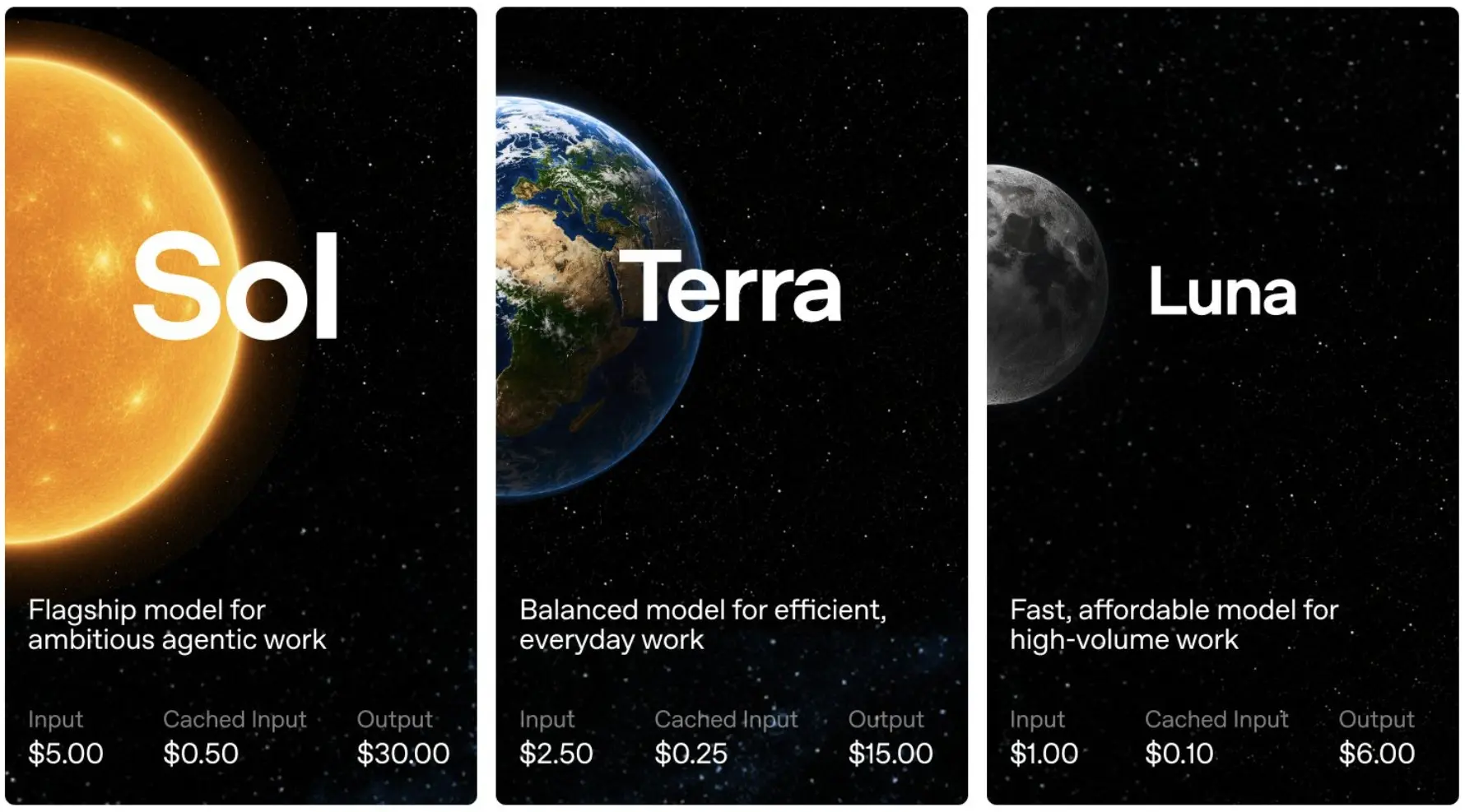
Among them, GPT‑5.6 Sol is positioned as the flagship model, targeting high-end scenarios such as complex reasoning, code development, scientific research, network security, and long-running agent tasks. GPT‑5.6 Terra is the "balanced model" in the family. Officials say that its overall performance can compete with GPT‑5.5, while the cost is only about half of the latter. GPT‑5.6 Luna is the smallest and lowest cost model in the series, better suited for workloads that require high speed and low cost.
In GPT‑5.6, OpenAI introduces a new “max reasoning effort” setting. Users can enable this option when using the Sol model to further improve the performance of complex reasoning tasks. At the same time, OpenAI has also launched a new "ultra mode" that schedules multiple sub-agents to work together to break through the upper limit of a single agent's capabilities and accelerate complex reasoning workflows.
A series of official benchmark test results show that GPT‑5.6 Sol has set new industry records in a number of professional evaluations for agent reasoning, code generation and security analysis. In the Agents’ Last Exam test, GPT‑5.6 Sol with adaptive inference enabled scored 53.6, 13.1 points higher than Claude Fable 5; even at medium inference settings, Sol still beat Fable 5 by 11.4 points at about a quarter of the estimated cost.
In the Artificial Analysis Intelligence Index test, GPT‑5.6 Sol with maximum inference effort enabled scored almost identically to Fable 5, yet completed the task 61% faster at about half the estimated cost. In the Artificial Analysis Coding Agent Index, GPT‑5.6 Sol (maximum inference) achieved a score of 80, setting a new industry best, 2.8 points higher than Fable 5. At the same time, the number of output tokens, task time and estimated cost were reduced to about half or even lower.
In the Terminal‑Bench 2.1 and DeepSWE v1.1 tests for complex engineering and real code base workflows, GPT‑5.6 Sol achieved new industry-best results. In the BrowseComp test for agent browsing tasks, GPT‑5.6 Sol scored 92.2%, setting a new record again. In the OSWorld 2.0 test, which simulates an operating system environment, GPT‑5.6 Sol scored 62.6%, surpassing Opus 4.8 while using 85% fewer output tokens.
In terms of security-related evaluations, GPT‑5.6 Sol also shows significant advantages. In the ExploitBench 1 test, GPT‑5.6 Sol scored 73.5%, while with a similar output token budget, GPT‑5.5 only scored 47.9%. In the ExploitGym 2 test, GPT‑5.6 Sol improved the top pass rate of GPT‑5.5 from 15.1% to 24.9% under a two-hour time limit, and further improved to 33.7% if the time was extended to six hours. In the SEC‑Bench Pro test for Securities and Security Analysis, GPT‑5.6 Sol scored 71.2%, significantly higher than GPT‑5.5's 45.8%, while improving latency performance.
OpenAI has also announced pricing for the GPT‑5.6 series. The fees for GPT‑5.6 Sol are US$5 per million input Tokens and US$30 per million output Tokens; GPT‑5.6 Terra is US$2.5 per million input Tokens and US$15 per million output Tokens; GPT‑5.6 Luna is US$1 per million input Tokens and US$6 per million output Tokens. In addition, OpenAI will provide a "fast mode" of GPT-5.6 Sol through Cerebras, which can achieve a generation speed of up to 750 tokens per second.
In terms of availability, OpenAI stated that GPT‑5.6 will be launched in ChatGPT, Codex and OpenAI API in the next 24 hours. ChatGPT Plus, Pro, Business, and Enterprise users can access GPT‑5.6 Sol with medium and higher inference strength settings; ChatGPT Pro and Enterprise users can also choose GPT‑5.6 Sol Pro, which is designed for complex tasks.
For ChatGPT Free and Go users, OpenAI will provide access to GPT‑5.6 Terra. ChatGPT Plus, Pro, Business and Enterprise users can freely choose between GPT‑5.6 Sol, Terra and Luna models and set different inference effort levels for each model. The new "max mode" will be available to all users using GPT‑5.6 in ChatGPT Work and Codex.
In the ChatGPT Work product, GPT‑5.6 Sol ultra mode will be available to Pro and Enterprise users to meet the needs of more complex enterprise-level workflows; in Codex, the new ultra mode is available to Plus and higher subscription plan users. With the official launch of GPT‑5.6 Sol, Terra and Luna, OpenAI’s new generation general model family has fully entered the enterprise and developer deployment stage, and competition around inference performance, cost efficiency and agent workflow has further escalated.