Tech giant Google announced its largest solar and battery storage purchase to date earlier this week. It is reported that the project is located in Arkansas, and the electricity generated by its first two phases will be enough to meet about 6% of the state's peak electricity demand.
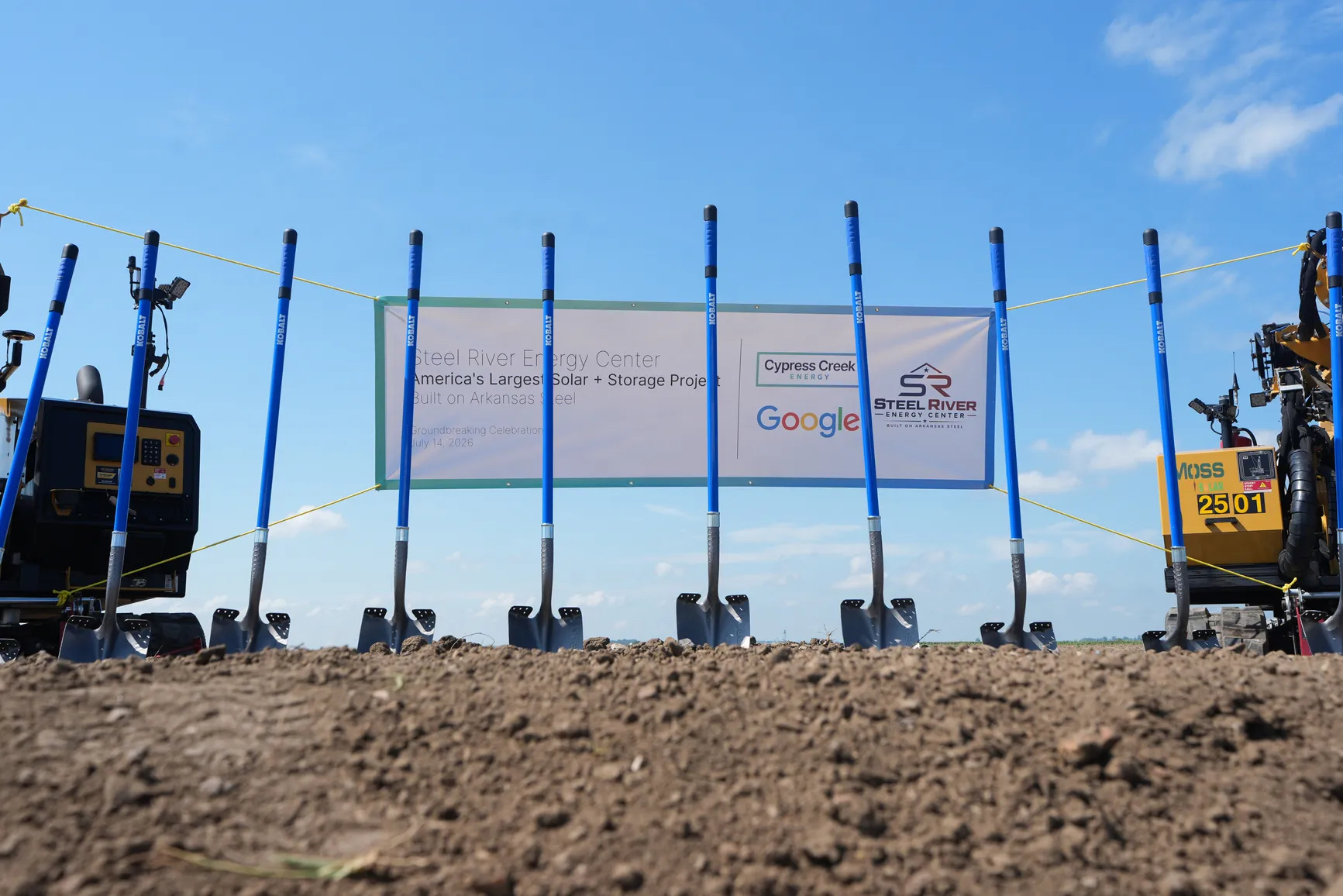
The electricity generated by the project will be directly integrated into the grid to offset the huge power consumption of Google's data centers. Google not only co-invested in the project with developer Cypress Creek Energy, but also directly bought out the entire production capacity of the first two phases, adding 1 GW of solar capacity and 1.9 GWh of battery storage to its energy matrix.
The companies said the three-phase project, known as the Steel River Energy Center, will be the largest solar facility in the United States when fully completed. The third and final phase of the project is expected to be connected to the grid in 2029, bringing the plant's total installed capacity to approximately 1.8 GW of solar and 2.9 GWh of battery storage. Currently, developer Cypress Creek has successfully raised US$3.5 billion in financing to support the construction of the first two phases of the project.
The Steel River Energy Center will be located approximately 30 miles north of Memphis, Tennessee. By pairing solar panels with large battery banks, the plant will have the ability to supply power to the grid around the clock. This will also give Google a strong push to achieve its strict environmental goals of fully matching electricity consumption with clean energy on an hourly level. The implementation of this standard is expected to attract more hybrid power plants to connect to the grid.
It is worth noting that Google’s decision to spend huge sums of money to build large-scale solar and battery facilities is in sharp contrast to Elon Musk’s xAI company. Currently, xAI is operating a yet-to-be-officially licensed natural gas-fired power plant approximately 40 miles south of the project.
Even though Musk is in charge of Tesla, which makes solar panels and grid-scale batteries, he still chose to invest heavily in using natural gas to power xAI's "Colossus" data center. According to a Reuters investigation, xAI illegally operated nearly 60 natural gas turbines without obtaining federal clean air permits. The report also pointed out that the pollution emitted by xAI’s power plant in Mississippi is having a serious impact on the local predominantly African-American community.
Judging from the current strategic layout, Musk seems to have no intention of changing the current energy route. He recently acquired APR Energy, a private company specializing in the development of modular natural gas power plants.
On the other hand, while Google has dabbled in natural gas power generation before, such as partnering with startup Crusoe to build a 933-megawatt power plant in West Texas, this project is more of a special case for a technology giant that has long relied mainly on clean energy for expansion. Considering the astonishing pace of deployment of clean energy projects such as River of Steel—nearly 2 gigawatts of solar capacity installed in just three years—it is widely expected that Google will continue to invest firmly in renewable energy and battery storage in the future.