Recently, China's top AI companies have launched strong challenges to Silicon Valley. Beijing-based artificial intelligence company Moonshot AI and technology giant Alibaba released their latest cutting-edge models within just a few days. These companies say that their models are not only powerful enough to compete with top products from OpenAI and Anthropic, but also more advantageous in terms of deployment costs.
This series of rapid response actions shows that at a time when global artificial intelligence technology is at the core of national security, economic development and geopolitical competition, the United States' leading edge in the frontier field of AI is facing unprecedented squeeze.
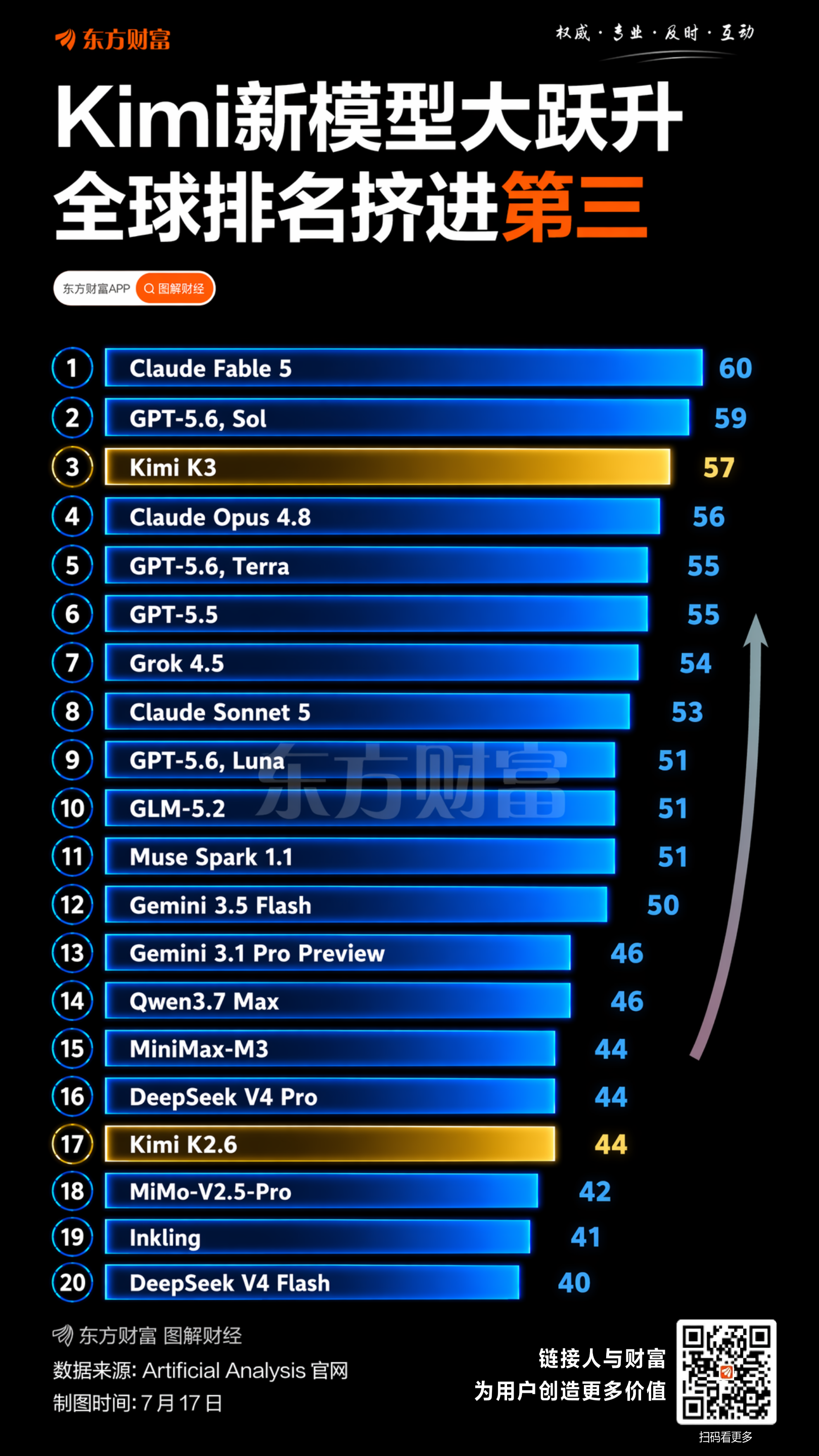
Dark Side of the Moon officially launched the highly anticipated Kimi K3 model last Friday. According to the company's internal test data, Kimi K3 has performed outstandingly in multiple benchmark tests. Its comprehensive strength has firmly ranked at the forefront of the industry, outperforming most similar systems in the United States, second only to OpenAI's GPT-5.6 Sol and Anthropic's Claude Fable 5. It even surpassed in some specific benchmark tests.
Following this, Alibaba also previewed its latest model Qwen3.8 over the weekend. Alibaba said that this model is one of the most powerful models in the world, second only to Anthropic’s flagship product Claude Fable 5 in performance.
Different from the closed-source strategy of some top U.S. laboratories that tend to "lock the core model technology behind the door", both Chinese companies have emphasized the importance of openness. Although some American companies, represented by Meta, have also adopted the open source route, Dark Side of the Moon and Alibaba are clearly committed to making the most advanced models public for developers to freely download, modify and build. Analysts pointed out that this approach of promoting the development of open source ecology has become an important differentiating advantage in the competition between China's AI industry and the leading laboratories in the United States.
According to the official introduction of Dark Side of the Moon, Kimi K3 is currently the world’s largest open source AI system, with 2.8 trillion parameters. Parameter size is usually regarded as an important indicator to measure the complexity and potential of model training. Although the number of parameters is not the only factor that determines performance, this scale has significantly increased the industry's expectations for the model's computing capacity and performance upper limit. As the AI competition between China and the United States enters the deep water zone, the rapid follow-up of Chinese models in terms of scale and openness is reshaping the global artificial intelligence competition landscape.