Scientists say that the El Niño climate phenomenon that continues to strengthen in the Pacific is expected to become the strongest in 150 years. If the dire situation they predict comes true, El Niño will release a large amount of heat from the ocean, coupled with the warming effect of human-induced climate change, it is likely to make 2027 the hottest year on record and trigger extreme weather in many places around the world.
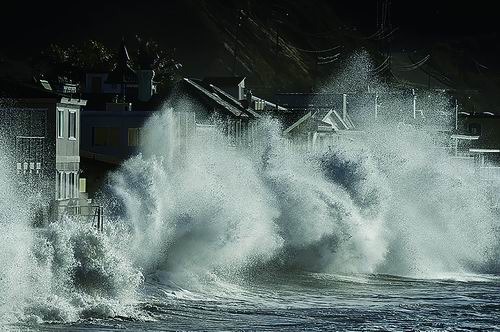
California in the United States is often hit by storms and waves during El Niño, causing floods. Photo credit: Mark Ralston
At a press conference held on July 23 by Berkeley Earth, a non-profit research institution in California, Zeke Hausfather, a climate scientist at the institution, said that a series of climate model predictions show that the peak intensity of El Niño this time may far exceed the previous record, and the gap is "shockingly large."
Hausfather mentioned at the meeting that it is "not entirely impossible" that the combination of this El Niño event and climate change will cause the global average temperature to increase by 1.7 degrees Celsius in 2027 compared with pre-industrial levels. This would push global temperatures closer to the 1.5 degrees Celsius threshold that countries committed to avoid in the Paris Agreement.
Today’s El Niño is no surprise. The El Niño-Southern Oscillation (ENSO) is a natural fluctuation in sea surface temperatures and winds in the tropical Pacific Ocean. Historically, this phenomenon has alternated between high-temperature El Niño and low-temperature La Niña every 2 to 7 years. The last round of El Niño occurred in 2023-2024. Meteorological experts have previously warned that a new round of strong El Niño is coming, and this year’s El Niño already appeared in June.
The latest forecasts show that this round of El Niño may be stronger than expected. Justin Mankin of Dartmouth College in the United States said this looks a lot like scientists predict that El Niño will be amplified by human-induced climate change later this century.
Since June, the warming sea surface and strong wind patterns in the Pacific Ocean that are signature features of El Niño have been rapidly intensifying. The latest report from the National Oceanic and Atmospheric Administration (NOAA) shows that there is an 80% chance of developing a strong El Niño event by the end of this year, and the El Niño phenomenon is almost certain to last until at least April 2027.
“Currently, all signals indicate that the ocean-atmosphere coupling in the equatorial Pacific is very active. This makes us more confident that a strong El Niño will eventually form and rank among the strongest El Niños in history,” said Michelle L’Heureux, head of NOAA’s ENSO prediction team.
However, NOAA's forecast may still be conservative. Hausfather compared the predictions of 14 climate models for this El Niño and found that the median prediction of peak Pacific sea surface temperature was about 0.8 degrees Celsius higher than the strongest record on record from 2015 to 2016. "While it's not a certainty, the likelihood of a strong El Niño is increasing month by month," he said.
Hausfather pointed out that in addition to El Niño, which may push global temperatures to a new high in 2027, the temperature increase in the next few months may also make 2026 the hottest year on record. Heat waves, droughts, floods and wildfires accompanying El Niño will also have an impact on the global economy.
Mankin's team estimated that the climate anomalies caused by the strong El Niño from 1997 to 1998 caused a $5.7 trillion reduction in global economic growth in the following years. If forecasts are broadly correct, the current El Niño could cause $10 trillion in economic losses by 2032.
In addition to impacting human society, El Niño also puts pressure on ecosystems and oceans, reducing their ability to absorb carbon from the atmosphere. Warming seawater will also exacerbate the coral bleaching crisis.
Kaustubh Thirumalai of the University of Arizona said that if we look back at climate records, this El Niño may not be the strongest one that has ever occurred on Earth. For example, coral evidence suggests there may have been a very strong El Niño in the 17th century. But short-term climate events that occurred in the past are difficult to accurately identify, so conclusive evidence is lacking.
Thirumalai believes that the real significance of this El Niño, which is only two years since the last one, is whether it means that man-made climate change is driving a systemic shift in the ENSO cycle. In other words, scientists already know that El Niño exacerbates global warming effects, but is the relationship a two-way street? "Frankly, we don't know yet," he said.
Many climate models predict that human-caused global warming may reshape the average state of ENSO in the 21st century, making El Niño stronger and more frequent. But researchers are still debating whether this trend is already seen in existing climate observations.
"We are in a transition period in the climate system." Thirumalai likened the climate changes taking place this century to the Earth's dramatic transition from an ice age to a warm world about 20,000 years ago. "The climate system has not yet reached equilibrium. Only when humans stop emitting carbon dioxide will it eventually stabilize." (Wang Fang)
"China Science News" (2026-07-28 2nd Edition International)