On July 29, the latest data from Counterpoint Research showed that smartphone memory prices increased by more than 80% month-on-month in the second quarter of 2026, resulting in a significant increase in BOM costs for models in all price segments.
Compared with the same period in 2025, the BOM cost of low-end models with the same configuration has increased by 70% year-on-year, and almost all growth is driven by storage; the BOM cost of mid-range models has increased by 52%, and memory accounts for 40% of the total BOM cost; the BOM cost of flagship models has increased by nearly 50%. In addition, DRAM has surpassed SoC to become the most expensive single component in flagship smartphones. It is estimated that the cost of the 1TB iPhone 18 Pro Max has increased by nearly US$300 compared to last year's iPhone 17 Pro Max of the same capacity.
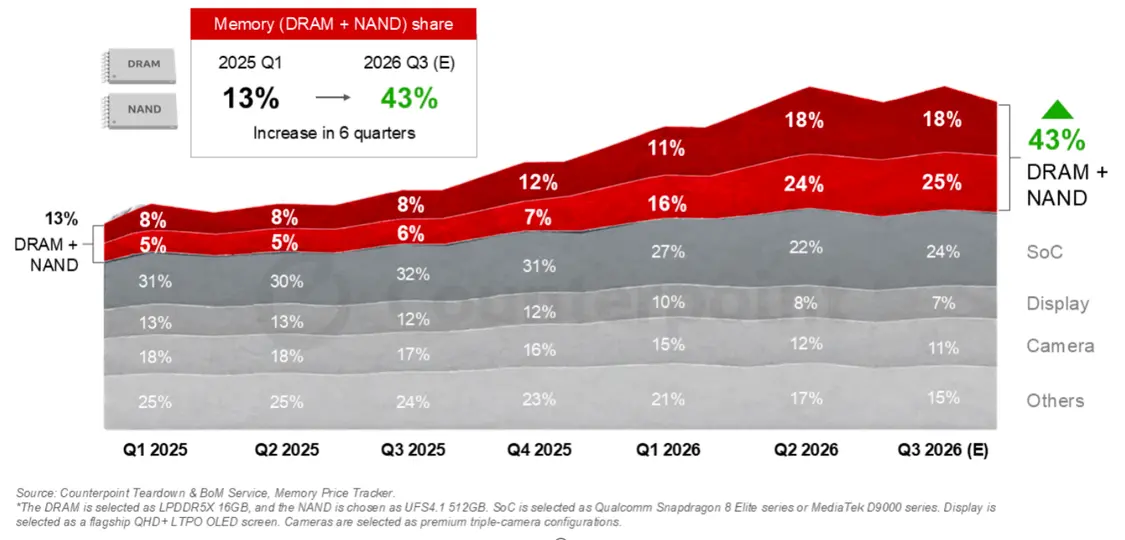
Shenghao Bai, a senior analyst at Counterpoint, said that although mid- and low-end model OEMs have alleviated cost pressures by optimizing product portfolios, they still face the risk of pressure on profitability and even losses for some models in the future; the rising BOM cost of flagship models has also slowed down the introduction of innovative technologies such as screens and imaging to a certain extent. He pointed out that smartphone OEMs will adopt differentiated pricing strategies for different storage capacities to balance cost pressures and market demand. Some OEMs are expected to control BOM costs of large-capacity models and slow down the increase in terminal retail prices by introducing more cost-effective NAND solutions.
The report also pointed out that the introduction of 2nm flagship SoC in the future will further push up the BOM cost of flagship models. Even if OEMs increase selling prices, the overall gross profit margin is expected to be slightly lower than the level of flagship products of the same generation in 2025.