
Abstract:
The 2026 Nobel Prize in Chemistry will be awarded to Henri Kagan and Kenso Soai for their "discovery of nonlinear effects and autocatalysis in asymmetric organic synthesis."
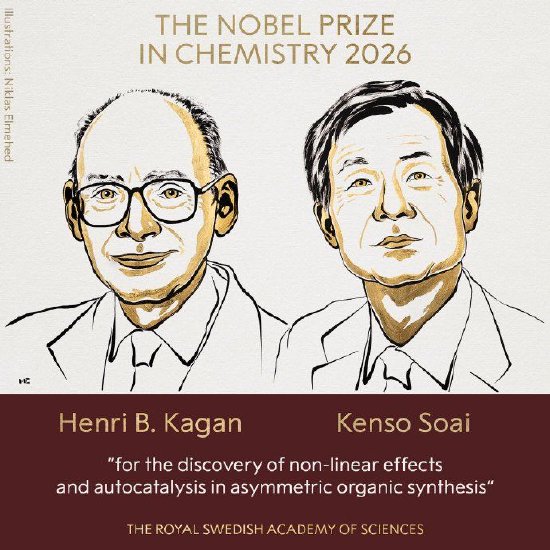
Some molecules, such as amino acids, have two variants that are mirror images of each other. But living things contain only one of these mirror-image molecules. Exactly how such chemical asymmetries arise has long been a mystery to chemists. Henry B. Kagan and Kenso Soai won the 2026 Nobel Prize in Chemistry precisely because they found the answer to this puzzle.
The chemistry of life possesses what chemists call homochirality, a word derived from the Greek words meaning "same" and "hand." Just like the left and right hands, all amino acids have two mirror image variants, but only one of them is found in human cell proteins, and the other is very rare in nature.
Chemists have long wondered how homochirality is formed. When experimenting with chemical reactions that produce two mirror-image molecules, the two products always coexist in equal amounts in the test tube. But chemists have always hoped to synthesize only one of the mirror image molecules, because when developing molecules that can interact with living organisms (such as drugs), often only one of the mirror image isomers can produce the expected drug effect.
The achievements recognized by the 2026 Nobel Prize in Chemistry allow chemists to drive chemical reactions and achieve the generation of homochiral products.
Heiner Link, Chairman of the Nobel Committee for Chemistry, said: "Henri B. Kagan and Kenso Soai have solved this century-old chemical mystery - how homochirality occurs spontaneously. The chemical reaction they developed is truly wonderful."
In 1986, Henri B. Kagan took the decisive first step and discovered a new way to regulate chemical reactions. Using this method, he was able to make the reaction product contain a far greater proportion of one of the mirror-image molecules than previously thought possible.
Kenso Soai completed the subsequent key breakthrough. In 1995, a core paper described his design of the first chemical reaction with the potential to generate homochiral products. In 2003, he achieved ultimate success: a chemical reaction that produced just one of two mirror-image molecules. Except for life itself, this has never been achieved before.
Thanks to the research of Henri B. Kagan and Kenso Soai, we now know the mechanism of homochirality. Their discovery played a decisive role in chemists designing drug synthesis reactions.
Comments