
Abstract:
56 years ago, on November 17, 1970, the U.S. Patent Office issued patent number 3541541 to Douglas Engelbart, titled "X-Y Position Indicator for Display System." This string of awkward descriptions is actually the computer mouse that everyone is familiar with today.
According to historical records, the actual invention of the mouse can be traced back to 1964. Engelbart was working with engineer Bill English at Stanford Research Institute to find a simpler way to edit screen information.
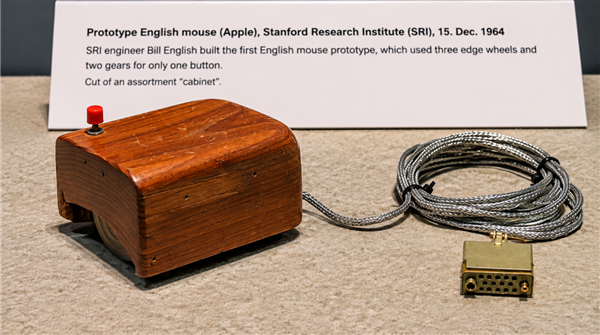
The first prototype was a crude rectangular wooden box with two metal wheels mounted vertically inside to capture horizontal and vertical movement. Because the connecting cord resembled a mouse's tail, the device was informally called a "mouse," and it is still used today.
It is worth noting that during the process of the mouse patent being approved, the German Telefunken company also developed a rolling ball control device called "Rollkugel" in 1966.
Different from Engelbart's metal wheel plan, the German plan uses a ball at the bottom to drive two sampling wheels for positioning. Although the German solution failed to obtain a patent, this rolling ball technology became the mainstream scanning method for mice in the following decades.
The road to commercialization of the mouse was not smooth sailing. In the early text command line era, the mouse was almost useless. It was not until the emergence of the Xerox Alto in 1973 and the widespread popularity of the Apple Macintosh in 1984 that the graphical user interface (GUI) truly made the mouse a standard feature of every computer.
Comments