
Abstract:
Most materials gradually wear and weaken during use, but a research team at Washington University in St. Louis has developed a new polymer that can become stronger after repeated bending and stretching. This collagen-inspired material is expected to be used in medical fields such as artificial joints and tissue repair to provide stronger support without sacrificing flexibility.
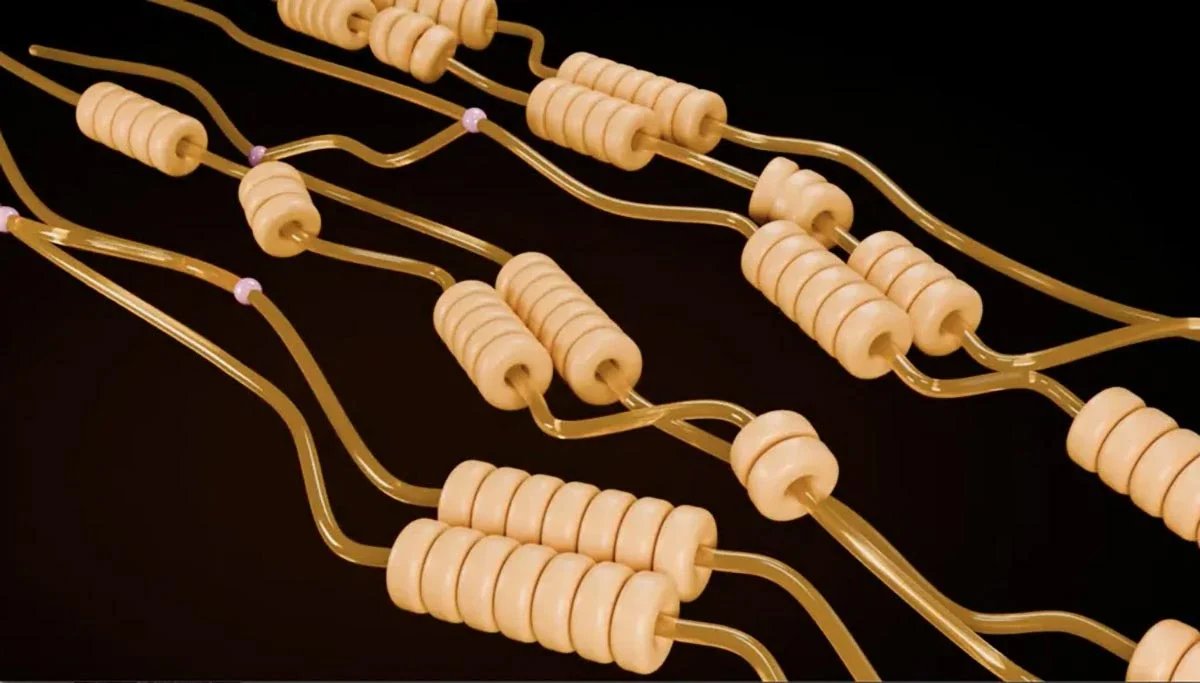
This "smart material" was developed by the team of chemistry professor Chenfeng Ke. He said that this material has properties that have never been seen before and can remember, adapt, learn and even "grow". Its potential applications are exciting. Relevant papers have been published online in "Nature·Materials".
This patented polymer is made from biodegradable sugar crystals mixed with polyethylene glycol. Polyethylene glycol is commonly found in health products such as laxatives, and the two combine to form a hydrogel. Hydrogel is a flexible material that can absorb and lock in large amounts of moisture and is compatible with 3D printing.
The magic of the material comes from cyclodextrin. This is a sugar-based compound that forms a ring structure. When the polymer is bent or stretched, the rings slide into position, reinforcing the areas experiencing the greatest strain. In other words, the material becomes stronger where it is repeatedly stressed.
The research team tested the material using a flexible joint similar to a knee joint, which was bent continuously 10,000 times. Repeated movement causes the polymers in the hydrogel to align more closely, strengthening the areas where stress is applied. Chen Fengke said that after bending 10,000 times, the material's performance provided verification of the team's previous predictions. The polymer became more uniform and ordered, and became stronger exactly where it was subjected to strain.
The design draws on biomaterials such as collagen. Collagen is the protein that gives skin its strength and elasticity. Chen Fengke said that some of the most impressive smart materials exist in biology, and the team got inspiration from nature.
This material is particularly promising for medical applications. Medical materials need to provide support while avoiding unnecessary stiffness. The polymer could potentially be used to support artificial joints or repair damaged tissue, making areas subject to repeated stress stronger while surrounding areas remain pliable. Chen Fengke said that because the material is made of sugar and polyethylene glycol, it is fully compatible with biological tissue and is expected to attract interest from surgeons and orthopedic medical device companies. He also pointed out that materials implanted in the human body do not necessarily need to be completely rigid; the material is only stronger where needed.
However, practical medical applications still require further exploration. Fengke Chen, a chemist rather than an orthopedic or medical device expert, hopes to collaborate with experts who can identify practical uses, including researchers at Washington University School of Medicine in St. Louis and other institutions. He said he hopes this paper will help researchers and potential investors understand the results.
Currently, the team can only produce this material on a scale of tens of grams, but Chen Fengke believes that production is expected to be expanded in the future. The research also involved graduate students Chen Yufei and Bai Mingliang and postdoctoral fellow Zheng Dan. Previously, Chen Fengke had been committed to research on materials inspired by nature, and proposed a new generation of smart fabrics at a research promotion event in April 2025. He said the team has proven that it is possible to create smart materials with the help of 3D printers and appropriate chemical design, and there are plenty of possibilities in the future.
The research was funded by the National Science Foundation and the U.S. Department of Energy.
Comments