
Abstract:
When an earthquake occurs, huge friction and stress changes will occur between underground rock layers. Scientists have long been trying to explain a puzzling phenomenon: Why can submarine faults slide tens of meters in a very short time when certain large earthquakes occur, and even trigger extremely destructive tsunamis?
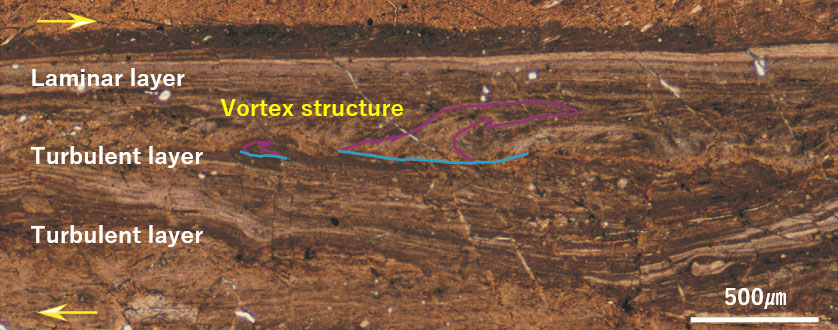
A latest study by a research team at Osaka Public University in Japan may provide a new explanation for this problem. Researchers have discovered ancient fault rocks formed about 15 million years ago in Japan's Boso Peninsula, which preserve an unusual geological structure. Analysis shows that during strong earthquakes, the clay inside the fault may have experienced drastic changes, and its viscosity was once close to the level of water, causing the originally tightly interlocked rock layers to suddenly form a state similar to liquid lubrication.
This means that seismic faults don't always move by solids rubbing against each other. Under certain conditions, the material inside a fault can rapidly fluidize, significantly reducing the resistance to slipping.
The research was led by Professor Tetsuro Hirono of Osaka Public University. The team conducted a detailed survey of ancient rocks exposed on the Boso Peninsula. These rocks were formed in a seafloor environment about 15 million years ago. One of the ancient earthquake faults preserves unusually obvious wavy and curved rock layers, as well as complex structures that resemble fluid vortices.
The researchers describe these structures as having turbulent-like characteristics. Normally, materials in rock faults form relatively stable arrangements under long-term geological processes, but the rock layers discovered this time show obvious signs of flow, as if they had experienced rapid movement of liquid in a narrow space.
To figure out how these structures formed, the research team used fluid mechanics methods to analyze the morphology of the rock formations, ultimately linking it to a geological process called "thermal pressurization."
Thermal pressurization often occurs during rapid slippage of earthquake faults. When the rocks on both sides of the fault suddenly move relative to each other, the huge friction will generate a large amount of heat in a very short time. There are many tiny pores inside rocks, which often contain water. When frictional heat rapidly heats this water, the fluid pressure within the pores rises sharply.
Because water is confined inside the rock, the pressure cannot be released in time, thereby weakening the frictional resistance between the rocks on both sides of the fault. As frictional resistance decreases, the fault may further accelerate sliding, generate more heat, and continue to increase pore pressure.
This process may form a positive feedback: the faster the fault slides, the more heat is generated; the higher the water pressure, the lower the frictional resistance between rocks; when the resistance is reduced, the fault can slide on a larger scale.
Researchers believe that the special structures preserved in the ancient rocks of the Boso Peninsula are the geological evidence left by this thermal pressurization process.
Professor Tetsuro Hirono said that the research team’s analysis showed that the viscosity of the material inside the fault may have been close to the level of water. The magnitude of this change is astonishing, meaning that clay materials that originally had high frictional resistance may transform into a nearly liquid state during earthquakes and act as a dynamic lubricating layer.
Once this phenomenon occurs in a shallow fault area close to the seafloor, it may have particularly serious consequences. Due to the sudden drop in fault resistance, rock formations can undergo large-scale displacements far beyond conventional expectations, which in turn promotes the overall uplift or subsidence of the seabed, disturbing large amounts of seawater and forming tsunamis.
In March 2011, a major earthquake with a magnitude of 9.1 occurred in the Tohoku region of Japan. The earthquake lasted for nearly 6 minutes. Large-scale slippage of submarine faults occurred, eventually triggering a devastating tsunami. The disaster caused serious casualties and resulted in a nuclear accident at the Fukushima Daiichi Nuclear Power Plant.
Researchers believe that the mechanism by which thermal supercharging causes a sharp decrease in fault friction resistance may help explain why some large earthquakes can produce such huge seafloor displacements. However, the 15 million-year-old rocks discovered so far do not prove that the same process must have occurred in the 2011 Tohoku earthquake in Japan. It provides a possible mechanism supported by physical evidence, rather than a direct reduction of a modern earthquake.
This research has potential value for future earthquake and tsunami risk assessments.
Currently, seismic risk assessment usually requires comprehensive consideration of factors such as fault location, rock structure, historical earthquake records, and plate movement speed. However, the changes in physical properties that may occur in the material inside the fault at the moment of an earthquake cannot always be accurately incorporated into prediction models.
If scientists can better understand the viscosity changes of different fault materials under high temperature, high pressure and rapid sliding conditions, it may be possible to more accurately estimate how far the fault can move when an earthquake occurs, and how large the displacement of the seafloor may be.
The research team hopes to apply the analysis method established this time to modern active faults, especially those shallow faults in subduction zones that may trigger large tsunamis.
This type of fault, located in areas where one tectonic plate dives beneath another, is the site of many of the world's largest earthquakes and tsunamis. Because shallow faults are directly close to the seafloor, the large-scale slip that occurs on them may have a more direct impact on seawater.
Relevant research results were published in the journal "Scientific Reports" on June 27, 2026. The paper is titled "Shallow fault material in the subduction zone exhibits turbulent-like flow during earthquakes."
This study reveals an easily overlooked link in the physical mechanism of earthquakes: faults do not always maintain fixed friction characteristics. Under extreme conditions, their internal materials may undergo drastic changes in a very short time, transforming from a hard solid friction interface to a state close to liquid lubrication.
This discovery provides new research directions for understanding why large earthquakes suddenly produce unexpected displacements and how to assess the resulting tsunami risk.
Comments