
Abstract:
The huge demand for chips and storage resources in artificial intelligence data centers is completely changing the competitive landscape of the global semiconductor industry. AMD, once known for its PC processors and game graphics cards, has now officially shifted its positioning to artificial intelligence and data center businesses. AMD CEO Su Zifeng made it clear in an interview that the company is already a "data center first" company.
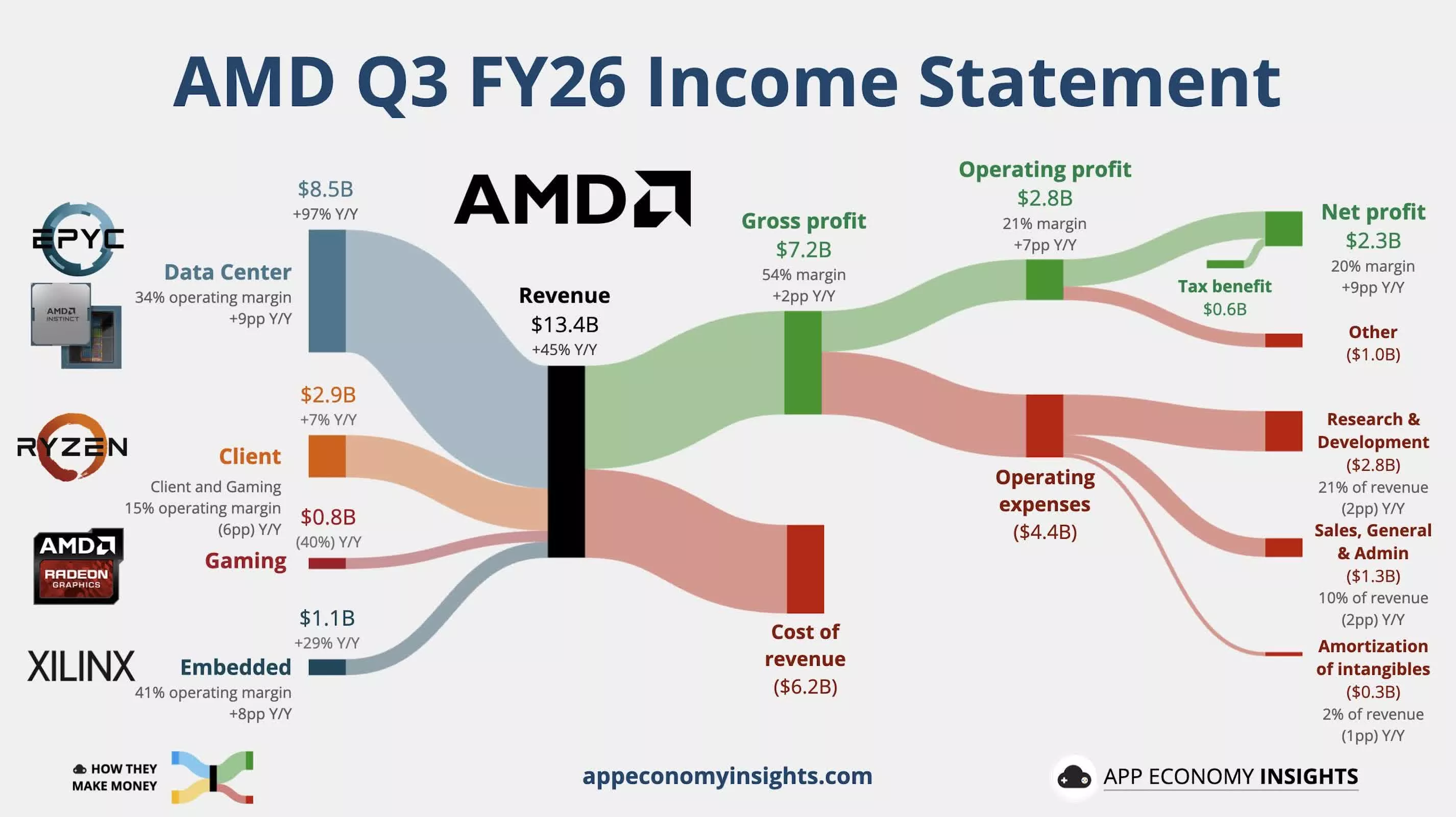
This statement appeared after AMD announced its third quarter 2026 results. The financial report showed that the company’s revenue for the quarter reached a record $13.4 billion, a year-on-year increase of 97%. However, in stark contrast to the rapid growth of the data center business, gaming business revenue fell 40% year-on-year to only US$773 million.
Su Zifeng said in an interview with Yahoo Finance: "We are a data center-first company, and this is our positioning. People need more computing power to support various applications."
This sentence actually reveals a fundamental change in AMD's current strategic focus. In the past, AMD has long relied on Ryzen processors and Radeon graphics cards to compete with Intel and Nvidia. The PC and gaming markets are its important business foundation. However, with the rapid development of generative artificial intelligence, data centers have become one of the fastest-growing markets in the semiconductor industry and the most concerning profit margins.
AMD’s strong performance in the third quarter mainly came from the Instinct artificial intelligence accelerator and EPYC server processor. The former is used for artificial intelligence model training and inference, while the latter provides CPU computing power for large data centers. As cloud service providers and large technology companies continue to build AI infrastructure, demand for these two types of products continues to grow.
In contrast, AMD's gaming business is facing multiple pressures.
TechSpot pointed out that the sharp decline in gaming business revenue is partly due to the large-scale purchase of memory chips and other key components by artificial intelligence data centers, squeezing the supply of consumer-grade hardware and pushing up the cost of graphics card production. At the same time, rising graphics card prices have also put pressure on demand in the PC gaming market.
This situation is not unique to AMD. The artificial intelligence industry is consuming a large amount of advanced memory, packaging capacity and other semiconductor manufacturing resources, causing the consumer electronics industry to face higher supply chain costs. For consumer-grade graphics card products with relatively limited profit margins, rising costs are particularly difficult to absorb.
Su Zifeng also revealed in the interview that AMD’s data center business is expected to grow by 50% quarter-on-quarter in the fourth quarter. The company hopes to expand this business to more than double its current size by 2027.
She said that AMD has sufficient technical resources and supply chain expansion capabilities, and hopes to become the most important partner of the world's largest computing demand side. Obviously, AMD is focusing more R&D, production and business resources on large cloud computing enterprises and artificial intelligence infrastructure customers.
Su Zifeng also responded to the recent concerns about whether there is a bubble in artificial intelligence investment in the market. She believes that some investors may be too focused on short-term returns when evaluating AI infrastructure spending and ignore the growth in computing demand in the coming years.
Su Zifeng said that AMD always invests from a long-term perspective and usually plans business development three to five years in advance. This means that the technology and supply chain capabilities currently being built by the company are not just to meet immediate market demand, but to prepare in advance for the computing needs of the next few years.
This strategy also means that it may be difficult for the consumer gaming market to regain AMD's highest priority resource allocation in the short term.
In fact, competitor Nvidia has more obviously completed its transformation into AI business. According to its latest released data for the second quarter of fiscal year 2027, data center business revenue reached US$89.02 billion, accounting for 92.5% of the company's total revenue. Nvidia no longer even discloses its traditional gaming business separately, but instead folds related businesses into the broader edge computing category.
In contrast, AMD still retains a relatively complete gaming business, but its revenue structure is rapidly tilting towards data centers. Based on third quarter results, data centers have contributed approximately 63% of AMD's total revenue.
For PC gamers, this industry shift may have some less than optimistic effects.
In the past, competition between AMD and Nvidia has prompted the two companies to continuously launch more cost-effective consumer-grade graphics cards. In particular, AMD's Radeon product line has long played a market role in providing strong gaming performance at a lower price.
But if artificial intelligence accelerators and server processors can bring greater market demand and revenue growth, AMD will naturally pay more attention to these products. Consumer-grade graphics cards may be affected by this in terms of R&D investment, supply chain allocation, and product update rhythm.
Of course, AMD did not announce that it would abandon the Radeon business, nor did it say that it would stop launching consumer graphics cards. What Su Zifeng emphasized this time was the change in the company's overall strategic positioning, rather than the termination of the consumer GPU business.
However, judging from financial data and management statements, AMD and Nvidia are showing increasingly obvious similar trends: Both companies are transforming from traditional PC and gaming hardware suppliers to semiconductor companies with artificial intelligence computing infrastructure as their core.
For the PC industry as a whole, this may mean that an era is changing. In the past, consumer-grade processors and graphics cards were important markets that drove progress in chip performance; now, artificial intelligence data centers have become the main flow of capital, manufacturing resources, and technology research and development investment.
When AMD's CEO publicly defined the company as "data center first," the reality facing the consumer graphics card market has become quite clear: Whether Radeon can continue to receive sufficient R&D and supply chain resources in the future will increasingly depend on its commercial value in AMD's overall business strategy.
Comments