
Abstract:
The global laptop market may face a new round of downward pressure in 2027. The latest report from market research organization TrendForce points out that as the prices of core components such as DRAM memory, CPUs and solid-state drives continue to rise, the main risk in the notebook computer industry is shifting from insufficient supply to the impact of rising costs on consumer demand. If manufacturers have to pass on more costs to consumers, rising terminal selling prices may further extend the replacement cycle, leading to an even greater decline in global laptop shipments in 2027.
TrendForce currently expects global laptop shipments to experience a low-single-digit percentage year-over-year decline in 2027. However, there is still considerable uncertainty in this forecast. If DRAM and CPU prices continue to remain high, notebook manufacturers are forced to further increase retail prices, and the decline in annual shipments may expand to a high single-digit percentage.
This means that the key issue in the laptop market in 2027 may no longer be whether manufacturers can obtain enough parts, but whether consumers are willing to accept rising product prices.
In fact, the performance of the laptop market in 2026 has been significantly affected by changes in the supply chain. Since the beginning of the year, the CPU supply situation has improved, and manufacturers have purchased a large number of components in advance. At the same time, some consumers who originally planned to purchase computers in the second half of the year or even 2027 have completed replacements in advance out of concern about future price increases or shortages. Together, these factors supported market shipments in the first half of 2026.
However, TrendForce emphasized that this shipment performance does not mean that terminal demand has truly recovered. Part of the demand is just released in advance from the future to the present. When consumers who originally planned to purchase computers in the second half of 2026 and beyond complete their purchases in advance, the subsequent market will naturally lose some potential buyers.
At the same time, the inventory of low-priced parts previously purchased by manufacturers is gradually being depleted. Once these inventories are used up, companies must purchase CPUs, DRAM, and SSDs at higher market prices, and production costs will be more directly affected by component price increases.
The rise in memory prices is particularly noteworthy. As the artificial intelligence industry continues to expand, large cloud service providers and data center operators continue to increase investment in AI servers. These servers require large amounts of high-performance memory, especially high-bandwidth memory for AI accelerators. As a result, memory manufacturers are investing more and more production resources into products with higher profits and stronger demand, and the supply of DRAM required for ordinary PCs is also affected.
This change is being transmitted to the consumer computer market. Although the memory used by ordinary laptops is not exactly the same as the high-bandwidth memory required by AI servers, both are still affected by semiconductor manufacturing capacity, production resource allocation, and overall market supply and demand. The growing demand for AI infrastructure makes it increasingly difficult for ordinary computer manufacturers to obtain memory products with stable prices and sufficient supply.
TrendForce pointed out that taking a mainstream laptop with a suggested retail price of US$900 as an example, in the third quarter of 2026, the three core components of CPU, DRAM and SSD together accounted for approximately 68% of the total machine bill of materials cost.
This ratio highlights the huge impact of core component prices on laptop pricing. When CPU, memory and SSD account for the majority of the material cost of the entire machine, even if the cost of other components remains unchanged, the price increase of these three types of products is enough to significantly push up the manufacturing cost of the entire machine.
For notebook computer manufacturers, this will bring about a difficult business problem to solve: if the retail price is raised, consumers may postpone purchases; if the original price is maintained, the company's gross profit margin will be squeezed; if costs are controlled by reducing memory capacity and other hardware specifications, product competitiveness may be weakened.
All three options have obvious flaws.
Raising selling prices is the most direct response, but the notebook computer market is very price sensitive, especially the entry-level and mainstream consumer markets. For many users, the core needs of computers are still office work, study, web browsing and audio-visual entertainment. If an otherwise affordable laptop becomes significantly more expensive because of increases in memory and processor prices, consumers may choose to stick with the old device rather than upgrade immediately.
If manufacturers choose to bear the pressure of rising costs themselves, they may face declining profits. The laptop market is highly competitive, with many brands operating on thin profit margins for a long time. With core component costs continuing to rise, it will be difficult for companies to absorb additional expenditures indefinitely.
As for cutting hardware specifications, there are also risks. Reducing memory capacity, reducing storage space, or controlling costs on other components will indeed help reduce the price of the entire machine, but it may also make the product lag behind its competitors in terms of performance and user experience. In particular, modern operating systems, office software, and artificial intelligence applications have increasing demands for memory, and computers with low configurations may be more prone to performance bottlenecks.
Therefore, TrendForce believes that it may be difficult for laptop brands to maintain their original prices, product specifications and profitability in 2027. How much cost manufacturers ultimately choose to pass on to consumers will become a key factor in determining market demand performance.
If companies can absorb some of the cost increases themselves by optimizing product mix, adjusting the configuration of products at different price points, then the decline in global laptop shipments in 2027 may still remain at a low single-digit percentage level.
However, if CPU, DRAM and SSD prices continue to rise, and manufacturers pass on most of the new costs directly to consumers, market demand may weaken further, and the risk of annual shipment declines expanding to high single-digit percentages will also increase.
In addition to core computing and storage components, other components also bring cost pressures to laptop manufacturers. Components such as printed circuit boards, multilayer ceramic capacitors and power management chips are all affected by capacity allocation, raw material prices and geopolitical factors. Not only may the price of some parts increase, but the delivery cycle may also be extended, making it more difficult for manufacturers to arrange production and manage the supply chain.
Among them, the cost of printed circuit boards is affected by the price of raw materials and the complexity of the design; as notebook computers adopt more complex motherboard designs and higher-specification hardware, the manufacturing cost of circuit boards may also rise. At the same time, power management chips need to adapt to the increasing power consumption of processors and the additional demands brought by new standards such as Wi-Fi 7 and USB4.
Looking at these components individually, the cost change may not be as significant as that of memory or CPU. However, when the prices of multiple components increase at the same time, the cumulative effect will still put considerable pressure on the complete machine manufacturer.
On the supply side, TrendForce predicts that the DRAM market will remain tight in 2027. Artificial intelligence servers continue to consume advanced process production capacity, and the supply growth of ordinary PC memory may be limited. This means that notebook computer manufacturers may not be able to easily obtain reasonably priced and sufficient DRAM in 2027.
In contrast, the supply situation of NAND flash memory may have improved. As new production capacity is gradually put into use, TrendForce predicts that supply constraints of NAND flash memory are expected to ease in the second half of 2027. This may bring a certain buffer to SSD prices, but it does not mean that the entire storage market will return to easing simultaneously.
The differences in the supply trends of DRAM and NAND flash memory also mean that the impact of different components on the cost of the entire machine may gradually diverge. If SSD prices fall, but memory and CPU are still expensive, laptop manufacturers will still be unable to significantly reduce the cost of the entire machine.
In addition to component prices, the global notebook computer manufacturing layout may also change.
In recent years, affected by geopolitical risks, tariff policies and the need to diversify supply chains, many brands have transferred part of their production capacity outside of China. As a result, manufacturing bases such as Vietnam and Thailand have improved their status in the global notebook computer supply chain.
However, TrendForce pointed out that as cost pressure becomes increasingly prominent, manufacturers may re-evaluate their previous production layout. If tariff pressure does not intensify further, the factors determining production location may gradually shift from reducing policy risks to production costs, supply chain integrity and operational efficiency.
In some emerging manufacturing regions, the production system still relies on importing large quantities of components from other countries. Additional logistics, parts procurement and supply chain management costs may weaken the manufacturing cost advantages of these regions. When complete machine manufacturers face increasing profit pressure, refocusing part of their production capacity to areas with more complete supply chains may become an option worth considering.
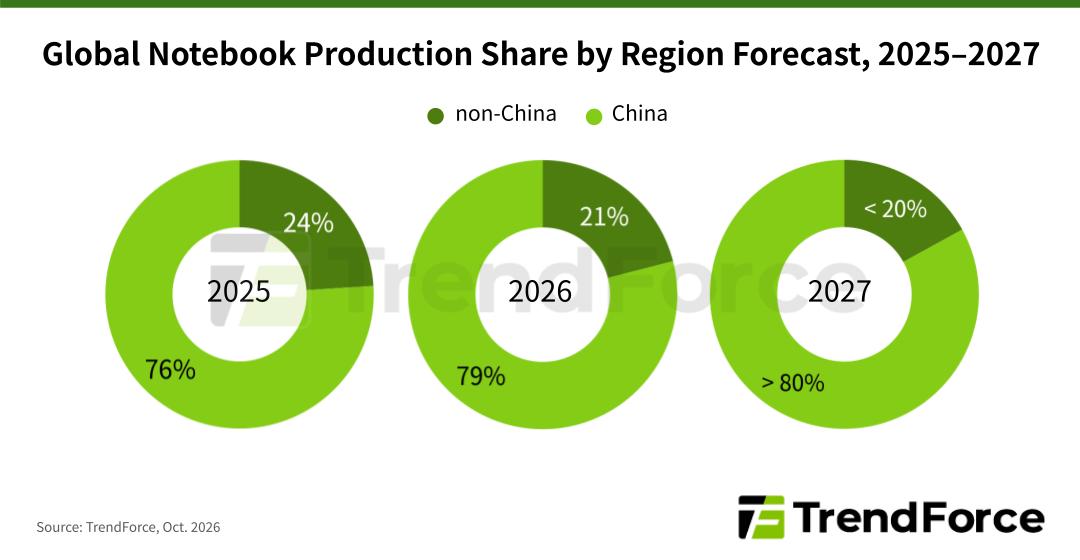
TrendForce estimates that the proportion of global notebook computers produced outside China may drop from approximately 24% in 2025 to approximately 21% in 2026, and further fall below 20% in 2027. In other words, if this prediction comes true, China's share of global laptop manufacturing may once again exceed 80%.
This trend does not mean that all manufacturers will move production back to China, but it means that companies may re-weigh the relationship between supply chain diversification and production efficiency. For different brands, the final production layout will still depend on tariffs, manufacturing costs, supply chain maturity, and the policy environment in each region.
From a longer-term perspective, 2027 may become an important year for the laptop industry to adjust its business strategies. Previously, companies were mainly worried about whether they could obtain enough CPUs, memory and other key components; as some supply issues gradually change, rising costs and consumer affordability will become more prominent conflicts.
For consumers, this means that when purchasing laptops in the future, they need to pay more attention to the relationship between price and configuration. Even if some models are still able to sell at relatively stable prices, manufacturers may control costs by adjusting memory capacity, storage specifications or other configurations. Therefore, when comparing different products, you should not just focus on the price of the whole machine, but also carefully check the specific hardware configuration.
For PC manufacturers, how to find a balance between price increases, specification adjustments and profits will directly affect their market competitiveness. Brands that can mitigate the pressure of price increases through long-term purchasing agreements, optimizing supply chains, controlling operating costs, and rationally planning product portfolios may be better able to maintain market share.
Overall, TrendForce’s forecast for the laptop market in 2027 does not mean that shipments will inevitably collapse sharply, but it emphasizes that rising costs may further suppress market demand that is already affected by early purchases. Under the baseline scenario, global notebook computer shipments are expected to decline by a low-single-digit percentage; if costs continue to rise and most of the pressure is passed on to consumers, the decline may expand to a high-single-digit percentage.
In the next year, the real problem that the laptop industry needs to solve will not be just how to produce more devices, but how to continue to provide products that consumers are willing to buy while the prices of core components such as memory and CPU continue to fluctuate. If terminal selling prices rise too fast, even if the supply chain is able to produce a sufficient number of computers, the market may fall into a longer downturn as consumers delay replacement.
Comments