
Abstract:
As Anthropic approaches its IPO, its corporate governance structure leaves common shareholders without a say in most major decisions, including board of directors appointments.
Anthropic is a public welfare company
(public benefit company), that is, a for-profit company that is legally allowed to pursue a public mission while pursuing profits, and whose goal is to promote AI safety. This status protects boards from being sued by angry investors for making decisions about AI safety that are not entirely driven by shareholder value.
Currently, the board of directors is chaired by Anthropic President Daniela Amodei and includes CEO Dario Amodei (her brother), Netflix co-founder Reed Hastings, former Microsoft and General Motors CFO Christopher Liddell, Novartis CEO Vas Narasimhan and Spark Capital partner Yasmin Razavi. There is a vacancy on the Board of Directors.
Second, Anthropic assigned significant control of the board of directors to the Long-Term Benefit Trust (LTBT), an independent group designed to keep the company focused on its mission of benefiting humanity. The trust holds a class of stock and has the power to elect and remove a majority of the company's directors, known as Class T directors. LTBT is chaired by global health expert Neil Shah, a former managing director of charity ratings nonprofit GiveWell, and includes former Federal Reserve Chairman Ben Bernanke, national security expert Richard Fontaine and Harvard physicist Christopher Stubbs. There is currently a vacancy in the LTBT, and current members will select their own candidates to fill the vacancy.
Third, Anthropic’s seven founders also jointly hold a special class of stock, giving the majority of them
50.1% of shareholder voting rights
, thereby being able to elect three board members. If for any reason the founders are unable to form a majority, their shares will be voted in proportion to common shareholders.Finally, the board of directors forms a check and balance on LTBT. When LTBT nominates one of its four directors as a "designated" director, or removes that director without cause (i.e., without alleging misconduct), the board's nomination committee can withhold approval and put the decision to a vote by the company's employees.
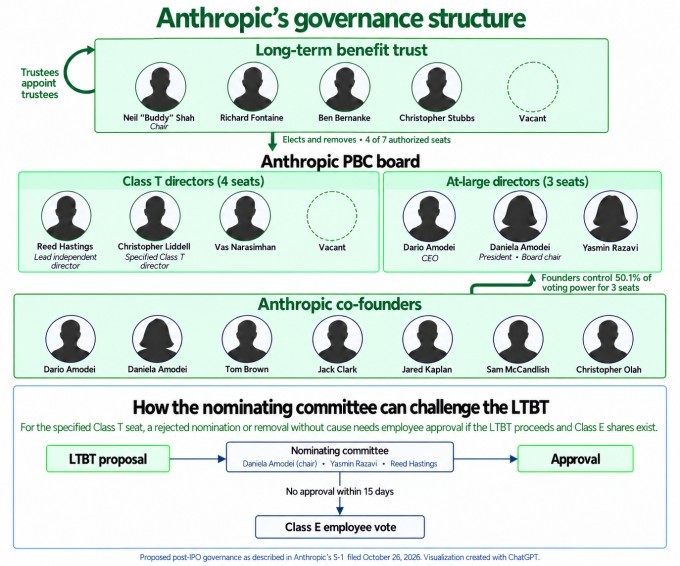
The dynamics of such complex structures are difficult to predict. The report mentioned that a similar structure had been essentially overturned: the OpenAI board of directors briefly fired CEO Sam Altman due to concerns that he was not honest with him, but due to employees' loyalty to Altman, the board backed down, reinstated his position, and established a new governance structure. Anthropic's structure seems to institutionalize this kind of employee power.
At Anthropic, if there are cracks in the founders' united front, ordinary shareholders may gain more say than expected; and if employees support the board rather than the trust, they can overwhelm LTBT on the issue of board seats.
Founders' control doesn't last forever: Ten years after the IPO, founders can choose to end control of the company, or control automatically ends when there are fewer than three founders. At that time, LTBT will continue to exist until
85% of common shareholders vote to end it
, or it decides to withdraw with the approval of the board of directors. If both types of special shareholders cease to exist—reportedly hoping it is not due to a disaster caused by AI—ordinary shareholders will finally gain control.
Comments