
Abstract:
British defense company BAE Systems recently demonstrated a new anti-UAV technology: by installing multiple laser-guided rocket launchers on a large quad-rotor UAV, it can continuously attack multiple air targets in one mission without having to return to the ground to reload after each interception. The technology is designed to counter large numbers of cheap attack drones at relatively low cost.
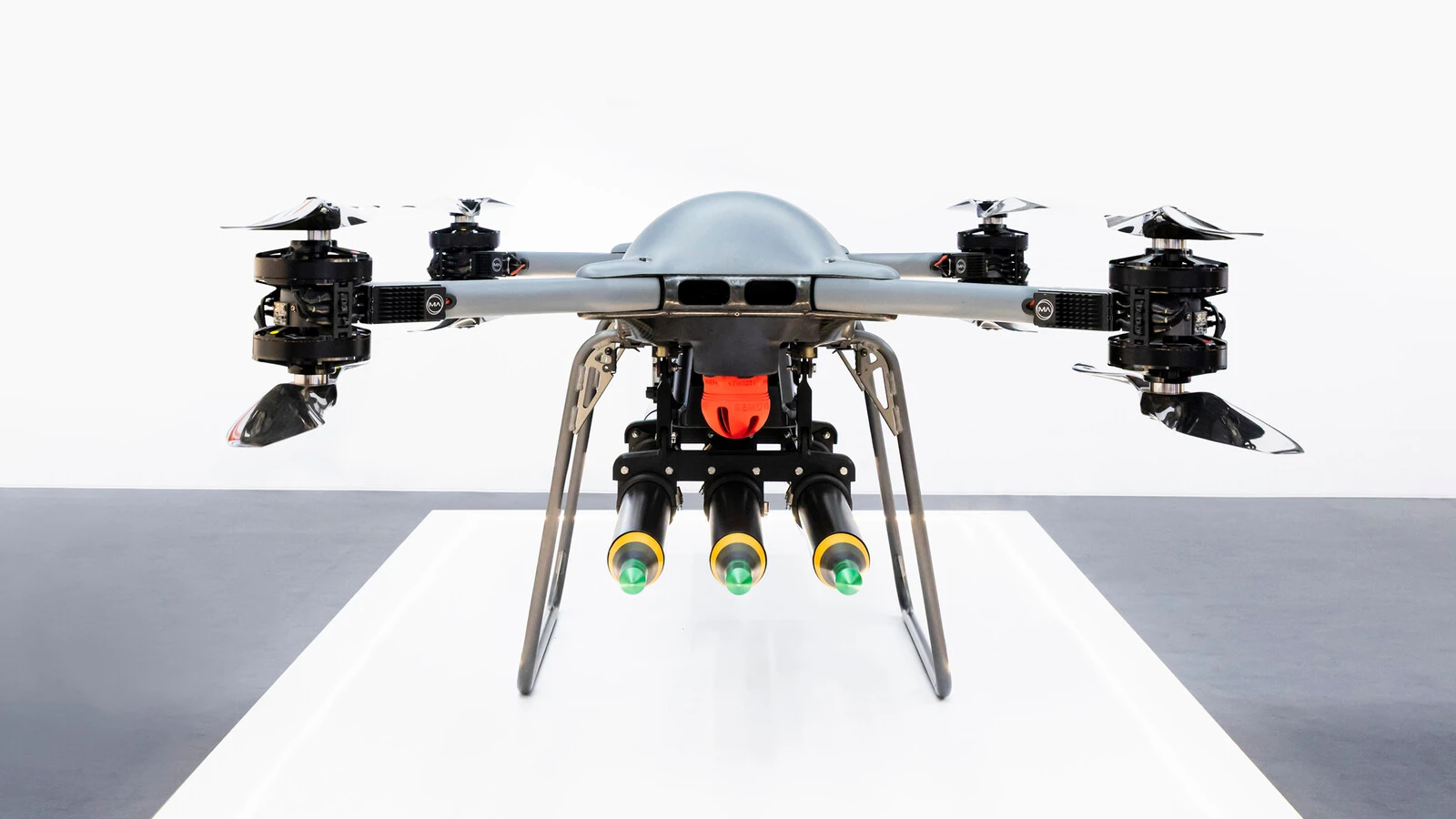
The UAV used in this test is an improved version of the T-150 produced by Malloy Aeronautics, numbered TRV-150. Malloy Aeronautics is a drone company owned by BAE Systems. The T-150 was initially intended for tactical transport missions, delivering supplies to the British Royal Navy and the U.S. Marine Corps. After modification, it began to undertake anti-UAV missions and became a multi-functional unmanned combat platform that takes into account both transportation and air defense purposes.
In a test held at Eglin Air Force Base in Florida, the TRV-150 was equipped with a triple launcher, each of which can carry BAE Systems' APKWS laser-guided rocket. The test was organized by the U.S. Department of Defense responsible for research and engineering affairs, and BAE Systems and the U.S. engineering technology company SURVICE Engineering participated. The test results show that the drone can attack and destroy multiple targets successively without landing or reloading.
APKWS stands for "Advanced Precision Kill Weapon System". Its core idea is not to develop a new missile from scratch, but to add a laser guidance component to the existing 70mm rocket, turning the unguided rocket that originally relied on ballistic flight into a precision-guided munition. This modification method can use mature rocket engines, warheads and related components to reduce R&D and production costs while improving target hit accuracy.
Although traditional air defense systems can effectively intercept incoming drones, there are still obvious cost issues when facing large-scale drone attacks. The price of a cheap attack drone is likely to be far less than the anti-aircraft missile used to shoot it down, and the production rate of high-performance interceptors is difficult to increase significantly in a short period of time. If defenders continue to use expensive missiles to intercept low-cost targets, even with high success rates, limited munitions inventories may be rapidly depleted.
BAE Systems hopes to change this cost structure through the combination of TRV-150 and APKWS. Large quad-rotor drones can carry multiple guided rockets and continuously intercept targets after discovering them, thereby reducing the time required to return to base to replenish ammunition after each engagement. Since the platform was originally designed for transportation missions, it can also switch between supply transportation, reconnaissance and anti-drone operations according to mission needs.
Another advantage of this approach is that it can leverage existing technology to speed up deployment. Compared with developing a dedicated interception drone from scratch, integrating guided weapons that are already in use on a mature drone platform is expected to shorten the development and testing cycle. For militaries that need to rapidly expand counter-drone capabilities, production speed, supply chain scale and ease of maintenance are as important as the performance of individual platforms.
Thomas Lancashire, head of drone business development at BAE Systems' FalconWorks division, said that the company and its partners have accelerated the process from concept proof to system testing, enabling the platform to continuously attack multiple targets in a single mission. He pointed out that the current drone threat is evolving rapidly, and the importance of delivering effective equipment to users as soon as possible may be as prominent as the technical performance of the equipment itself.
This trial builds on previous work. The BAE system has previously tested launching a single precision-guided munition from a modified T-150 platform, and the latest test further introduced a production-ready triple launcher, verifying the platform's ability to continuously attack multiple air targets.
However, the information currently released mainly proves the feasibility of the system under specific test conditions, and does not mean that it has mature combat capabilities to deal with all types of drone swarms. The actual effect still depends on the target detection, identification and tracking capabilities, the target illumination conditions required for laser guidance, and the UAV's survivability in complex weather, electronic interference and high-intensity combat environments. Continuously launching multiple rockets does not mean that the same number of targets can be intercepted at the same time; the specific interception efficiency requires more test data support.
BAE Systems stated that the next step will continue to explore the anti-drone application of the T-150 platform in the maritime environment. This means that similar systems may not only be used to protect land military bases and troops in the future, but are also expected to provide additional low-cost protection means for ships and maritime supply formations.
As low-cost attack drones increasingly appear in modern conflicts, anti-drone equipment is gradually shifting from purely pursuing interception performance to simultaneously considering price, output, supply speed and multi-target engagement capabilities. The TRV-150 equipped with APKWS is a manifestation of this trend: by converting mature transport drones into platforms that can repeatedly perform multiple interception missions, the military is expected to establish a larger-scale and more flexible anti-drone defense system without completely relying on expensive air defense missiles.
Comments