
Abstract:
U.S. defense technology company Anduril Industries recently announced a new series of surface-to-air interceptor missiles called Steelfin. The system adopts a modular two-stage structure. By replacing the first-stage booster and adjusting some components in the second-stage interceptor, it can be configured for different types of air threats.
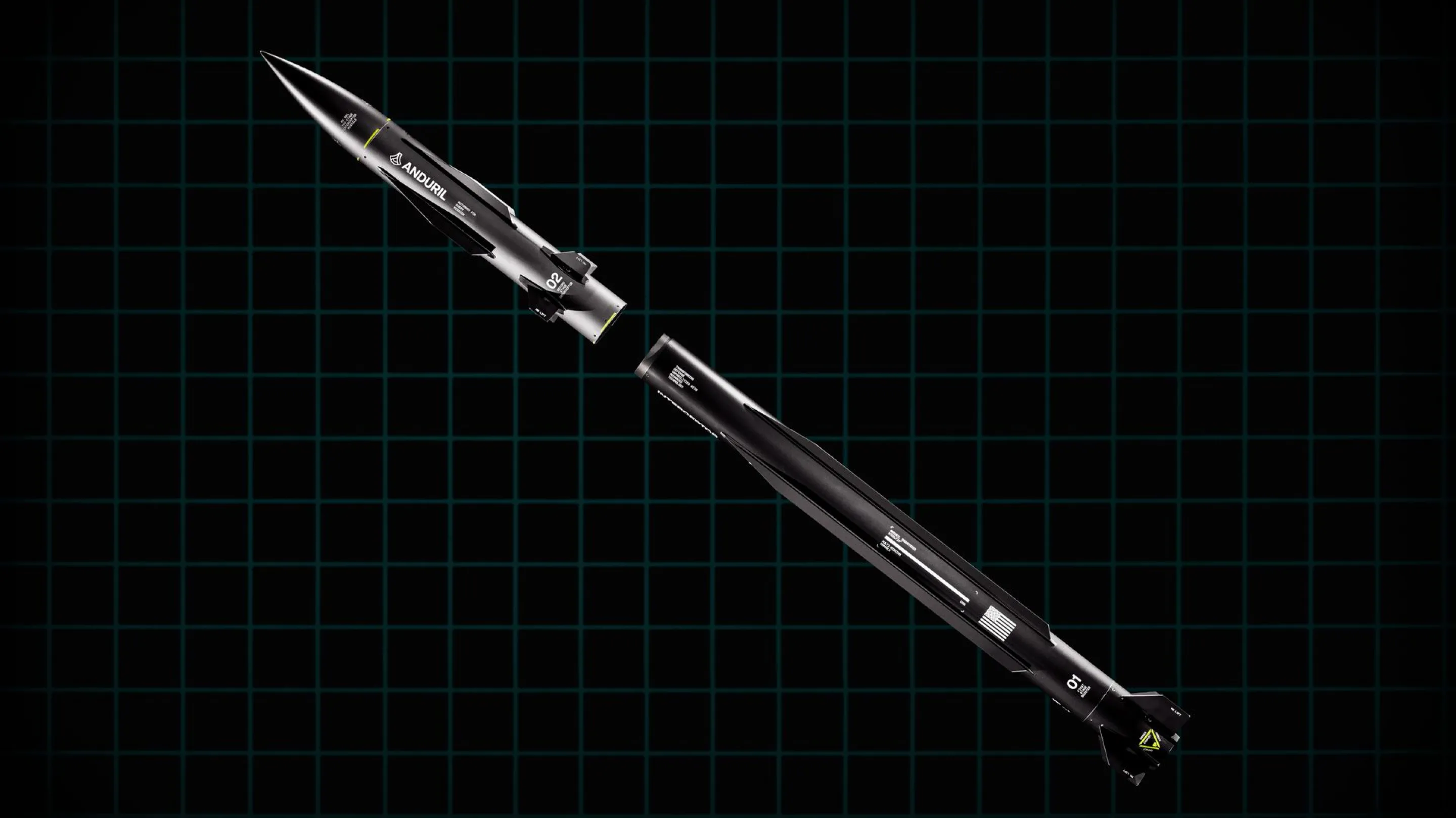
Anduril hopes to reduce the time and money spent on repeated research and development, redesign and modification of production lines for traditional missile projects, while increasing the production scale of interceptor missiles to cope with the pressure on anti-aircraft ammunition inventory caused by global conflicts.
According to a report by New Atlas on October 17, 2026, the design focus of Steelfin is not to allow one missile to deal with all targets with the same configuration, but to establish a common technology platform that can derive multiple models. For different missions, manufacturers can adjust the missile's range, flight performance, target search methods and terminal interception capabilities without having to develop a completely new missile system from scratch.
This design idea targets two prominent problems faced by current air defense operations: first, there are more and more types of incoming targets, and second, the production speed of interceptor missiles often cannot keep up with the consumption speed.
Modern air defense systems need to deal with targets including relatively low-cost drones and cruise missiles, as well as faster ballistic missiles and hypersonic weapons with more complex flight trajectories. Different targets have different requirements for the interceptor's range, speed, guidance accuracy and terminal maneuverability. The traditional approach is usually to develop special missiles for different tasks.
This method allows weapons to be optimized for specific tasks, but it also brings problems such as complex production systems, difficulty in universal parts and components, and long development cycles. When new threats emerge, the military may need to launch new missile projects, and existing production lines and supply chains may not be able to quickly meet new demands.
Steelfin hopes to change this situation through universal design. It adopts a two-stage structure. The first stage is responsible for providing initial acceleration and main flight energy, and the second stage is responsible for the terminal interception mission. Different models can use different solid rocket motor and booster configurations to adapt to different ranges, speeds and launch conditions.
The second-stage interceptor remains as common as possible, including basic missile structure, avionics equipment, software, flight control systems and standardized interfaces. At the same time, some equipment such as target detection and tracking components can be replaced or adjusted according to specific tasks.
This design enables Steelfin to form interceptors of different performance levels while retaining a common core structure. For example, for low-altitude aircraft and cruise missile models, boosters and terminal components that match the mission can be used; for ballistic missile or hypersonic target models, different propulsion configurations and interception components can be used.
Anduril emphasized that this modular architecture allows the weapon system to adjust as threats change without having to redesign the entire missile each time. For the military that needs to maintain a large inventory of anti-aircraft ammunition for a long time, this approach is expected to reduce some R&D and production costs and shorten the cycle from design to manufacturing of new models.
In terms of production, another important feature of Steelfin is that multiple models can share production facilities, equipment, tools and parts of the supply chain. Traditional missile projects often have their own dedicated production processes and assembly facilities, making it difficult to quickly transfer production capacity from one model to another. Steelfin is trying to use a unified production structure to allow factories to adjust the output of different models according to actual demand.
Anduril plans to produce thousands of Steelfin series interceptors per year in the short term, and hopes to adjust the production ratio of different models according to customer demand. The company believes that sharing production lines can improve manufacturing efficiency and make it easier to shift production capacity to corresponding interceptor models when a certain threat suddenly increases.
However, producing thousands of pieces per year is currently still the company's production goal, not the output that has been achieved. Whether it can ultimately reach this scale depends not only on the capabilities of the missile assembly line, but also on the supply of rocket engines, propellants, guidance equipment and other key components.
In terms of deployment compatibility, Anduril said that Steelfin's design takes into account the use conditions of existing land-based and sea-based air defense systems, and the goal is to utilize as much as possible the launchers and combat management systems that are already in service, rather than requiring customers to re-establish a complete set of air defense infrastructure.
Compatible objects listed by the company include the M903A2 launcher used by the US Army, the Mk 41 vertical launch system, and land-based launch systems such as Typhon. In addition, Steelfin plans to integrate with existing battle management and fire control systems, including the U.S. Navy's Aegis system (Aegis) and the U.S. Army's Integrated Air and Missile Defense Battle Command System (IBCS).
If these compatibility capabilities can be realized as planned, Steelfin has the opportunity to be deployed as a supplementary ammunition to existing air defense systems, helping the military increase interception capabilities without completely replacing launch facilities. However, actual integration still needs to be verified, and design goals alone cannot mean that all models can be directly integrated into existing systems.
Steelfin's cost positioning is also worthy of attention. In recent years, conflicts in Ukraine and the Middle East have continued to consume air defense interceptors. Many countries have begun to seek cheaper alternatives that can be mass-produced to avoid consuming a limited number of high-end missiles when dealing with lower-cost drones.
Take the US Patriot air defense system as an example. Its PAC-3 series interceptors have strong target interception capabilities, but the price of a single missile is relatively high. If a defender needs to continuously intercept a large number of incoming targets, even if each engagement is successful, it may rapidly deplete inventories and face lengthy production cycles required to replenish munitions.
Anduril hopes to reduce this pressure through modularization and large-scale production, allowing the military to select a more appropriate interceptor based on the type of threat, rather than using the most expensive and most powerful missile against all targets.
Company executives have said that the price of Steelfin's configuration for high-end missions may be higher than PAC-3 MSE and lower than the interceptor missiles used by the US THAAD system, and claimed that it can undertake corresponding high-level interception missions at a lower cost. Another configuration for missions similar to the PAC-3 is described by the company as being able to accomplish a significant proportion of the mission at less than half the cost.
But these claims are still enterprise performance and cost propositions. Anduril has yet to release full model pricing, purchase contract quantities, and test results sufficient to independently verify its mission performance, so it's unclear how much of its actual cost advantage will be.
Technical verification is also still in its early stages. Anduril said that ballistic tests have been completed using representative aircraft, and flight tests of various Steelfin models are planned to begin in 2027. Ballistic testing can help researchers verify part of the structure and flight characteristics, but it is not equivalent to a complete live-fire interception test.
Especially when facing high-speed ballistic missiles or hypersonic targets, the interceptor needs to complete detection, guidance, maneuvering and terminal rendezvous in a very short time. If the target is destroyed by direct collision, the requirements for guidance accuracy and control system will be very high. Whether Steelfin can stably achieve expected performance under different mission configurations still needs to be verified by subsequent flight and interception tests.
Moreover, modular design itself does not come without costs. Reliable mechanical, electrical and software interfaces need to be maintained between the different boosters, sensors and terminal intercept components. Although replacing parts can shorten some development work, it still requires re-verification of flight performance, guidance compatibility and system reliability. Modular architecture can reduce design duplication, but it cannot completely eliminate testing and certification efforts.
The supply chain is also a real bottleneck. No matter how versatile a missile's structure is, sufficient quantities of solid rocket motors and propellant are required to sustain production. As global demand for air defense grows, manufacturing capabilities for key propulsion components are also under pressure. If engine or propellant production capacity cannot be expanded simultaneously, even if the assembly line is ready, it will be difficult to achieve the goal of thousands of units per year.
In the European market, Steelfin may also gain opportunities for further development. Reuters reported on October 16 that Anduril was considering co-producing this interceptor missile with European partners to meet local needs for air defense capabilities and ammunition stocks. Brian Moran, head of the company's European business, said that the company is willing to discuss cooperation with European customers and industrial partners, and Poland is a potential partner worthy of attention.
Poland is expanding local military production in the hope of reducing its dependence on foreign suppliers. Anduril has previously discussed the possibility of local production of Barracuda-500 cruise missiles with Polish state-owned military industrial group PGZ. If relevant cooperation progresses, the cooperation experience between the two parties may create conditions for the local production of other weapons projects.
However, there is also a trade-off between cost and delivery time for localized production in Europe. Defense industry autonomy involves not only where weapons are produced, but also control over maintenance capabilities, software upgrades and future improvements, Moran noted. Moving production locally may increase costs and may extend lead times, so it needs to be assessed in the context of actual threats and military requirements.
From a broader perspective, Steelfin embodies a current trend in the development of air defense weapons: the military not only needs high-performance weapons that can intercept advanced targets, but also interceptors that can be mass-produced and whose price matches the mission. Simply improving the performance of a single missile cannot solve the problem of ammunition consumption in long-term conflicts; if the inventory cannot be replenished in time, no matter how advanced the air defense system is, it may be limited in quantity.
Anduril hopes to combine universal design, modular components and shared production lines, which will not only reduce duplication of research and development between different models, but also allow production capacity to be flexibly adjusted according to changes in demand. This idea is attractive, but its actual value ultimately depends on three key factors: whether different configurations can achieve expected interception performance, whether actual manufacturing costs can be significantly reduced, and whether the supply chain can support large-scale continuous production.
At present, Steelfin has completed some ballistic tests, but has not yet started planned flight tests, and there is not enough public evidence to prove that it has mature actual combat interception capabilities. For this new missile, the modular design and the goal of producing thousands of missiles per year demonstrate Anduril's technology and industrial planning. The real performance, cost and production capacity still need to be tested in subsequent tests and actual deployment.
Comments