
Abstract:
In the first half of this year, South Korea’s domestic construction orders totaled 116 trillion won, a year-on-year increase of 25.8%. That's the highest level in nearly three years, dating to the first half of 2022. A large part of the surge in orders comes from non-residential construction projects such as semiconductor factories and data centers.
Yrim Song (transliteration), a researcher at Hanwha Investment & Securities, pointed out in a report released on the 26th: "Just as we are waiting for the real estate and housing market to fully recover, the non-residential sector has begun to show significant growth. The construction industry has unexpectedly entered a period of prosperity."
The estimated orders for data centers alone are equivalent to two years of domestic housing orders in South Korea
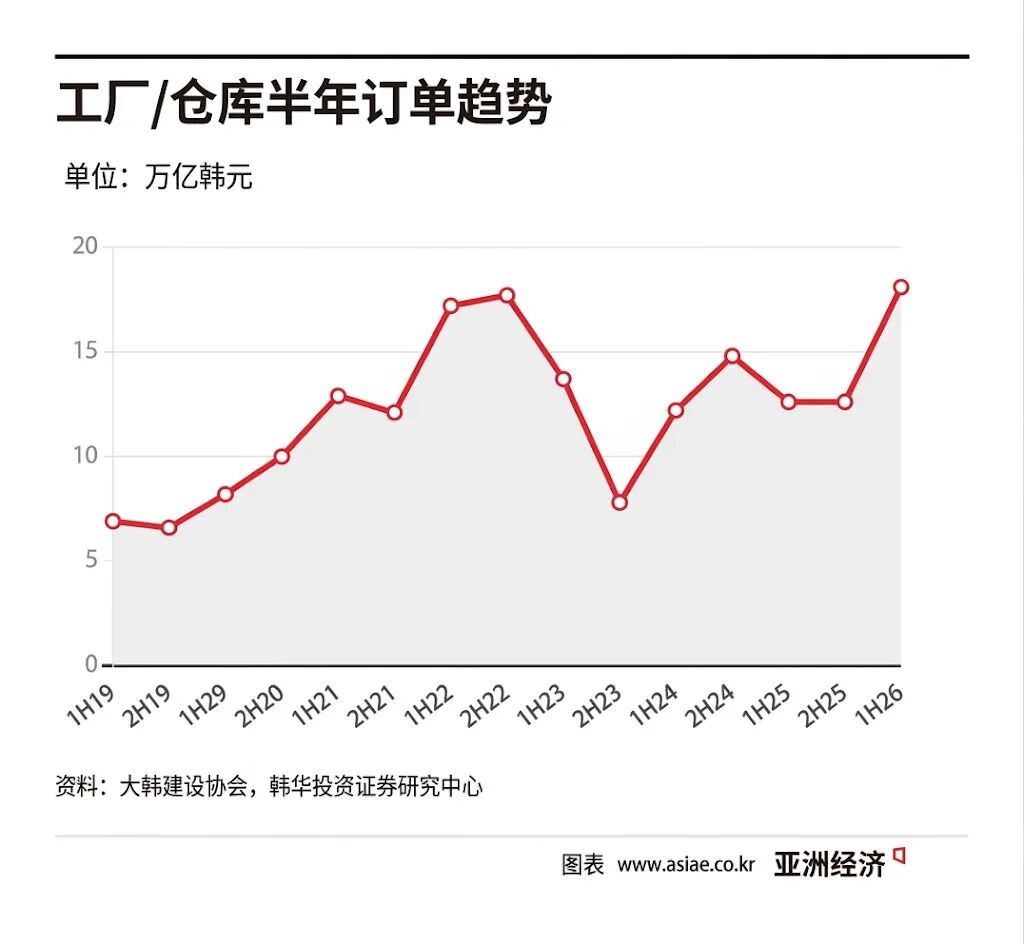
By project type, private non-residential construction made the largest contribution, especially orders for factories and warehouses, which reached a record 18.2 trillion won. The key areas receiving large orders are concentrated in Yongin and Pyeongtaek, and the vast majority of projects are semiconductor factories.
As Samsung Electronics and SK Hynix announced medium- and long-term semiconductor facility investment plans on June 29 (investment amounts of approximately 2100 trillion won and 1100 trillion won respectively), the construction period has also accelerated. In the P5 and P6 factories in Pyeongtaek, the construction plan was adjusted from the original "build one and then build one" to "two buildings started simultaneously", shortening the construction period by 3 to 4 years. The Yongin cluster project has been accelerated by 12 years.
Details of the "AI Data Center Construction Plan", one of the three major super projects of the Korean government, have also been announced. Construction of the first phase of 8.4GW of capacity (including SK's 1GW in Ulsan, GS's 2.4GW in Donghae and Naver's 1GW in Sejong) will start in the first half of 2028, with an additional 10GW to be built by 2035.
Based on a construction cost of 10 billion won per megawatt (MW), researcher Song estimates that the total order size of the 18.4GW data center will reach 180 trillion to 190 trillion won. This amount is equivalent to two years of total domestic housing orders in South Korea. Since the construction period of such projects is short (only 2 to 3 years), the relevant performance can be quickly reflected in the financial statements.
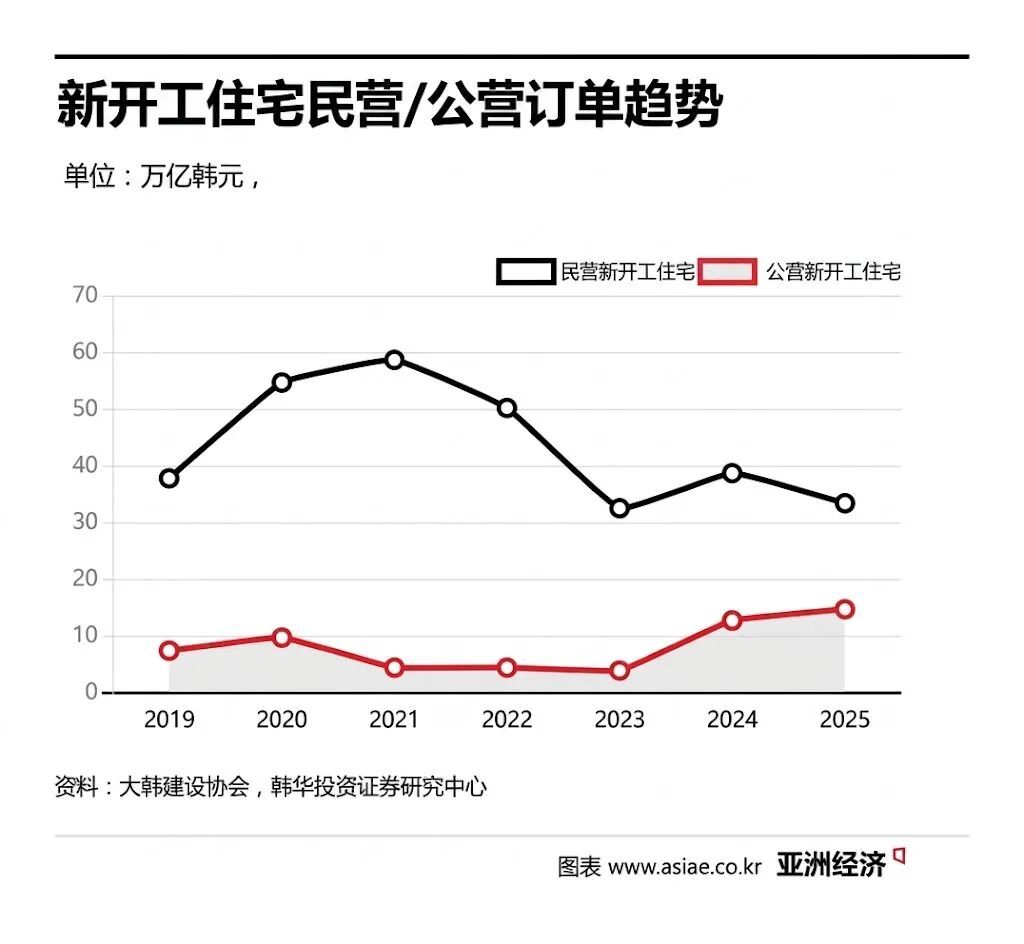
Meanwhile, the construction company's housing business has not deteriorated. In the first half of this year, public new housing orders reached 5 trillion won, a year-on-year increase of 62%; private new housing orders also increased 6% to 14.8 trillion won. The "Rapid Housing Supply Plan" released by the government on August 13 includes measures to provide an additional 230,000 housing units in the metropolitan area and shorten the cycle from the designation of public housing land to the start of construction from 68 months to 37 months. This is also expected to be a positive factor in promoting the development of the industry.
Looking at overseas orders, the cumulative total as of July was US$11.9 billion, a year-on-year decrease of 64%. This is mainly due to the base illusion of a high base effect caused by very large contracts signed last year such as the Czech Nuclear Power Plant ($19.6 billion). The project planning for the second half of the year is already clear: In August, Daewoo E&C was selected as the preferred bidder for the Papua New Guinea LNG project and received a letter of intent (LOI) for the Rovuma LNG project in Mozambique. The company subsequently raised its annual order target from 18 trillion won to 27 trillion won; Hyundai E&C is also expected to finalize the US Holtec company Palisades in the second half of the year. Partial contract for the Small Modular Reactor (SMR) project.
Relevant stock prices in the construction sector have risen sharply before. The construction industry index is up 61.6% so far this year, outpacing the 58.9% gain in the Korea Composite Stock Price Index (KOSPI). After peaking in early May, the index experienced a 47% correction through the end of July, but has rebounded strongly again over the past month. The current 12-month dynamic price-to-earnings ratio (P/E) of the sector is 9.3 times. Researcher Song assessed that its price advantage is no longer particularly prominent.
Despite this, the investment rating of the construction sector remains "Overweight (Positive/Optimistic)". The reason is that this industry is one of the very few sectors where profitability is expected to continue to improve this year and next year; and with the recovery of profitability in the housing sector and the surge in orders, the revenue growth trend has become increasingly clear. This judgment applies not only to large construction companies, but also to medium-sized construction companies and building materials companies throughout the industry chain.
Regarding the construction of data centers, Researcher Song added: "The actual start schedule and scale may become variables that affect performance forecasts. But even if the housing market fails to usher in an explosive boom, starting from this year's record order volume, we expect that the order expansion cycle will continue in the next two to three years."
Comments