
Abstract:
Developing an operating system kernel from scratch usually takes a team of experienced engineers several years. However, CentOS co-founder and Rocky Linux project initiator Gregory Kurtzer recently demonstrated a rather special result: he used artificial intelligence agents to create a new operating system kernel Ginux in just 11 days. This kernel does not use any Linux kernel code, but it can already boot Rocky Linux 10. Although it is still a research prototype, this project shows a new possibility for AI to participate in the development of complex underlying software.
Kurtzer announced the Ginux project for the first time last week through the social platform X. The relevant code has also been uploaded to GitHub and adopted the Apache 2.0 open source license. The name Ginux combines the three elements of Linux, GPT and Greg. The project introduction even joked that in order to prevent the author from being too self-aggrandizing, the letter G should be interpreted as GPT.
Ginux is not a fork of Linux, nor does it copy kernel components from existing Linux code. Its memory management, process scheduling, file system and network functions are all written from scratch and mainly developed using the Rust language. What it really shares with Linux is the Application Binary Interface (ABI). That is to say, Ginux simulates the system interface provided by Linux to software, so that programs originally written for Linux can run without modifying the code.
The project developer describes this design as: Linux is not just a kernel implementation, but can also be regarded as a "personality" or compatibility environment presented by the kernel to application software. Currently, Ginux only implements Linux compatibility mode, and the possibility of adding BSD compatibility mode is not ruled out in the future.
However, Ginux is still far from being fully compatible with Linux. According to the project documentation, taking the x86-64 interface of Linux 6.12 as a reference, only 82 of its 375 system calls have been fully implemented, another 245 can only partially work, and the remaining 48 are intentionally set to be unavailable. This means that although it can already run some existing Linux software, it cannot yet be regarded as a mature general-purpose Linux replacement.
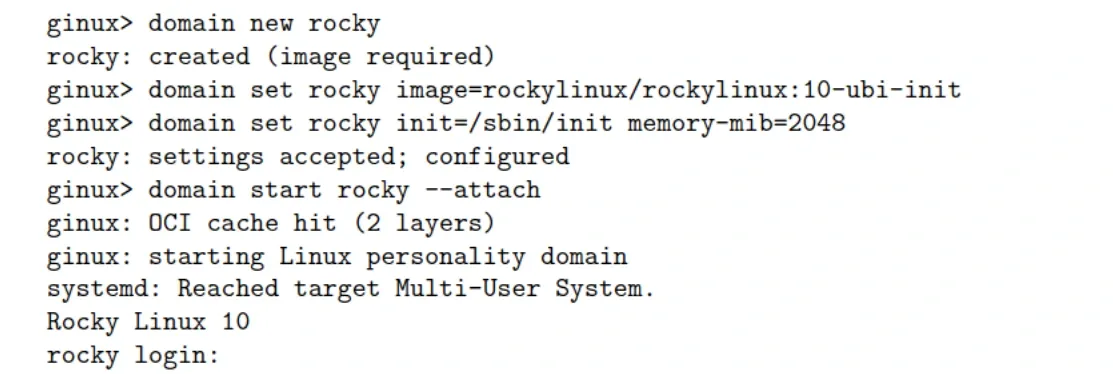
Ginux also introduces a set of isolation mechanisms called "Domains". The software runs in an isolated environment, and each domain has independent processes, memory space and file systems. The project hopes that this mechanism will provide stronger isolation boundaries than traditional containers. However, Ginux can still use standard OCI container images to build file systems for each domain. It is in this way that it has been able to load Rocky Linux 10 and advance the system boot to the systemd multi-user target.
The most interesting aspect of this development is the role of artificial intelligence. Kurtzer calls his approach "Human-Directed Agentic Engineering" in a technical report. He is responsible for determining the overall architecture, formulating development phases and acceptance criteria, while the artificial intelligence agent is responsible for most of the subsequent execution work, including writing code, starting the kernel, running tests, and modifying the code after discovering problems.
The entire process is completed by a continuously running OpenAI Codex task, and the model used is GPT-5.6 Sol. In 11 days, AI generated a total of approximately 139,000 lines of code and test content, and completed more than 1,000 code submissions. During the development process, the real distribution Rocky Linux also played an important role: it exposed some problems that artificially constructed test cases failed to find when it was actually started and run.
However, Kurtzer did not package Ginux into a production-ready operating system. At present, the project is still completely running in the QEMU virtual machine. It does not yet support direct startup on physical hardware, and there is no support for GPU and NVMe storage devices. What's more, Ginux has not yet undergone independent security audits, and its security cannot be fully verified.
Kurtzer believes that artificial intelligence now has the ability to write complex system software, but the real difficult part has not disappeared. Software compatibility, security and long-term maintenance capabilities are still key barriers that determine whether an operating system can truly succeed. In other words, AI can significantly shorten the process of developing code from scratch, but it cannot automatically ensure that these codes are reliable enough, nor can it replace long-term engineering verification.
At the same time, the Linux kernel development community is also gradually trying to introduce AI tools. Last month, Linux founder Linus Torvalds used Claude Code to write a set of experimental page cache patches, but reviewers later discovered that there were race conditions, so the relevant code is still under review. Around the same time, Linux kernel maintainers also agreed to no longer require contributors to disclose whether their code was AI-assisted.
The significance of Ginux may not be that it can immediately replace Linux, but that it demonstrates a new software engineering model: humans are responsible for goals, architecture, and key decisions, and AI agents are responsible for a large amount of specific implementation and testing work. Complex systems that once took years to take shape can now have a working prototype in a fraction of the time. However, it is still a long engineering road to move from a prototype to a truly reliable operating system that can adapt to a wide range of hardware and be maintained over the long term.
Comments