
Abstract:
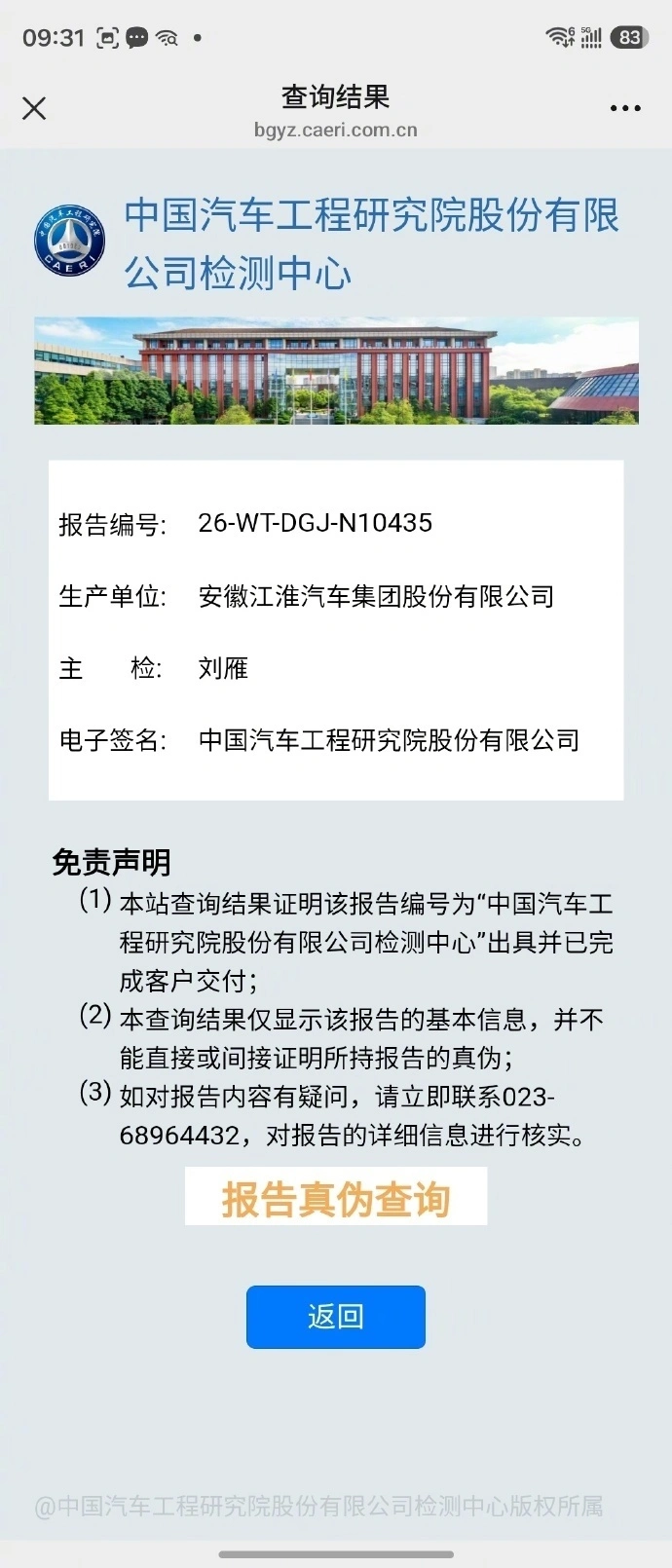
On October 13, Zunjie Auto released the "Zunjie V800 Brake Pedal Testing Instructions", stating that the third-party testing agency completed the inspection on October 11. The relevant strength inspection items of the inspected samples met the requirements of QC/T 788-2018, and no cracks or damage occurred during the strict inspection with a maximum longitudinal force of 3000N. According to reports, the test was conducted by the China Automotive Engineering Research Institute Co., Ltd. Testing Center.
Some media reporters then called the China Automotive Research and Testing Center for inquiries. The staff member who answered confirmed that the report corresponding to the provided number was issued by the company, and the test was based on the sample vehicle provided by the company at the time. However, two explanations were made: First, the testing center only conducted testing based on the sample vehicle provided by the company at the time; second, there was no guarantee whether the reports circulated by the outside world had been tampered with.
This reply confirms the existence of the corresponding report. It does not mean that the testing agency found that the report has been tampered with, nor should it be expanded into a formal technical conclusion by the agency.
The summary of the public explanation also disclosed that the tightened test used a loading speed of 20mm/min, maintained it for 5 seconds and then released the longitudinal force. It was conducted a total of 5 times, involving 14 brake pedal component assemblies, and no cracks or damage were found in visual inspection. The 20mm/min here describes the displacement loading speed, not the force growth rate. The load and specific test procedures corresponding to each sample still need to be checked with the complete report. You cannot just rely on the summary to write "all 14 samples passed the 3000N test".
Previously, Dongchedi released a test video saying that the brake pedal bracket of three Zunjie V800s broke during the 100km/h to 0 emergency braking test. The inspection results provide a basis for strength verification under specific conditions, but they cannot directly explain the previous fracture phenomenon.
Whether the slow loading test can be directly compared with the pedal force process during vehicle emergency braking is a technical issue that requires further clarification. Merely comparing "up to 3000N undamaged" with the fracture force value disclosed by the media is not enough to determine the cause of the difference in results. It is also necessary to check the sample status, installation constraints, loading direction, loading history and measurement data. Different working conditions cannot directly prove that the test is invalid, nor can it be a reason to skip the investigation of the cause of the fracture.
For safety disputes about brake control components, the conformity report cannot replace the investigation of the cause of failure. In the future, it is still necessary to disclose the complete and verifiable report and sample sources, analyze the broken parts, and clarify the differences in results by randomly selecting mass-produced vehicles and retesting under unified working conditions. What the public needs is a clear explanation of the cause of the break, its scope of impact and improvement measures.
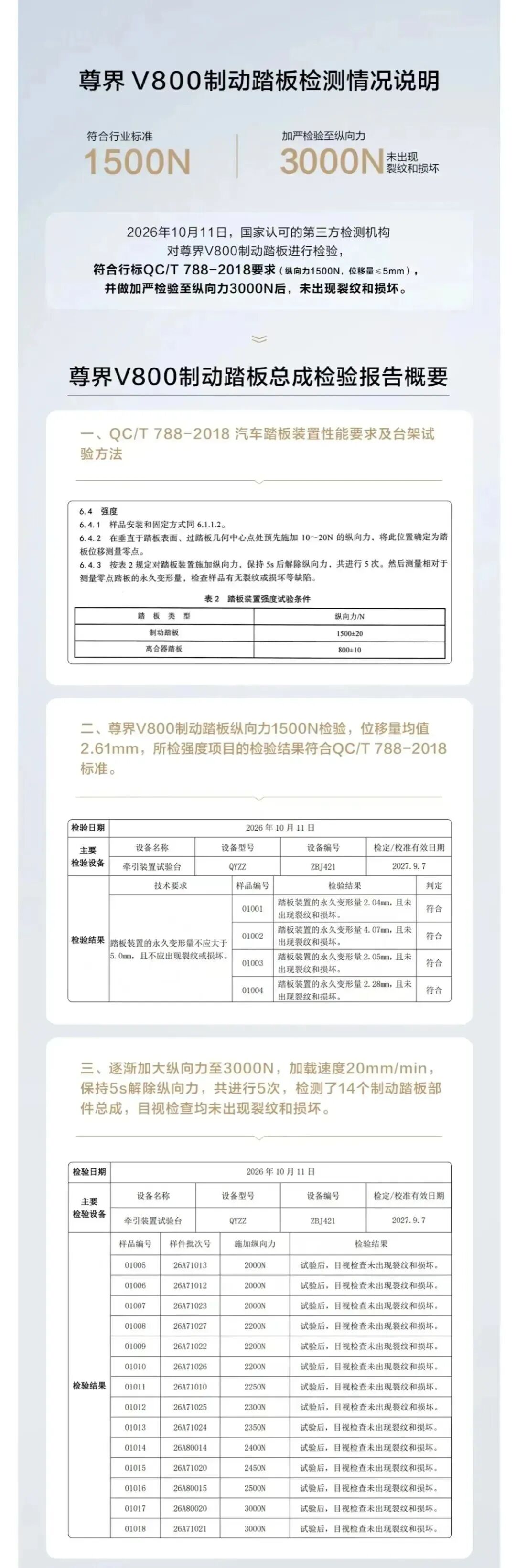
"Zunjie V800 Brake Pedal Detection Instructions" released by Zunjie Automobile
Comments