
Abstract:
The reporter learned from the Aerospace Information Innovation Institute of the Chinese Academy of Sciences (hereinafter referred to as the "Aerospace Institute") on the 17th that the institute, together with many domestic units, successfully achieved experimental verification of wireless communication with the highest code rate in the Q/V band at the China Remote Sensing Satellite Ground Station Lijiang Station. The two-way transmission rate of this experiment is as high as 27Gbps, breaking the domestic record for the same frequency band, and the key indicators have reached the domestic leading and internationally advanced levels. Relevant results will provide core technical support for the development of my country's 6G communications and satellite Internet technology.
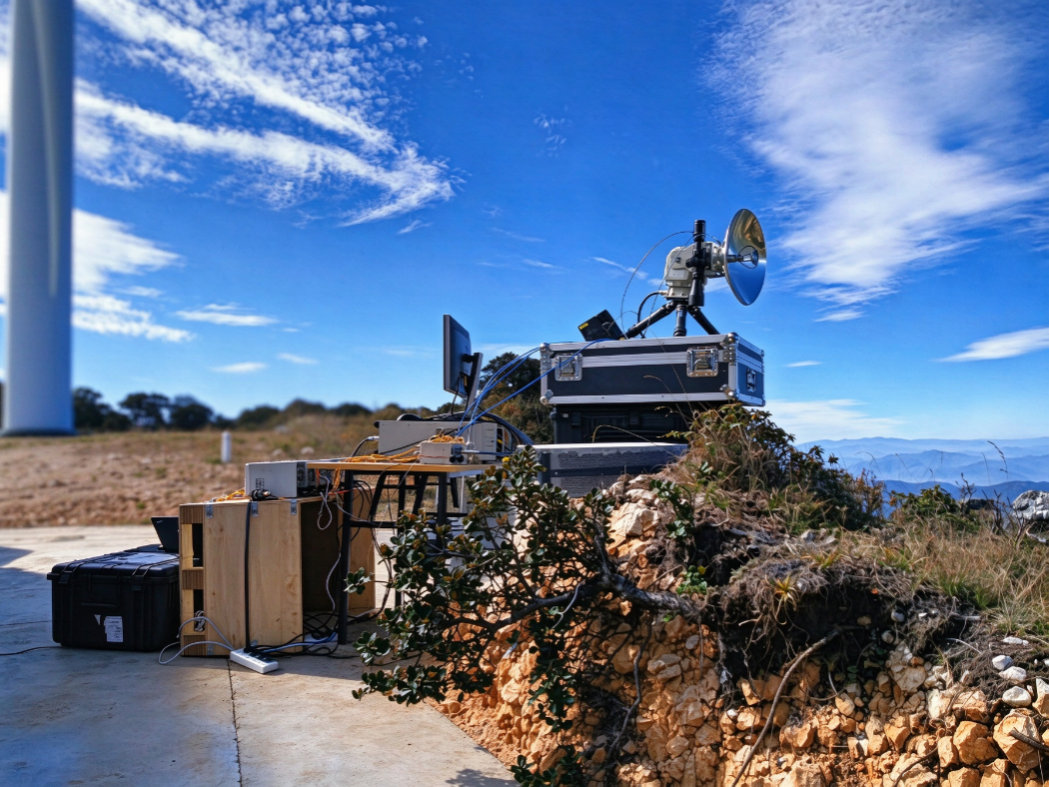
Wireless communication experiment satellite signal simulation source. Image source: Kongtianyuan
The Q/V band is an important frequency band used for future 6G communications, with an available bandwidth of about 10 GHz and abundant spectrum resources. To put it figuratively, it is like a wider information highway, with good carrying capacity for high-speed satellite communications.
But this "road" is not easy: millimeter wave signals in this frequency band have special characteristics and are extremely sensitive to factors such as radio frequency nonlinearity and phase noise. The technical threshold for achieving high-quality, high-code-rate transmission is extremely high. How to make full use of the frequency band and increase the two-way transmission rate between satellite and ground faster is the current key research direction in the field of Q/V band communications.
Relying on the accumulation of high-end modulation and demodulation technology in the X and Ka frequency bands, the Aerospace Research Institute has taken the lead in working with Beijing Rongwei Technology Co., Ltd. and other units to carry out technical research. The technical team has successfully conquered many key technologies such as lightweight Q/V antennas, intelligent signal compensation, and phase noise compensation, and independently developed a full set of antennas, power amplifiers, channels, and baseband equipment, built a ground experiment platform, and simulated satellite in-orbit status for verification.
In layman's terms, high-order modulation technology is like installing a "super compressor" on data, allowing more information to be crammed into limited spectrum channels. In this experiment, the team implemented the step-by-step implementation of "wired closed-loop testing - far-field wireless docking - full-link comprehensive performance assessment", and for the first time in China systematically tested the effect of multiple high-order modulation modes on improving transmission rates.
Test results show that when using 512QAM mode, the maximum bidirectional transmission rate of a single channel in the Q/V band can reach 6.75 gigabits per second (Gbps), which is 2.25 times the existing single channel transmission rate in the same frequency band. On this basis, with the dual carrier frequency and polarization multiplexing technology, the two-way communication rate is further increased to 27Gbps, which is equivalent to completing the extremely high-speed transmission of massive data in one second, setting a new record for the domestic Q/V band communication rate in one fell swoop.
It is reported that the follow-up team will continue to improve technical indicators and strive to achieve two-way communication transmission capabilities exceeding 50Gbps, providing strong support for the technical system design and engineering implementation of my country's new generation of low-orbit high-throughput satellite Internet, and helping my country seize the commanding heights in the global technology competition for 6G communications.
Comments