
Abstract:
As the demand for artificial intelligence computing continues to grow, a production line for large-scale transformation of NVIDIA GeForce RTX 5090 gaming graphics cards into AI accelerator cards has emerged in China. According to the latest video information cited by Wccftech and other hardware media, relevant factories are dismantling the retail version of the RTX 5090 graphics card, transferring the GPU core and video memory chips to specially designed server circuit boards, and equipping them with a cooling system suitable for data center use, so that high-end graphics cards originally targeted at gamers can be used for AI computing.
The latest leaked video was shared by Hong Kong hardware media HKEPC. The screen shows that a large number of retail RTX 5090 graphics cards are stacked in a large-scale modification workshop. Workers follow the assembly line process to disassemble the graphics cards, remove the original radiator, and transfer the GPU and video memory chips to customized circuit boards. In the video, you can see graphics cards from manufacturers such as PNY, Gigabyte, Asus, and even Nvidia's own Founders Edition products.
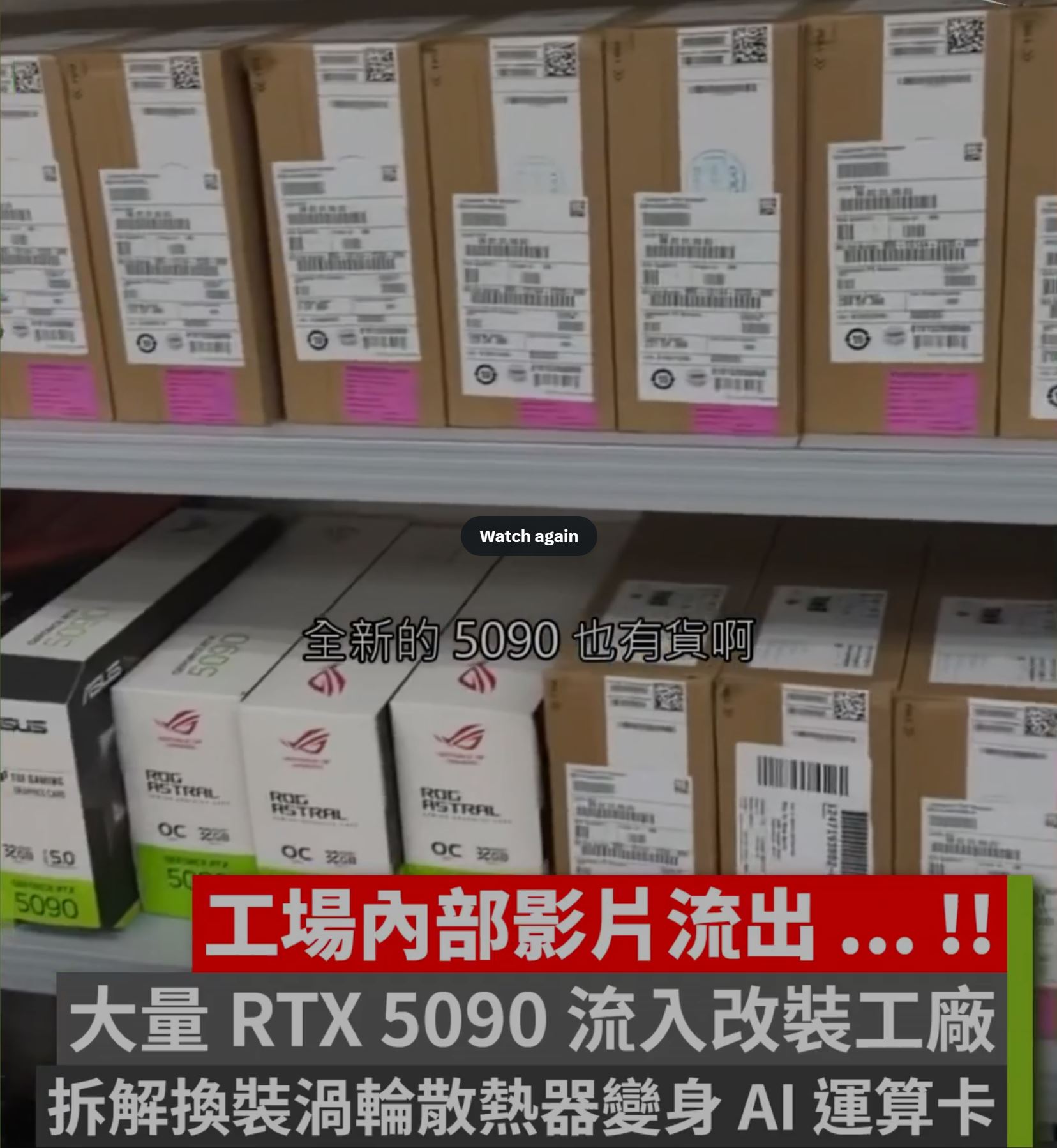
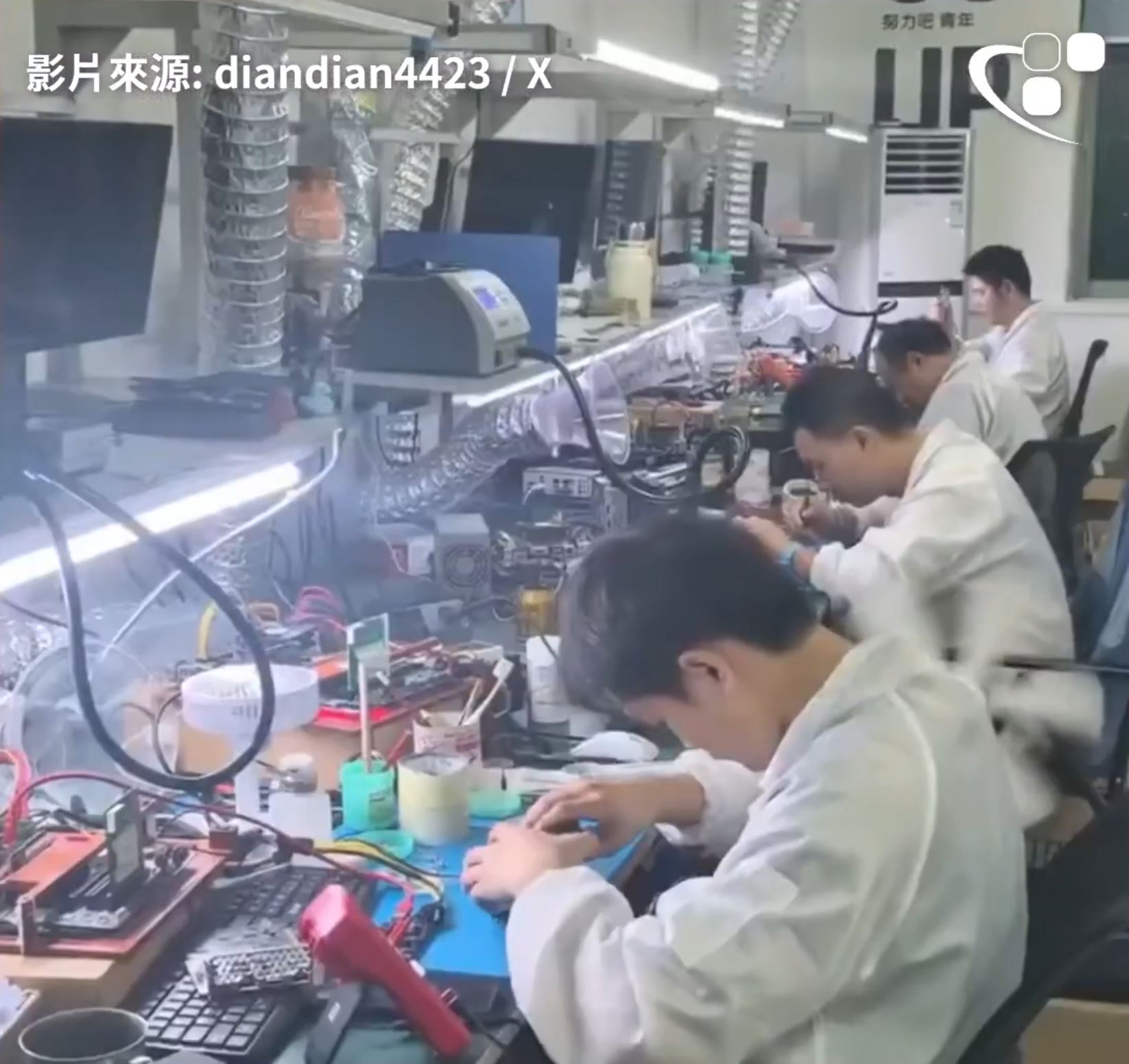
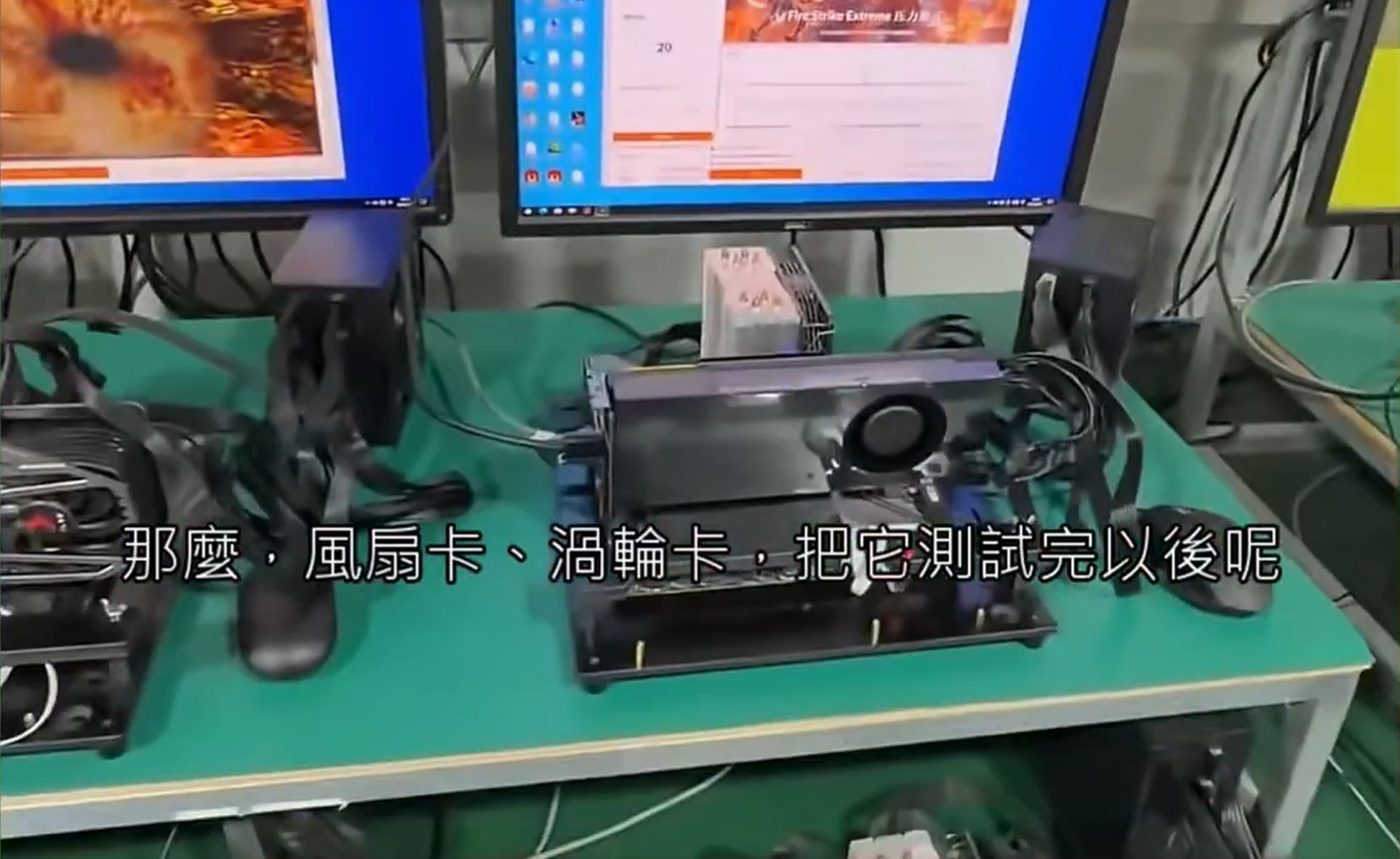
Judging from the on-site pictures, this is not an individual modification performed by ordinary computer enthusiasts on the workbench, but a production operation of a certain scale. A large number of graphics cards are processed centrally, and the modified products are tested to confirm that they can operate properly. The original video was allegedly posted on social media and subsequently deleted, but HKEPC retained the relevant images.
The core reason for modification is that there are obvious differences between the design of ordinary game graphics cards and the needs of data centers. The RTX 5090 uses a bulky multi-fan radiator that usually occupies three or more expansion slots. In ordinary desktop computers, this design is good for heat dissipation, but in server cases that require dense installation of multiple GPUs, it takes up too much space and makes airflow organization inside the case more difficult.
Therefore, the modification factory will remove the original GPU core and video memory chip from the retail version of the circuit board, and then weld them to the redesigned custom PCB. New circuit boards often feature more compact dual-slot designs and feature turbine-style heat sinks that focus hot air toward the outside of the case. In this way, graphics cards originally designed for gaming computers can be more suitable for installation in multi-GPU servers or AI computing systems.
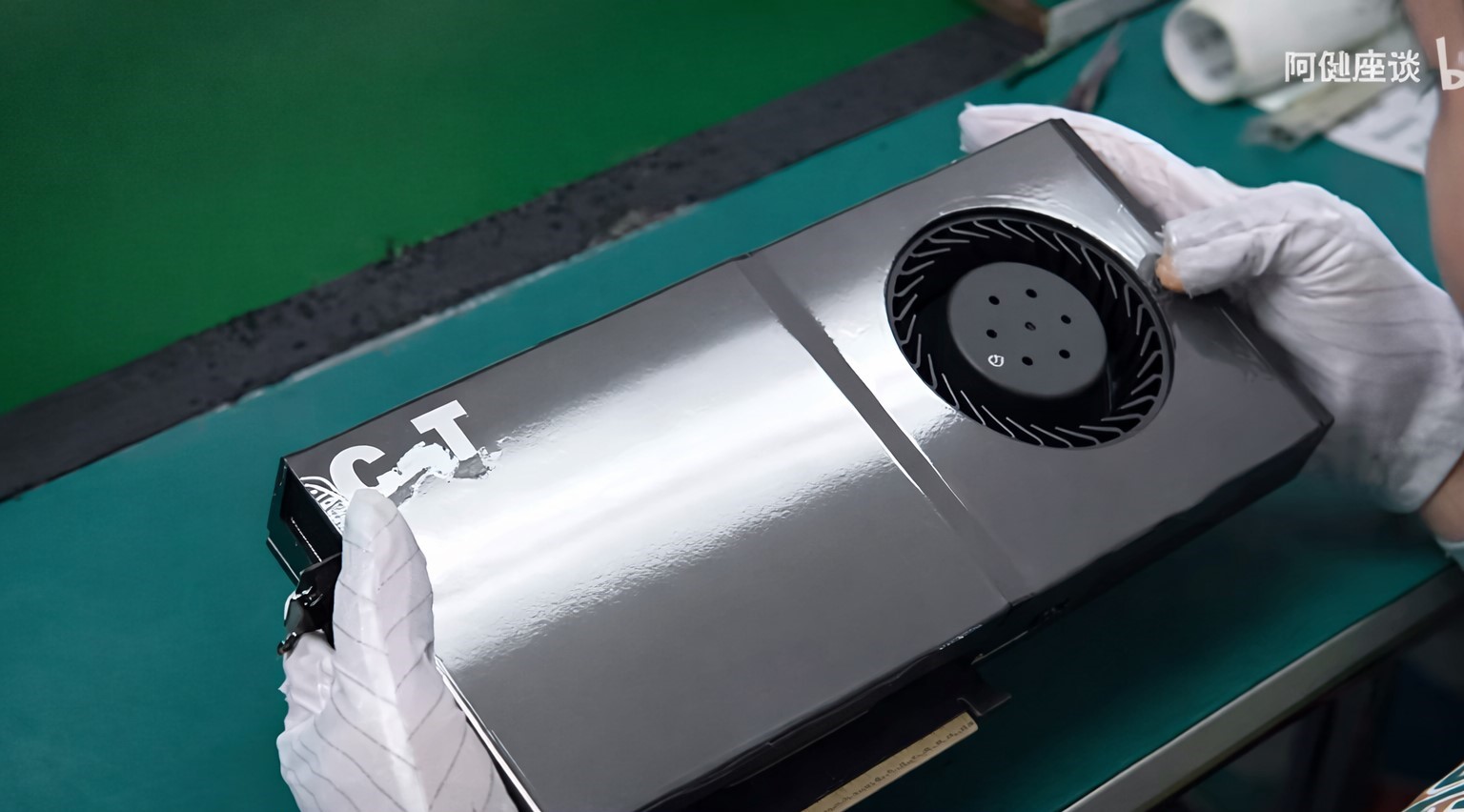
This type of modification is not simply about replacing the radiator. GPU cores and memory chips use complex packaging and welding processes, requiring the use of professional equipment for disassembly, cleaning, re-balling and welding. Customized circuit boards must also redesign the power supply lines, component layout, heat dissipation structure and interface locations to meet the operating requirements of high-power GPUs. After the modification is completed, the product still needs to undergo functional testing and stability verification before it can be used for actual computing tasks.
RTX 5090 uses NVIDIA Blackwell architecture, is equipped with GB202 GPU core, and is equipped with 32GB GDDR7 video memory. Its memory capacity and computing power enable it to undertake some large-scale model inference, model fine-tuning and other AI computing tasks. For enterprises or research teams that cannot obtain certain data center GPUs through formal channels, transforming consumer-grade GPUs into server accelerator cards may become an alternative way to obtain computing resources.
However, the RTX 5090 modified card is not completely equivalent to Nvidia's specially designed data center GPU. There may be differences between the two in terms of video memory capacity, cooling redundancy, reliability design, server management functions, software support and long-term operation guarantee. The modified RTX 5090 still mainly retains the original 32GB GDDR7 video memory. It will not automatically gain greater capacity or all the functions of a data center product just because it is replaced with a custom circuit board.
Some rumors circulating recently claim that Chinese manufacturers can expand the video memory of RTX 5090 to 64GB or even 96GB, but there is currently no reliable public evidence to prove that these high-capacity modified versions have achieved stable operation. The product shown in the latest video, judging from the existing data, still uses the original 32GB video memory configuration.
This phenomenon is also related to the United States’ export restrictions on advanced computing chips. The U.S. export controls to China restrict the entry of some high-performance computing chips into the Chinese market, and the computing performance of the consumer-grade RTX 5090 is highly attractive. Therefore, related products were transformed into accelerator cards suitable for AI servers by dismantling and redesigning circuit boards, triggering discussions on the actual effects of export controls.
However, based only on the appearance and quantity of the products in the video, it is not possible to determine the specific procurement channels of these graphics cards, whether the transactions are legal, or whether they violate relevant export control regulations. The modification itself and the source, cross-border transportation method and final use of the chip are different issues and need to be judged based on specific facts.
At the same time, the supply of RTX 5090 in the global market has also attracted attention. Recent reports indicate that this flagship gaming graphics card has become extremely difficult to purchase in some markets, with retail prices significantly higher than the official recommended selling price. Nvidia executive Jeff Fisher said in mid-October that the RTX 5090 has not stopped production and the company will continue to supply it, but supply chain capacity is indeed limited. Therefore, the current tight supply of graphics cards cannot simply be attributed to the fact that all products have been discontinued.
If a large number of RTX 5090s are used for AI computing instead of entering the general gaming computer market, it may further exacerbate the difficulty for players to purchase flagship graphics cards. However, the video does not provide the actual output, procurement scale and market share of this factory, so its impact on global retail supply cannot yet be quantified.
For Nvidia, this modification also reflects the increasingly blurred lines between consumer GPUs and AI accelerators. Although the RTX 5090 is targeted at the gaming market, its powerful parallel computing capabilities are also suitable for some AI workloads. As long as the GPU core and video memory can work stably and the circuit board and cooling system are redesigned, there is a chance that it can enter a server environment that was not originally designed for it.
Overall, the latest video shows that Chinese manufacturers are transforming the retail version of RTX 5090 into an accelerator card more suitable for AI servers in a more industrialized manner. This not only reflects the market's demand for high-performance GPU computing capabilities, but also shows that consumer-grade hardware can enter the professional computing field through redesign. However, there is still a lack of sufficient public data on the actual scale of modified products, chip sources, long-term reliability and their impact on the supply of game graphics cards.
Comments