
Abstract:
According to Reuters, three major Chinese Internet companies have ordered more than 3 million NVIDIA RTX PRO 5500 graphics cards. Based on a list price of approximately US$11,400 per block, the potential value of this batch of orders exceeds US$35 billion. You know, RTX PRO 5500 is a workstation graphics card. In the past, this type of card was mostly used for rendering, simulation, and 3D modeling, and belonged to a different product line than chips specifically designed for ultra-large-scale AI clusters. But now, it's one of the most powerful Nvidia GPUs available to Chinese buyers.
According to reports, Chinese customers’ total orders for this card have exceeded 6 million yuan, and Nvidia told partners that global production of this card in 2027 may not exceed 3 million yuan.
In other words, the demand reported by one market in China has exceeded twice the global annual planned production. Even if every card produced next year is sold to China, it will only be enough for half at most.
This is an ideal scenario, actual delivery is less. Nvidia has warned its partners that it may only be able to meet 5% to 10% of the ordered quantity in the end.
But even if it is 5% to 10%. There are also 150,000 to 300,000 cards.
In normal times, this would be a large purchase. But for today’s major Chinese manufacturers, it’s already worth it if they can get it.
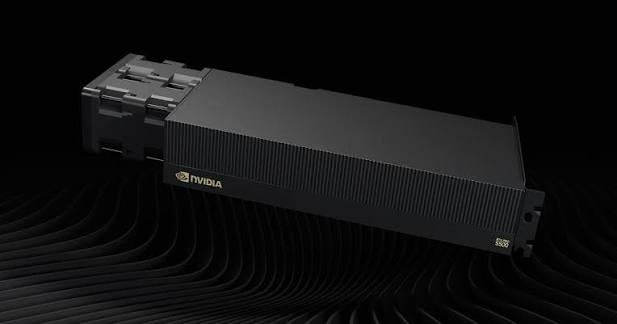
Big manufacturers are eyeing workstation cards, first of all because of limited choices.
For Chinese customers, RTX PRO 5500 has a very real advantage: it is compliant and can be purchased.
The United States has relatively tight restrictions on the export of high-end chips. NVIDIA's B300 data center chips based on the Blackwell architecture cannot be sold to China, and the H200 based on the Hopper architecture must also be approved on a case-by-case basis. And the "workstation card" is stuck right on the edge of the control list.
According to reports, major Chinese manufacturers buy RTX PRO 5500 mainly for AI inference, that is, to let already-trained models answer user questions. Compared with training large models from scratch, inference requires relatively low computing power, and workstation graphics cards can also take on some of the tasks.
The limited supply of high-performance chips, coupled with the continued growth in domestic demand for AI computing power, further highlights the alternative value of the RTX PRO 5500.
This order also meets local market requirements. At the end of September, the Ministry of Industry and Information Technology required some companies to report their purchase plans and uses for the RTX PRO 5500, and informed some of them that they planned to approve the purchase. Obviously, this purchase also complies with domestic regulations.
On the other hand, the hot demand for the RTX PRO 5500 has in turn boosted the market for the gaming flagship RTX 5090. According to media reports, some manufacturers have provided AI computing power by modifying 5090 or customized servers, while some traders are hoarding goods and reluctant to sell them. The channel price of 5090 has also continued to rise, exceeding 50,000 yuan.
However, RTX PRO 5500 was quietly launched on the official website in September this year, but it is still some time before batch delivery, and its large-scale use performance has yet to be verified.
The positioning of the RTX PRO 5500 card itself is very "tricky", much like the approved "special edition" created by Lao Huang targeting major manufacturers that are short of cards.
Nvidia officially states that this card has a maximum power consumption of 600W, coupled with rack-oriented deployment design, air cooling and liquid cooling options, this card is obviously not prepared for ordinary companies, power supply and heat dissipation are the first threshold. It has only one place to go - the corporate computer room.
It uses the same GB202 chip as the game-oriented RTX 5090. The number of CUDA cores is the same as 21,760, but the video memory is increased from 32GB to 84GB. On the other end, the memory bandwidth dropped from about 1792GB/s on the 5090 to 1398GB/s. By cutting bandwidth, change the video memory capacity.
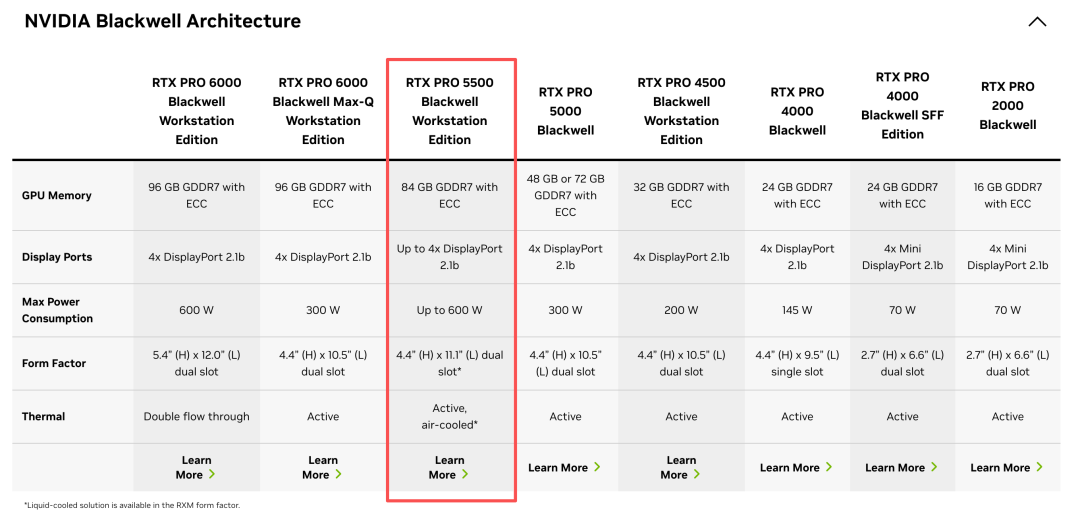
This choice is based on reasoning. Model training is a one-time investment, inference means burning money every time you answer, and the answer effect depends entirely on the video memory. RTX PRO 5500 also supports MIG (Multiple Instance GPU). One card can be divided into two 42GB, and two-way inference tasks can be run in parallel.
It is easier to understand its appeal when considering the price factor.
According to media reports, the initial quotation of RTX PRO 5500 to major customers is about 85,000 yuan. During the same period, the spot price of 5090 in some domestic channels has reached 57,000 yuan. Based on this quote, it costs about 50% more, and the video memory is increased from 32GB to 84GB, which is 2.6 times the original amount, but it has GDDR7 ECC video memory and is designed and reliable for computing power centers.
In fact, Lao Huang launched the RTX PRO 6000D workstation graphics card last year, and even specially divided it into server, workstation and other versions. However, it is also an NVIDIA product, and the treatment of the 6000D last year was much colder.
At that time, some large customers felt that its performance had shrunk, but the price was about 50,000 yuan. The price/performance ratio was not good enough, and some did not place orders at all. At that time, buyers were still hoping that export restrictions might be loosened and stronger chips would be available sooner or later.
Nowadays, control has not been relaxed, but computing power is even less available. The RTX PRO 5500, newly launched this year, has become a more attractive alternative.
Using workstation graphics cards to run large AI models is not a new idea.
After DeepSeek became popular in 2025, local deployment and all-in-one machines became popular. At that time, desktop-level deployment solutions already used professional cards such as RTX 5000 Ada and RTX 5880 Ada.
The approach at that time was to install several professional cards into the same workstation to create larger video memory capacity, and then run the model in parallel through software. For example, at that time, there was a deployment plan consisting of four RTX 5000 Ada, with a total of 128GB of video memory, used to run the 32B distillation model of DeepSeek-R1.
But in this year's round, the conflict is no longer whether we can run, but whether we can buy or not. How many orders Chinese customers have placed and how many cards Nvidia plans to produce are two different things.
For Nvidia, it has to decide who to supply the limited chips to first. Previously, overseas social media reported that GB202 will turn more to RTX PRO professional cards, and 5090 may be discontinued. Nvidia executive Jeff Fisher later denied the suspension of production, but also indirectly admitted that supply chain capacity was limited.
RTX PRO 5500, RTX 5090, and RTX PRO 6000 all use GB202 chips, and different products must share this part of the production capacity. In terms of larger production arrangements, NVIDIA still has next-generation products to take care of.
Therefore, major Chinese manufacturers have a very practical consideration when placing orders in advance: first determine the demand and strive for supply, and then arrange deployment.
It is difficult to fulfill all of these 6 million orders, but if you go too late, you may even have less room for choice.
The reason why this order number seems exaggerated now is because the order here is not just an order, but more like a placard at the auction. You have to submit the order even though you know you won't get it all.
Comments