
Abstract:
The reporter learned from the Anhui Provincial Key Laboratory of Quantum Computing Chips on the 2nd that Origin Quantum, together with the University of Science and Technology of China, the Hefei Comprehensive National Science Center Artificial Intelligence Research Institute and other scientific research teams, successfully developed a "coherent quantum routing system" for barrel quantum random access memory (QRAM) on the "Original Wukong" independent superconducting quantum computer. This is equivalent to setting up a "fast road" for data centers and effectively solves the industry problem of QRAM expansion. The relevant paper was recently published in the international physics journal "Physical Reviews X".
If a quantum computer is compared to a "smart city", then quantum random access memory (QRAM) is the "data center" where data is stored and scheduled. QRAM is an important functional module for implementing algorithms such as quantum search and quantum machine learning. Its core is the "quantum router" - it is responsible for accurately delivering data to the target location according to address instructions. However, as the scale of the routing network increases, the traditional solution requires a large number of standard quantum gates to decompose instructions layer by layer for each additional node, resulting in a sharp increase in line depth and accumulation of errors, which limits the expansion of QRAM.
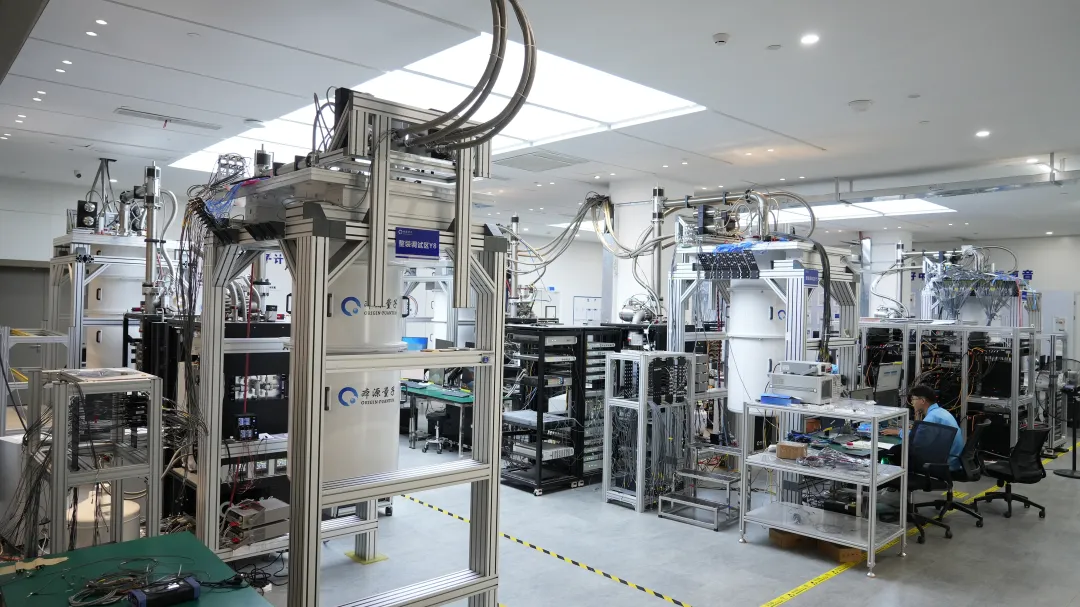
To address this difficulty, the research team proposed a quantum router construction scheme based on auxiliary energy levels. The "coherent quantum routing system" uses the auxiliary energy level of superconducting qubits to transform complex controlled switching operations into the equivalent implementation of a shallow line composed of a small number of two-bit transition gates. It is equivalent to erecting a "fast road" over a congested data channel, allowing data to bypass redundant nodes and reach its destination directly, significantly reducing line depth and reducing errors. Researchers actually built three independent quantum routers and a two-layer quantum routing network on the "Original Wukong" autonomous superconducting quantum computer for testing. The results show that the information transmission efficiency of a single quantum router is as high as 98%, and the overall transmission efficiency of the two-layer routing network can also reach 93%. In the random access test, the average fidelity of a single quantum router reached 94.8%, and the average fidelity of the two-layer routing network reached 82.4%. The data shows that this solution can achieve coherent, reversible routing controlled by quantum addresses and has the potential to expand to larger-scale networks.
The researchers said that this breakthrough not only provides a new path for building scalable QRAM on existing superconducting hardware, but also marks that my country's quantum computing research and development has moved from single performance optimization to the verification stage of complex quantum functions on real hardware. Relying on the characteristics of the quantum device itself can achieve lower cost and higher efficiency operations, opening up new ideas for the collaborative optimization of quantum chips and circuits.
Comments