
Abstract:
After increasing Apple's market value by 15 times and pushing annual revenue to a peak of US$416 billion, Cook officially handed over his CEO seal on the eve of the autumn new product launch conference, which is also a key node that is about to end the entire fiscal year.
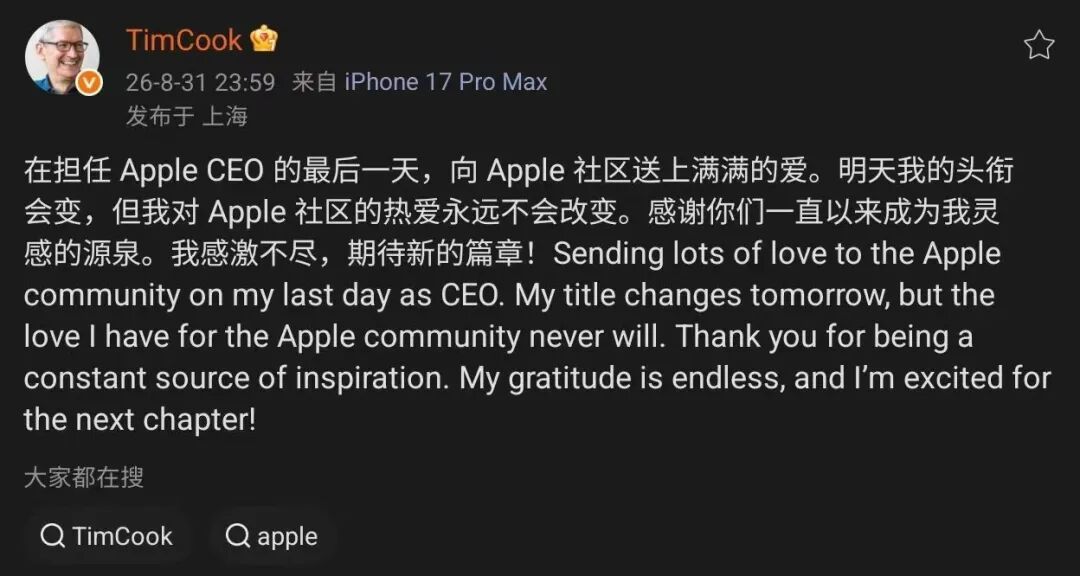
On the evening of August 23 not long ago, Apple held a small farewell party for Cook in the employee canteen at the Apple Park in Cupertino, California. Accompanied by a rock band, current Apple executives and Steve Jobs's widow took the stage to pay tribute. On September 1, local time, 51-year-old hardware leader John Turnus will officially take office. Cook stepped back behind the scenes as executive chairman.
Behind this seemingly peaceful transfer of power, what Cook left to his successor is actually an extremely complex chess game full of variables. The most important place on the chessboard is in China on the other side of the ocean.

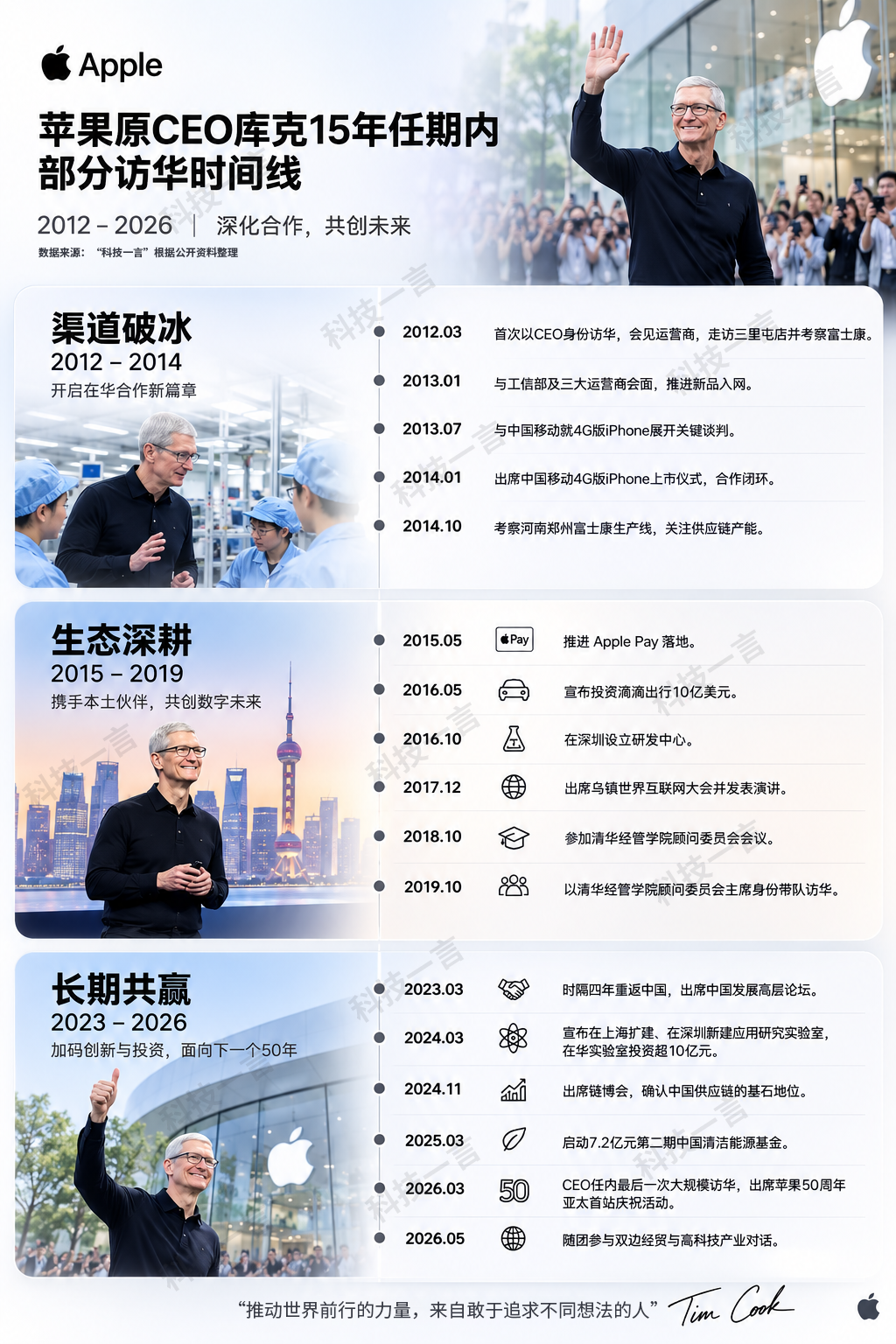
From taking over the leadership position on August 24, 2011, to resigning on September 1, 2026, Cook visited China approximately 20 times during his 15-year tenure as CEO. He traveled to Beijing, Shanghai, Zhengzhou, Chengdu, Hangzhou and Shenzhen, entered foundry workshops, stood at directly-operated stores, participated in high-level forums, and frequently visited the reception rooms of major ministries and commissions.
Currently, many media are discussing whether the newly appointed Ternus can make up for Apple’s AI shortcomings. At this critical juncture of executive handover and internal personnel adjustment, the reality before Apple is that Greater China has reached a new turning point.
From the early two-way rush, to the mid-term interest bundling, and now to the current hand-to-hand fight on the same stage, Cook once created a golden era for Apple. Also in the current environment, Cook has left the 15-year offensive and defensive transition of foreign companies in China to latecomers.
1#
The golden age of dual-anchor drive
Cook plunges Apple’s lifeline into China’s manufacturing hinterland
To understand Cook’s Chinese management skills, we must first tear away the veil of “technology without borders”. In terms of business nature, Cook has never regarded China as just a single consumer market for dumping hardware. Instead, he has built a dual-anchor model of "sales market plus manufacturing hub" that reinforce each other.
Jobs was a pure product genius, but he had never set foot in mainland China in his life, and even had a certain arrogance and insouciance in his localized operations in the Chinese market. When Cook first took over Apple in 2011, although the iPhone was famous among geek circles and high-income circles, there were almost no breakpoints in the business chain that was accessible to the general public. For example, parallel imports are rampant, network standards are fragmented, and ordinary consumers who want to buy a genuine product have to face scalpers' price increases.
This is not the case with Cook. Although he was criticized for his lack of innovation in the early days, after taking over as CEO, he visited China for the first time in his new capacity in March 2012, and then intensively mediated between the Ministry of Industry and Information Technology and major telecom operators. From the end of 2013 to the beginning of 2014, China Mobile finally cracked the biggest problem and officially launched the mobile 4G versions of iPhone 5s and 5c.
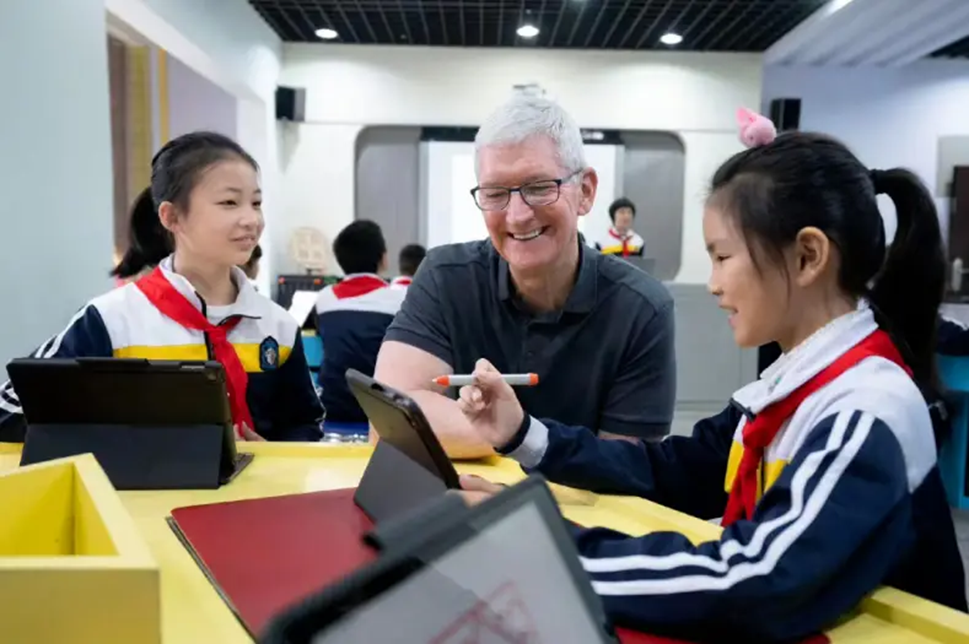
Joining forces with operators completes the underlying link for the iPhone from a high-end niche toy to a national consumer product. In the following years, Cook accelerated the establishment of Apple Store directly operated stores in China's first- and second-tier core business districts, connected UnionPay payment, WeChat and Alipay, and introduced interest-free installment and annual renewal services. Through a combination of channels and financial tools, Apple has turned a high-end electronic product priced at 5,000 to 6,000 yuan into a standard status within the reach of China's middle class.
But just having a market is not enough. Cook’s most ruthless move is to completely insert Apple’s production lifeline into China’s high-density manufacturing clusters.
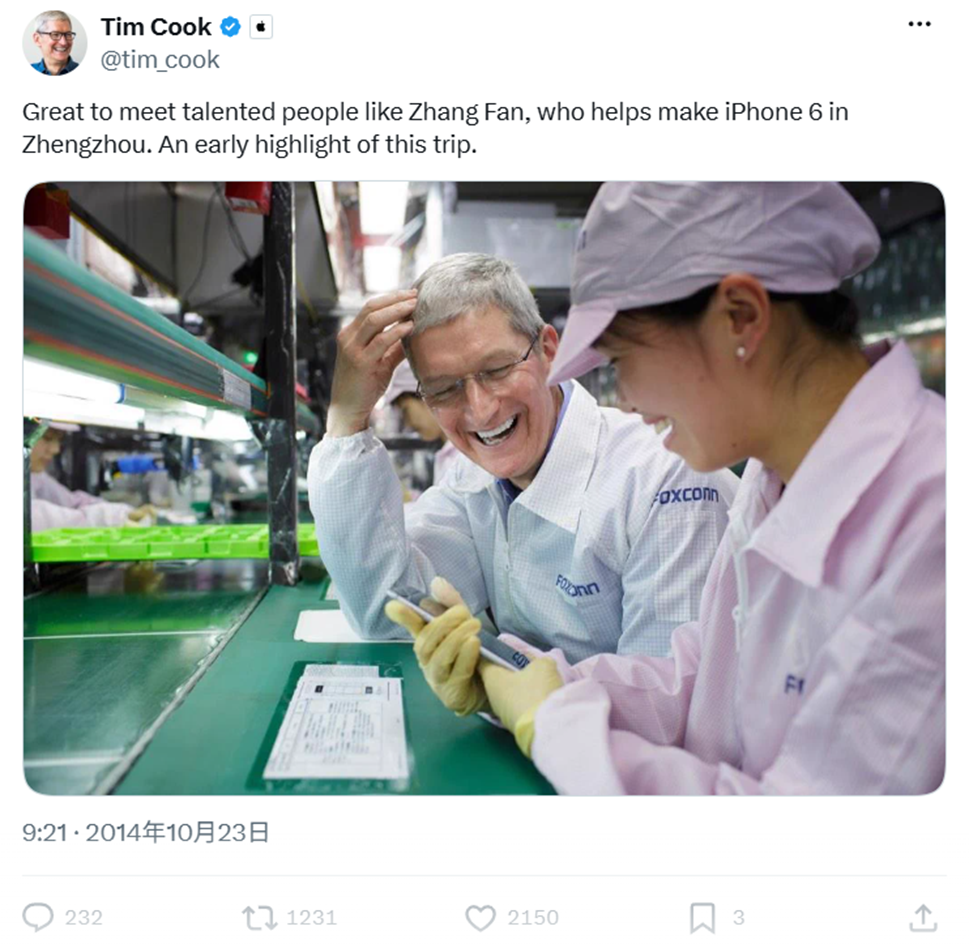
You know, Cook has been engaged in business related to the industrial manufacturing industry since he entered IBM after graduating. After joining Apple, he was also responsible for manufacturing, supply chain and operations. Before taking over as Apple's CEO, he had served as Apple's COO for many years, and had managed Apple's daily operations three times when Steve Jobs was seriously ill.
Under Cook's promotion, Zhengzhou Foxconn sprang up. Hundreds of thousands of workers and tens of thousands of upstream and downstream supporting companies formed a precision manufacturing industry chain within a radius of dozens of kilometers. At the same time, Cook implemented an extremely cruel dual-supplier horse racing mechanism within the supply chain, supporting local manufacturers such as Luxshare Precision, Lens Technology, and Goertek. While using extremely high purchase volumes to drive down the unit price of components, he sent Apple engineers to the workshop to control yield rates.
This dual-anchor system reached its peak in fiscal year 2022. That year, Apple's net sales in Greater China reached a record high of approximately US$74.2 billion, accounting for more than 20% of Apple's total global revenue. Greater China not only contributes massive net hardware profits, but is also the only irreplaceable delivery hub for Apple in the global hardware supply chain network.
Apple took away the most generous excess profits in the industry chain, but it also left the Chinese manufacturing industry with its primitive accumulation of precision processing and modern industrial management
.During that cycle, Cook’s dual-anchor strategy was almost a perfect business win-win, but new local competitors were quietly emerging.
2#
The Whampoa Military Academy Effect of Fruit Chain
Hatch the most difficult opponent with your own hands
The cruel logic of the business world is that the strongest moat often becomes a breeding ground for disruptors.
In the more than ten years since Apple has been deeply involved in China, its strict quality control standards and huge R&D in-factory support have objectively served as the "Whampoa Military Academy" of China's smart hardware industry. From CNC processing of the fuselage, cover glass, acoustic modules to precision motors, in order to comply with the manufacturing standards of Apple's entire range of products, fruit chain companies were "forced" to complete a full range of process evolution and automation transformation.
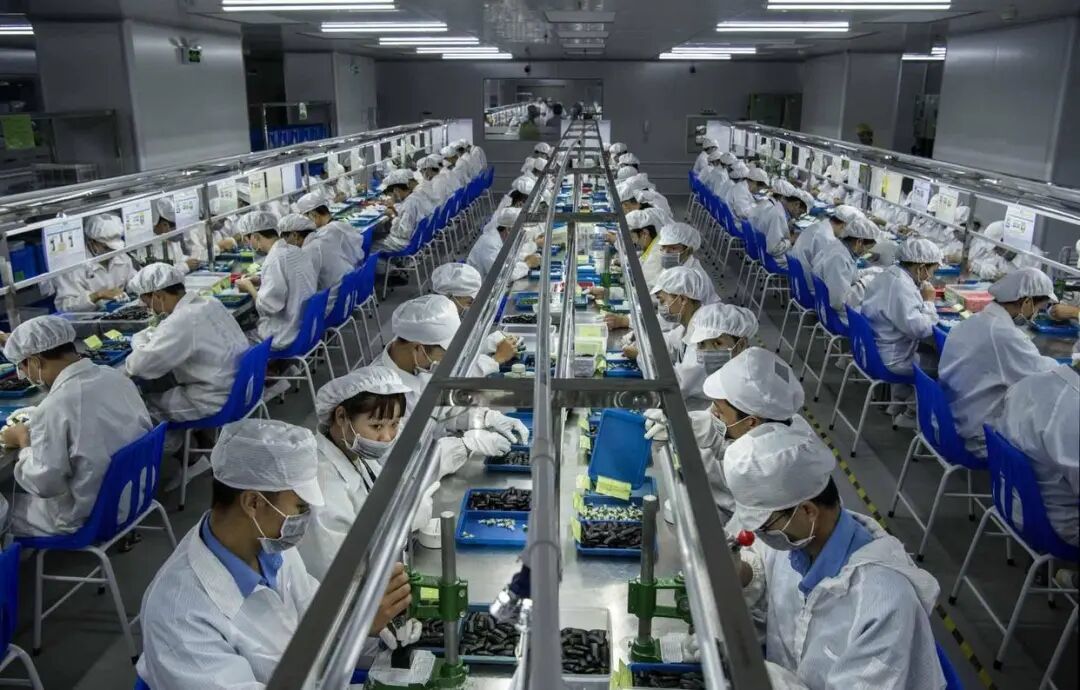
This spillover of manufacturing capabilities has directly rewritten the subsequent industrial competition pattern.
When China's local mobile phone brands began to attack the high-end after primitive accumulation, they already had the world's most mature, fastest-responsive, and most cost-controlled supply chain system at their doorstep
.At the same time, Apple began to accelerate the relocation of some production capacity to Southeast Asia and India out of geopolitical hedging considerations, which to a certain extent diluted its absolute synergy efficiency in local manufacturing. Domestic manufacturers are breaking through upwards, multinational giants are diversifying their positions, and the strength of both parties is growing and declining, and finally ushered in an inflection point in third-party statistics.
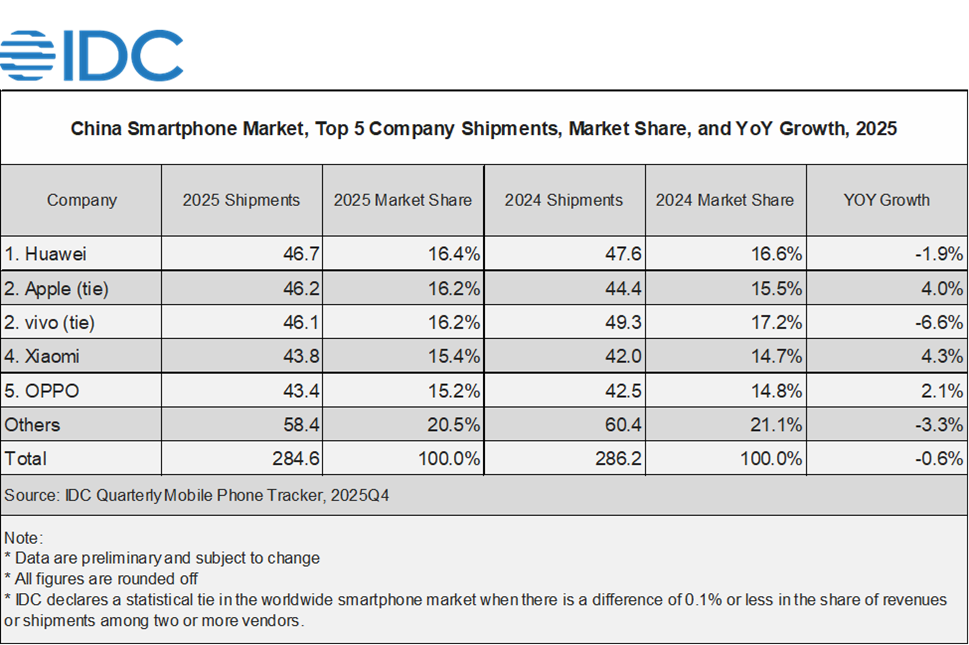
IDC data shows that in China’s smartphone market in 2024, Apple’s shipment share will fall to 15.5%, a year-on-year decrease of 5.4 percentage points. By 2025, in the fourth quarter, relying on the significant improvement in the supply of the iPhone 17 series and the promotion of some models, it won 21.1% of the market share in the quarter, regaining the number one position in the Chinese smartphone market in single-quarter shipments after a year. However, judging from the full-year results, Apple's annual market share only rebounded to 16.2%, with 46.2 million units shipped throughout the year. By a narrow margin, it lagged behind Huawei's 46.7 million units and 16.4%, losing its top spot in annual shipments. In Counterpoint's quarterly monitoring, local brands such as vivo and Huawei have also formed a continuous encirclement trend in the high-end price segment.
Another deeper reason lies in the transfer of product definition rights. In the past, Apple taught the industry how to make mobile phones, Pads, and even notebooks, and Chinese manufacturers followed suit and imitated. Many of the current domestic first-tier technology brands often used Apple products as benchmarks at press conferences. In recent years, due to Apple's conservative operations, domestic flagship mobile phones have made radical iterations in dimensions such as thinner and lighter folding screens, periscope telephoto optical systems, 100W-level two-way fast charging, in-vehicle interconnection, and AI, which have rapidly raised the hardware aesthetic threshold of domestic consumers.
In contrast, Apple is based on a globally unified mold, and it is increasingly difficult for Apple to support the high brand premium of more than 6,000 yuan in the Chinese market. From the end of 2024 to 2025, although e-commerce price cuts and various subsidy policies have stimulated a wave of iPhone shipments in the short term, this is essentially a demand overdraft caused by price leverage, rather than an absolute lead in product appeal.
When subsidies recede, domestic brands rise strongly, and price wars become the norm, Apple has to face a reality.
Cook himself has spent 15 years building a world-class precision manufacturing ecosystem in China and is arming its strongest local rivals at an alarming rate
.3#
From high-level mediation to close combat
Apple’s new normal in China in the post-Cook era
In Cook’s arrangements for announcing his retirement, there is one detail that everyone should have noticed. Although Cook handed over the CEO position, he will continue to be responsible for maintaining government-enterprise relations between Apple and key powers as executive chairman.
This is definitely not because Cook is retiring, but because Apple’s board of directors is self-aware that Ternus, the new head of the company who is a pure hardware engineer, is currently unable to face the complex business network in Greater China.
While Cook was in charge of Apple, his personal "diplomacy" was taken to the extreme. Faced with various pressures such as geopolitical friction, data security compliance, and the relocation of industrial chains, Cook's visits to China in recent years have obviously changed the tone. He is no longer just a platform for new phone sales, but has focused a lot of energy on compliance communication, R&D implementation and green investment.
For example, in order to comply with national regulations on data and information security, Apple has made a large number of localized adjustments in data storage, application distribution filing and content management. In 2024, Cook conducted an in-depth discussion on network data security and cloud service implementation during intensive communication with relevant departments. On this basis, the Shanghai Applied Research Laboratory was expanded, a Shenzhen laboratory was added, and the cumulative investment in laboratories in China exceeded 1 billion yuan. In the spring of 2025, Apple announced the launch of the second phase of China Clean Energy Fund, investing 720 million yuan to help China's supply chain promote the green electricity transformation.
With Cook's strong promotion, Apple is trying to maintain Apple's development in China by integrating R&D front-end, green binding and rural public welfare into China's high-quality development narrative.
But the marginal utility of high-level public relations is diminishing.
On the one hand, Apple’s previous moves to expand production capacity in India, Vietnam and other places to diversify geopolitical risks have inevitably caused anxiety among coastal fruit chain cities and suppliers. Although existing evidence shows that Southeast Asia and South Asia simply cannot replicate China's high-density engineering collaboration and quality of industrial workers in the short term, the trust rift caused by the migration of production capacity has already occurred.
On the other hand, with the advent of the generative AI era, the implementation of Apple Intelligence in mainland China faces multiple barriers to model filing, data export and local computing power cooperation. Although Apple has begun cooperation with Alibaba in the field of AI, the cost for Apple Intelligence to implement a globally unified AI system into the domestic industrial ecosystem in a compliant, safe and uncompromising manner is far longer and more complicated than we imagined.
Apple’s financial statement for fiscal year 2025 shows that Apple’s net sales in Greater China were US$64.377 billion, a year-on-year decrease of 3.8%, and it has shrunk by nearly US$10 billion from the high point in 2022. Although a period of support has been formed with the help of national subsidies and the hot sales of the iPhone 17 series, Greater China's share of its global revenue still inevitably fell to 15.5%.
These data show that Apple has completely lost its "super-national treatment" in China. It is no longer the technology hegemon that only needs the CEO to socialize to make the market pay for it. Instead, it has retreated to a regular operating state where compliance costs, local values and technical barriers must be calculated at all times.
4#
Say it at the end
There is no permanent winner in the face of cycles
Cook brought Apple to the peak of its market value in 15 years, but during this long cycle, he also witnessed and participated in an irreversible industrial migration.
In terms of supply chain management, capital efficiency and government-enterprise balance, Cook has almost maximized the skill points of a professional manager. But the dividends of the times that he relied on, namely the ultimate efficiency of the global division of labor, the consumption upgrade brought about by China's rapid urbanization, and the technological generation gap in the early days of the mobile Internet, are now almost over.
Apple, which Ternus took over, will usher in its first autumn conference without Cook on September 9, local time (September 10, Beijing time). By then, the first foldable screen iPhone, wearable devices with cameras, and revised AI systems will all be thrust into the spotlight.
But for the fiercely competitive Chinese market, Apple's relatively prudent pace of incremental innovation is facing a comprehensive impact from local manufacturers in terms of form innovation and localized experience. When the local supply chain has become self-reliant, when local competitors are advancing in the integration of software and hardware, and when compliance and geography have become unavoidable hard constraints, what can Apple rely on in the post-Cook era to convince Chinese consumers to continue to pay?
As the curtain falls in 2015, business will return to business, and cycles will return to cycles. After losing Cook's trump card, where will Apple go in the Chinese market?
Comments