
Abstract:
Researchers from the University of California, Berkeley, Harvard University, and Istanbul Polytechnic University in Turkey have developed a metamaterial design method that takes into account load-bearing capacity and fluid performance, drawing on the skeleton structure of the deep-sea glass sponge "Euplectella aspergillum." The research, published in Nature Communications, focuses not on replicating the sponge itself, but on translating its lightweight, strong grid geometry into computationally optimized engineering structures.

The frame of the Venus Basket is made of glass-like silica. The longitudinal and circumferential frames, cross diagonal braces and external spiral patterns together form a complex lattice, allowing it to withstand deep sea pressure and currents and guide water through or around the body. The research team hopes to learn from this structure and solve the common contradictions in engineering design: the material should be as light as possible and use as little material as possible, while at the same time being strong enough to reduce the resistance and vibration caused by wind or water flow.
To this end, the team used finite element analysis to evaluate the structural strength, computational fluid dynamics to simulate the flow, and then used a multi-objective Bayesian optimization algorithm to automatically screen and adjust hundreds of geometric solutions. Optimization goals include increasing the critical buckling load of the structure and reducing fluid drag, lift, and lift fluctuations; the latter is related to vortex shedding and the vibrations it induces. The researchers then used stereolithography to fabricate the selected structures and verified the simulation results through compression experiments and particle image velocimetry.
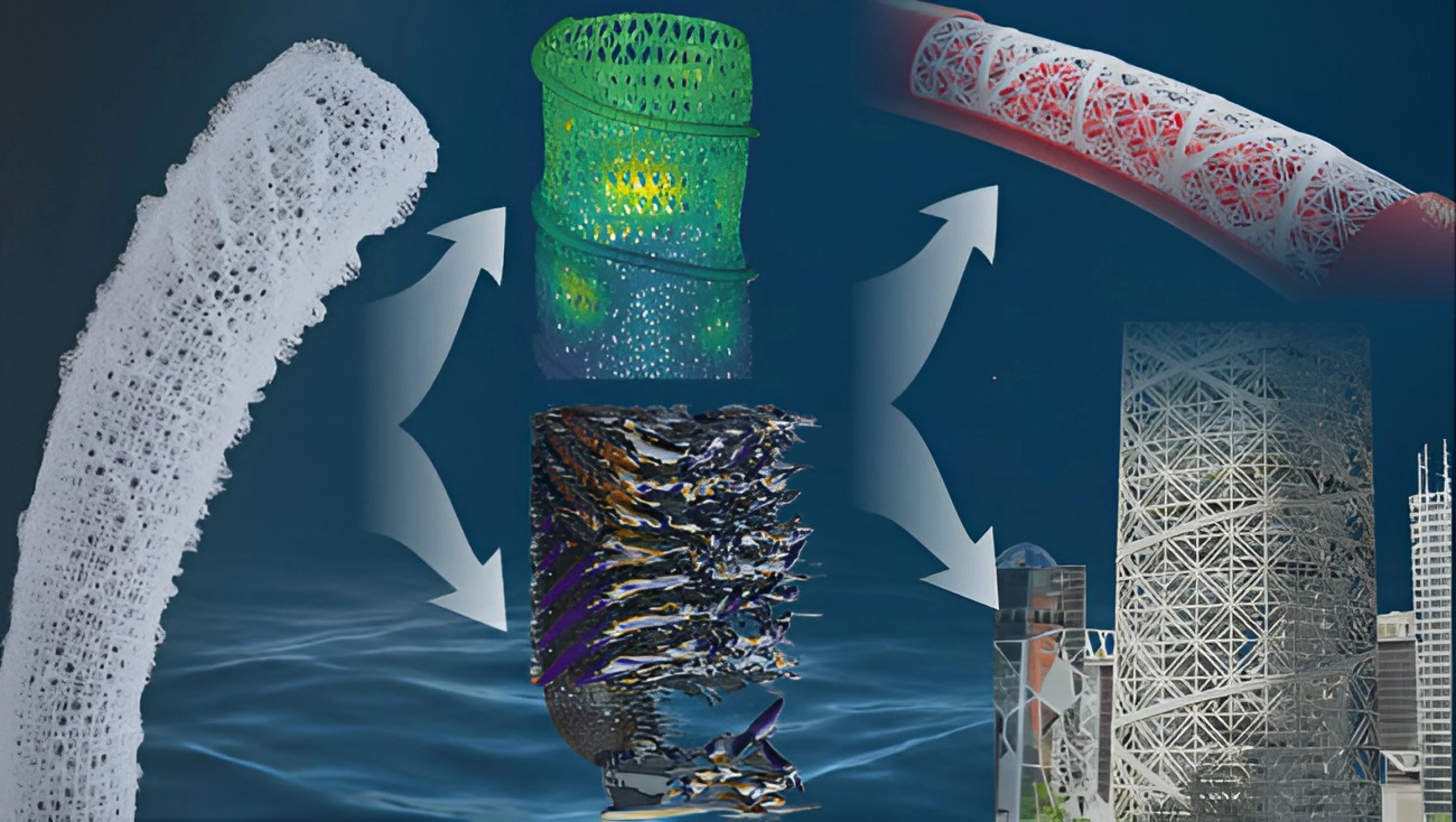
Experiments show that under different material volume fractions, the critical buckling load of the optimized grid is increased by about 140% on average compared with the baseline design, while reducing drag, lift and vortex shedding. For example, Berkeley said that a nearly solid cylindrical structure with an opening ratio of only about 5% and a spiral ridge can also significantly suppress fluid-induced vibrations without sacrificing structural stability. The researchers said that these improvements come from geometry optimization and do not increase the material volume; the relevant values are the comparison results of the experimental structure and the benchmark scheme, and do not mean that all materials or applications can be equally improved.
The team believes that this method has the potential to be used in structures that need to be lightweight, load-resistant and exposed to fluid environments for a long time, including aircraft components, submarine pipeline support structures, and medical stents that help maintain fluid channels in the body. It may also be suitable for engineering facilities affected by wind, such as high-rise buildings. The research is still in the design framework and prototype verification stage, and practical applications require further testing on different materials, scales, loads and manufacturing methods.
Comments