
Abstract:
As mankind's first black hole photo, the supermassive black hole (M87* black hole) at the center of the M87 galaxy, which is about 55 million light-years away from the earth and has a mass 6 billion times more than the sun. The image is known as the "doughnut". It has attracted widespread attention since it was released more than 7 years ago, and academic circles are also controversial about the existence of its unique ring structure.
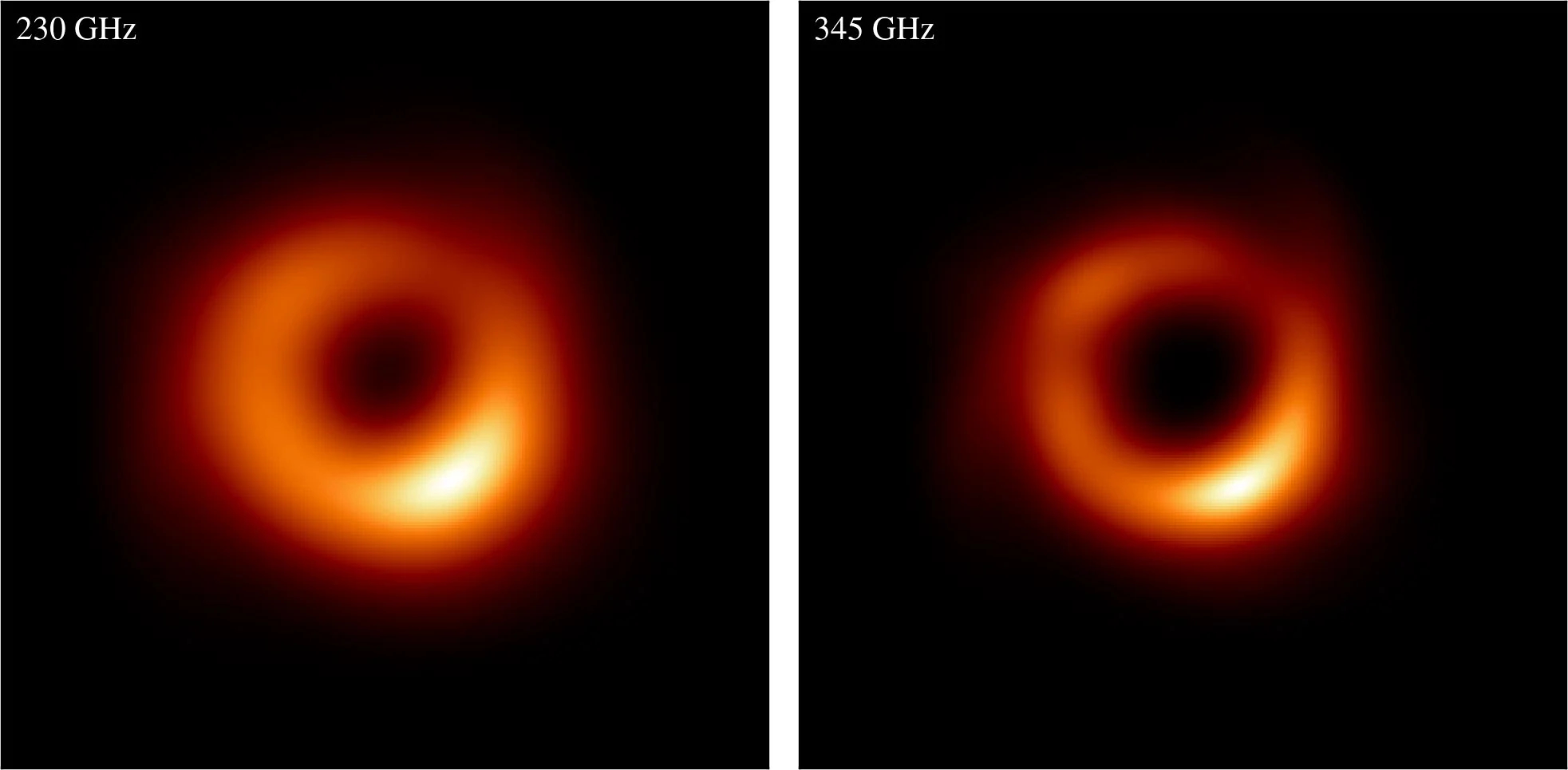
The international academic journal "Nature" published an astronomy paper online in the early morning of November 12, Beijing time, saying that a study independently verified the unique ring structure in the classic reconstructed image of the M87* black hole, confirming that the "donut" image is correct. The latest reconstruction results use a newly developed independent imaging algorithm, and the new image generated is highly coincident with the original image.
According to the paper, the Event Horizon Telescope Collaboration (EHTC) released mankind’s first image of a black hole (M87* black hole) in April 2019. There is a ring-like structure and a clearly visible black hole shadow in the photo. Researchers reconstructed the donut-like image by gathering all data from EHTC telescopes distributed around the world.
However, because these telescopes are geographically far apart, equipment and environmental errors can significantly affect the accuracy of the resulting images. Other researchers analyzed the data using industry-accepted methods, but the resulting reconstructions did not contain ring structures. Later studies pointed out that the original image came from the average of the results of multiple image processing processes, and there was uncertainty in the ring structure of the M87* black hole.
In this study, Samuel Lai, the first author and corresponding author of the paper and Australia's Commonwealth Scientific and Industrial Research Organization, worked with colleagues to input the M87* black hole data set into an imaging algorithm to verify previous image reconstruction results. The algorithm divides the telescopes into three closed stations rather than two-by-two pairs. It then combines measurements from individual telescopes. This allows it to calculate calibration errors and ultimately results in a set of reconstructed images that meet these criteria.
This study reconstructs the M87* image based on synthetic images from the Event Horizon Telescope (EHT) public data set (picture from the author of the paper). Photo courtesy of Springer Nature
The author of the paper stated that the newly generated image from this study reproduced the ring structure in the original image, independently verified the first human black hole image released more than 7 years ago, and the interpretation of the Event Horizon Telescope data and shape is correct.
Comments