
Abstract:
DeepSeek, known for its "small team and high talent density", began to recruit engineering personnel on a large scale. On the evening of September 7, Cui Tianyi, the leader of the DeepSeek Harness team, publicly recruited on social platforms, releasing about 150 places at one time. He said that this is an "unprecedented recruitment demand for 150 HCs" and that the company currently has "many new directions, new systems, and new needs that need to be addressed."
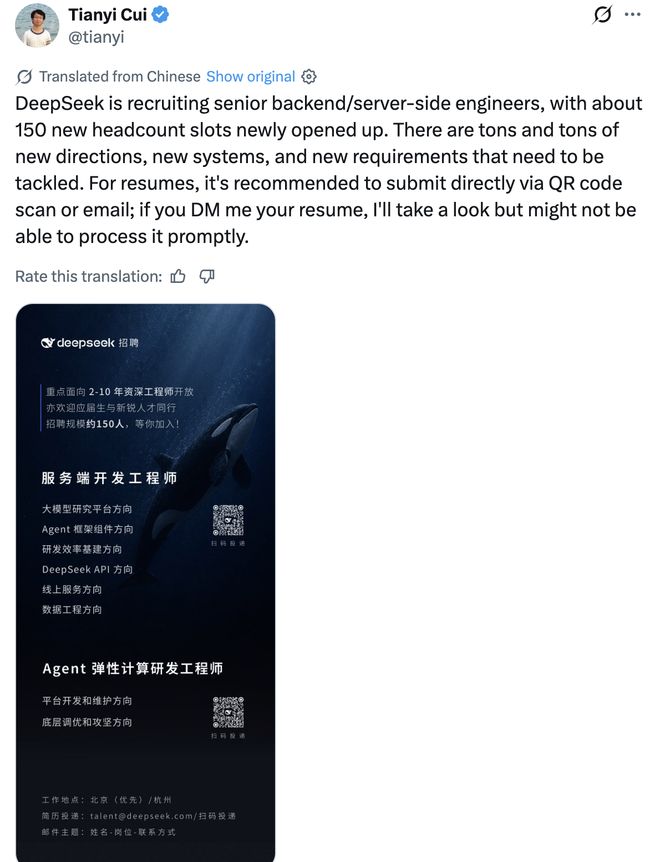
Screenshot of Cui Tianyi's post
Two days later, DeepSeek announced a reduction in the price of the Flash series API, with the cache hit input price dropping by up to 60%. Compared with price changes, this recruitment better reflects the changes faced by DeepSeek as its business scale expands.
150 places are concentrated in engineering positions
This round of recruitment focuses on senior engineers with 2 to 10 years of work experience. It also accepts fresh graduates and candidates who have worked for less than two years. The work location is mainly Beijing, and some positions can be selected in Hangzhou.
Positions are mainly divided into two sequences: server development and agent elastic computing. Server-side development engineers cover six directions: large model research platform, Agent framework components, R&D efficiency infrastructure, DeepSeek API, online services and data engineering; Agent elastic computing R&D engineers are divided into two directions: platform development and maintenance, underlying tuning and attack.
This is DeepSeek’s second large-scale enrollment expansion in more than two months. On June 25, the company proposed to "at least double the size" of all departments, with recruitment covering multiple categories such as full-stack development and algorithms, AI core system research and development, operation and maintenance, products, model data strategy, deep learning research and functional departments.
Compared with the comprehensive recruitment in June, the approximately 150 places this time are mainly allocated to back-end systems, APIs and Agent infrastructure, and there are no model research positions.
To be more precise, this is a special expansion for engineering systems.
Staff experience requirements have also changed. DeepSeek has been known for employing a large number of fresh graduates and young researchers in the past. Liang Wenfeng has previously stated that most of the company's core technical positions are filled by fresh graduates or employees with only one or two years of work experience. This recruitment focuses on senior engineers with 2 to 10 years of experience.
Cui Tianyi explained that the "volume" currently faced by DeepSeek is rapidly increasing, including the amount of data, the number of machines and containers, training and evaluation tasks, Agent environment, users and request volume. As the scale increases, the system complexity will also increase significantly. The original back-end system may not be able to continue to meet the needs, so it needs to be upgraded, maintained or even rewritten.
The recruitment information also disclosed that DeepSeek's Agent elastic computing platform DSec has hosted "thousands of sandbox environments" to promote next-generation model iteration. When agents perform tasks, they usually need to call models and tools multiple times, and continue to occupy computing, storage and operating environments. As tasks increase, resource scheduling, environment isolation, fault recovery, and concurrency stability will become specific engineering issues.
Jiang Han, a senior researcher at Pangu Think Tank, told Caiwen that this recruitment expansion shows that DeepSeek is moving from an entrepreneurial stage focused on model research to a new stage that requires simultaneous processing of user requests, computing power scheduling and complex system construction. New personnel can supplement the back-end infrastructure and Agent platform capabilities, but rapid expansion may also dilute the original small team collaboration efficiency and place higher requirements on organizational management and execution.
The price reduction is a partial correction after the price increase in August
On September 9, DeepSeek announced that it would adjust the price of the Flash series API from 12:00 on September 10.
During the idle period, the cache hit input price per million Tokens dropped from 0.05 yuan to 0.02 yuan, a drop of 60%; the cache miss input price dropped from 1.5 yuan to 1 yuan, a drop of about 33%; the output price dropped from 4.5 yuan to 4 yuan, a drop of about 11%. Weekdays from 9:00 to 12:00 and 14:00 to 18:00 are still peak hours, and the price is twice that of the idle period; the idle period price is applied all day on Saturdays and Sundays.
The "up to 60% price reduction" only applies to cache hit input, and does not mean that the comprehensive call cost for all users will be reduced by 60%. The actual decrease depends on the cache hit rate, input and output token ratio, and call period.
This price adjustment comes less than a month after DeepSeek’s last price increase. Compared with before the price increase in August, after this adjustment, the idle price of Flash cache hit and miss inputs has basically returned to the previous level, but the output price still rose from 2 yuan per million Tokens to 4 yuan.
In Jiang Han's view, DeepSeek's recent price adjustment is not just a price reduction in the general sense, but also takes into account the need to adjust computing power. Maintaining higher prices during peak hours on weekdays and lower prices on weekends and other idle periods can guide some tasks that do not require high timeliness to run at off-peak hours and improve the utilization efficiency of computing resources. When DeepSeek launched peak and valley pricing in August, it also stated that this move was to allocate resources more reasonably.
The day before the price adjustment, DeepSeek also launched the test of the V4.1 Flash intermediate version, which officials said was more capable, faster and lower cost. However, the company did not explain whether the new version was directly related to this price reduction, nor did it disclose that the price adjustment was mainly due to improvements in model efficiency, market competition, or changes in demand.
Engineering capabilities become a new test
This expansion occurred after DeepSeek successively updated V4 Flash, V4 Pro and Harness. With the increase in model development, agent environment, and online requests, the systems that companies need to maintain include not only the model itself, but also research platforms, APIs, data engineering, sandboxes, and elastic computing.
Jiang Han believes that the current changes in DeepSeek that are noteworthy are not just the iteration of a single model capability, but also include the construction of back-end infrastructure and Agent platforms. After the enrollment expansion, whether the engineering capabilities can keep up with the increase in task volume and system complexity, and ultimately translate into stable and cost-effective service capabilities, will be the next stage of the test.
Comments