
Abstract:
DeepSeek's talent expansion continues, but the gun has turned its direction. On September 8, DeepSeek launched a new round of recruitment, planning to recruit about 150 engineers. The positions are all concentrated in two directions: server development engineers and agent elastic computing R&D engineers. The focus is on senior back-end engineers with 2 to 10 years of experience. There are no AI research positions.
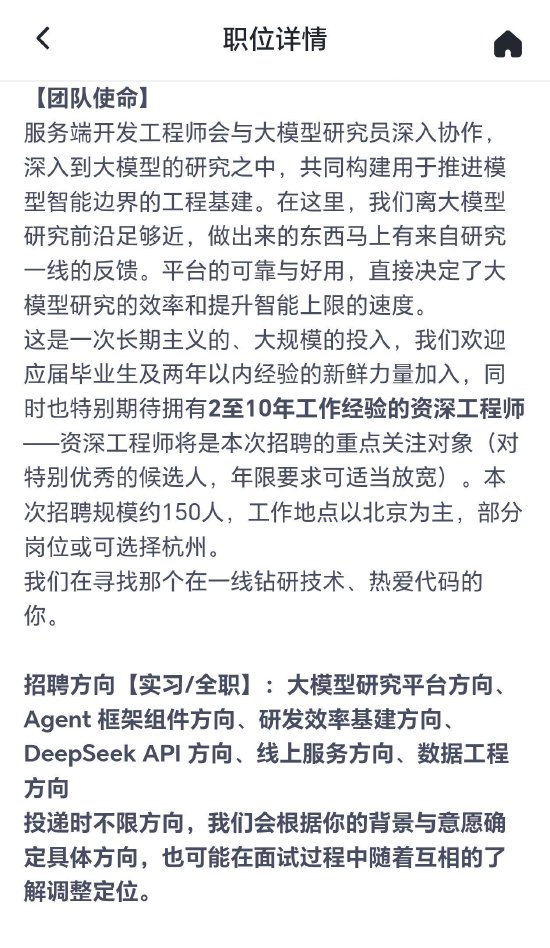
This is DeepSeek’s second large-scale recruitment in more than two months. On June 25, DeepSeek announced on its official public account that "with the evolution of technology, it is working hard to at least double the size of all departments" and opened a total of 33 positions in 7 categories at one time, covering Beijing and Hangzhou.
Different from the last comprehensive recruitment expansion, the 150 positions recruited this time are precisely focused on engineering and infrastructure.
The shift in recruitment demand reflects that this large model company, known as "small but powerful", is shifting its competitive focus from model research itself to the infrastructure arms race in the Agent era.
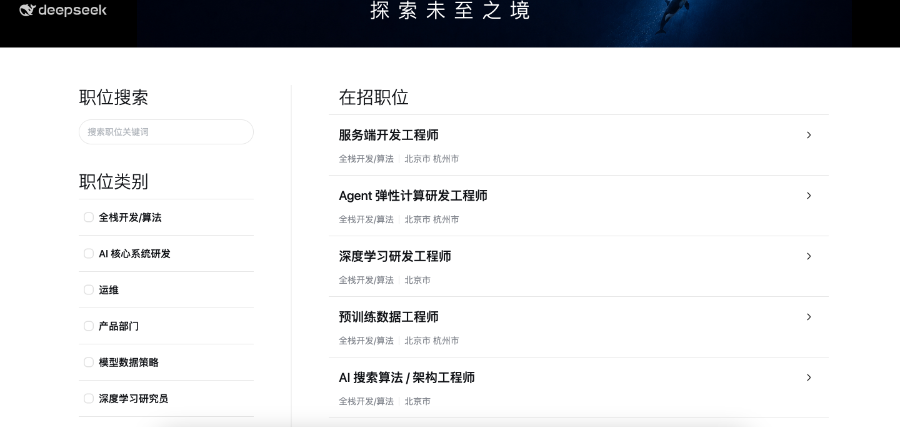
(The picture shows the recruitment information released by DeepSeek's official website)
150 people all bet on engineering positions, and DeepSeek is supplementing the course of "Complexity"
From a job structure perspective, DeepSeek’s recruitment is highly targeted.
Server-side development engineers are divided into six directions: large model research platform, Agent framework components, R&D efficiency infrastructure, DeepSeek API, online services, and data engineering, covering the complete link from model research to user-oriented services. Among them, the online service direction needs to support the design of large-model application architecture with a scale of "tens of millions of daily active users", and the API direction needs to cope with the "very large-scale API service challenge".
Agent elastic computing R&D engineers are divided into two directions: platform development and underlying systems. The recruitment information bluntly stated that the bonus point for the bottom direction is "the ability to squeeze the performance of certain operating system components to SOTA, or simply directly push it to the hardware limit."
Regarding the logic of recruitment expansion, Cui Tianyi, the leader of the DeepSeek Harness team, explained quite straightforwardly:
"Large scale creates complexity, and complexity in turn requires expansion of scale." As early as June 21, Cui Tianyi posted on the social platform that the team "has a heavy workload and is very short of people" and "is interviewing every day and posting small advertisements in various places."
It is worth noting the changes in employment standards. DeepSeek has been known for recruiting young researchers and fresh graduates in the past, but this time it has clearly targeted senior engineers with 2 to 10 years of experience to grab "immediate combat power." The recruitment information also requires candidates to be "proficient in using AI Agent tools for software development" and "when the Agent provides problematic solutions, you can be keenly aware and intervene in a timely manner."
A headhunter who has long observed the AI industry told reporters that
This experience threshold means that DeepSeek's positioning of candidates has changed from "training targets" to "plug-and-play backbones." "In the field of Agent infrastructure, which does not have a mature talent pool, back-end engineers with 2 to 10 years of experience happen to be the scarcest stock in the market."
DSec has moved from a paper to large-scale engineering, and Agent infrastructure has become a battleground for military strategists
The technical coordinate of this recruitment is DeepSeek’s self-developed elastic computing platform DSec (DeepSeek Elastic Compute).
DSec was publicly disclosed for the first time in the previously released DeepSeek-V4 technical report. It consists of three Rust components: API gateway (API Server), host Edge agent and cluster monitor Watcher. The three are interconnected through the self-developed RPC protocol and run on DeepSeek's self-developed 3FS distributed file system.
The recruitment information revealed the next project expansion plan: "In order to increase reliability and efficiency, DSec needs to modify the entire system stack: from the operating system to virtual machines, to networks and storage at all levels, all the way up to application layer scheduling and management and control plane services." DeepSeek also admitted frankly: "Many things in this project have not been done before, and there are no ready-made answers to copy."
Another sentence in this recruitment message is equally intriguing: "Your work directly determines the diversity and efficiency of Agent model training."
From the perspective of the industry, this reveals a complete link of DeepSeek: the model performs tasks in a sandbox environment, the platform records the operation process and results, forms training and evaluation data, and the data feeds back the model iteration. Agent infrastructure is no longer an auxiliary tool, but a production link directly embedded in the evolution of model capabilities.
A senior engineer in the cloud computing industry analyzed to reporters that the first half of the competition for large models is about algorithms and computing power, while the second half is about the ability to put the model into a real task environment. "Behind the implementation of the Agent is a complete set of system engineering such as elastic scheduling, sandbox isolation, and data reflow. This is exactly the home of traditional back-end engineers, and it is also the underlying logic behind DeepSeek's recruitment of all engineering positions."
The competition for talent is fierce, and engineering capabilities may become the winner in the next stage
DeepSeek’s intensive recruitment expansion takes place against the background that the AI talent war continues to heat up.
The New Economy Talent Report released by Maimai shows that from January to April 2026, the number of jobs in the AI field increased by 8.7 times, accounting for 22.03% of the total new economy jobs from approximately 2.78%. The AI penetration rate of newly created jobs in Beijing reaches 30.17%, which is equivalent to 3 of every 10 new jobs being created.
The other side of expansion is churn pressure. According to incomplete statistics, from the second half of 2025 to the first half of 2026, at least five core R&D members of DeepSeek have confirmed their resignation: DeepSeek-R1 core researcher Guo Daya joined Byte Seed, the first generation of large language models Model core researcher Wang Bingxuan joined Tencent Hunyuan, DeepSeek-V2 key developer Luo Fuli joined Xiaomi MiMo, OCR series model core developer Wei Haoran joined Baidu, and multi-modal achievement core contributor Ruan Chong joined Yuanrong Qixing.
In terms of food and grass, DeepSeek is not in short supply. According to public reports, DeepSeek recently completed 51 billion yuan in financing; the list released by Hurun Research Institute in June showed that DeepSeek was listed as a global unicorn for the first time with a valuation of 340 billion yuan, ranking first among the new companies on the list. On the recruitment platform, DeepSeek implements a 14-salary system. The monthly salary range for large model full-stack engineers is 40,000 to 70,000 yuan, and the monthly salary for deep learning R&D engineers can reach 60,000 to 90,000 yuan.
As for the industry implications of this expansion, the above-mentioned headhunters believe that when model capabilities gradually converge, the depth of engineering and infrastructure will become the key variables to widen the gap. "Whoever can make the Agent's operating environment SOTA and open source will be able to define industry standards - DeepSeek has verified this path on models in the past, and now it wants to take it again on infrastructure."
From the comprehensive doubling in June to the precise increase in investment in September, DeepSeek's organizational expansion roadmap has been clear: the research end will remain lean and the engineering end will increase its troops significantly. This competition for 150 senior engineers may be just the beginning of the infrastructure arms race in the Agent era.
Comments