
Abstract:
With the advent of NVIDIA's new generation DLSS 5 neural rendering technology, the PC gaming hardware community once again demonstrated amazing folk technical creativity. A developer recently created a groundbreaking ReShade plug-in Mod, which has successfully brought the long-dormant multi-graphics card parallel (Multi-GPU) operating mode back into the mainstream players' horizons.
This solution completely strips off the DLSS 5 neural post-processing tasks that consume extremely hardware performance and transfers them to a second independent graphics card. It not only greatly relieves the burden on the main rendering graphics card, but also achieves a significant frame rate jump of up to 127% in some test scenarios.
For a long time, NVIDIA's dual-card parallel technologies such as SLI and Crossfire have been gradually abandoned by mainstream game and hardware manufacturers due to difficulty in driver adaptation, cross-core synchronization delays, and micro-stuttering issues. However, although NVIDIA's latest DLSS 5 Neural Rendering (DLSS-NR) technology brings extremely shocking image quality reshaping effects, due to its complex full-frame AI post-processing pipeline, official tests show that when turned on, it often causes traditional raster and ray tracing performance to suffer a cliff-like frame rate drop of 50% or more. The high computing power penalty means that even when players turn on super-resolution, most of the performance bonus will be completely swallowed up by the heavy AI filtering calculations.
To break this performance impasse, developer Marcelo Gibut took advantage of the unique pipeline features of DLSS 5 to build a self-developed add-on called "MGPU Bridge." Unlike traditional SLI, which requires two graphics cards to be highly coordinated and alternately rendered, DLSS 5 neural rendering occurs at the end of the entire graphics pipeline. Its essence is to receive a complete picture that has been rendered, and then spit out the final picture after reconstruction by the AI model. With the help of this mechanism, this Mod allows the main graphics card to concentrate on rendering the 3D native scene of the game, and then transfers the rendered frame data to the secondary graphics card in real time through the PCIe bus; the secondary card creates an independent Direct3D 12 device to take over the frame and performs DLSS-NR neural network calculations independently, and finally outputs the image directly to the monitor from the secondary card's own display interface.
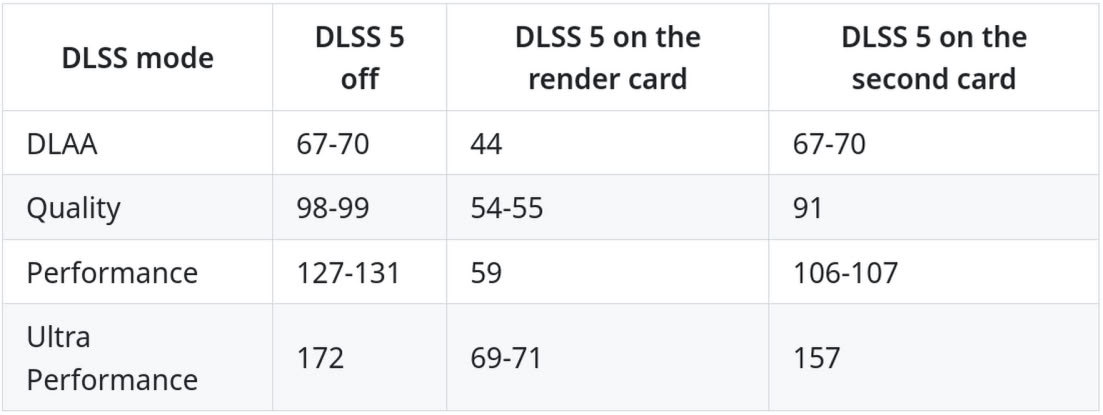
On a test platform consisting of an AMD Ryzen 7 7800X3D processor paired with two Nvidia RTX 5060 Ti 16GB graphics cards, this dual-card division of labor architecture demonstrated amazing performance release. Since the main card is completely exempted from the high load of neural rendering, the temperature and power consumption are significantly reduced. In "Cyberpunk 2077" and a number of complex technology demonstrations, the game frame rate with neural rendering turned on increased by up to 127% compared to single-card operation, almost minimizing the performance loss caused by neural rendering. Since the image is directly output from the secondary card to the screen, the transmission overhead and additional loss caused by the secondary transmission of data back to the PCIe bus are avoided.
However, this technology is not free at present. The analysis pointed out that since the frame data must be transferred across the PCIe bus between the two graphics cards and complete asynchronous calculations, the overall end-to-end display delay of the screen will increase to a certain extent. Its interactive feel performance is similar to that of frame generation technology, and is more suitable for slow-paced actions or heavily immersive image quality-oriented stand-alone masterpieces. Nonetheless, this working mode is widely praised by senior hardware enthusiasts in the industry as the modern version of the "independent PhysX physical card mode." It not only points out a new direction for enthusiasts who have idle or upgrade old graphics cards to make the best use of them, but also shows graphics card manufacturers the unlimited potential of using heterogeneous multi-core collaboration to deal with future ultra-heavy end-side AI graphics rendering.
Comments