
Abstract:
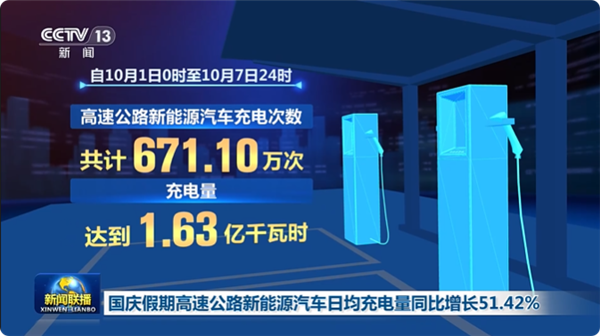
The National Energy Administration released National Day high-speed charging statistics. From October 1 to October 7, the high-speed charging guns included in the monitoring platform completed a total of 6.711 million charges.
The total charging capacity is 163 million kWh, and the average daily charging capacity is 23.2566 million kWh, a year-on-year increase of 51.42%.
This statistics covers 62,700 high-speed charging facilities. The holiday travel peak directly pushes the charging demand to a new height.
Among them, the charging volume on October 1 hit a record high in a single day during the holiday, with a single-day charging volume of 28.0469 million kilowatt-hours, an increase of 60.4% compared to the first day of the National Day last year.
It can be seen that more car owners choose to drive long-distance driving in new energy vehicles every year, and the proportion of green travel continues to rise.
Although the overall number of charging facilities has been increasing, the tidal surge of demand during holidays will still cause charging queues in some service areas.
Charging piles are sufficient most of the time, but during the daytime hours when leaving the city and returning, there will be a large number of vehicles waiting to recharge in popular high-speed service areas.
Interestingly, against the backdrop of a sharp increase in high-speed traffic of new energy vehicles, the number of particularly busy service areas dropped by 17% year-on-year.
On the one hand, many high-power fast charging piles have been added this year. From January to August this year, 11,000 high-power charging facilities were added. On the other hand, service areas in various regions have also used methods such as scheduling and number-taking and current limiting to minimize long queues.
Congestion is not a common phenomenon across the country. It is mainly concentrated on a few popular lines and a few time periods. During non-peak hours, there is basically no queue for charging in most service areas.
The high-speed charging network is still continuing to expand, and charging guns will continue to be added in the future to fill the energy supply shortcomings of some road sections. However, it is difficult to completely resolve the short-term surge in traffic flow during holidays simply by relying on unlimited piles of charging piles.
For tram owners, before going on a long journey, it is best to plan a recharge point in advance and not wait until the battery reaches the bottom before looking for a service area. Charging at off-peak hours, or driving out of the highway to recharge in surrounding cities, is the most practical way to avoid queues.
Comments