
Abstract:
Former Intel CEO Pat Gelsinger recently stated that the semiconductor industry cannot rely solely on incremental chip improvements to meet the computing power needs of artificial intelligence. He believes that AI computing efficiency needs to achieve a leap-forward improvement of about 10,000 times, and Moore's Law has not come to an end, but needs to be "awakened" through more fundamental technological breakthroughs.
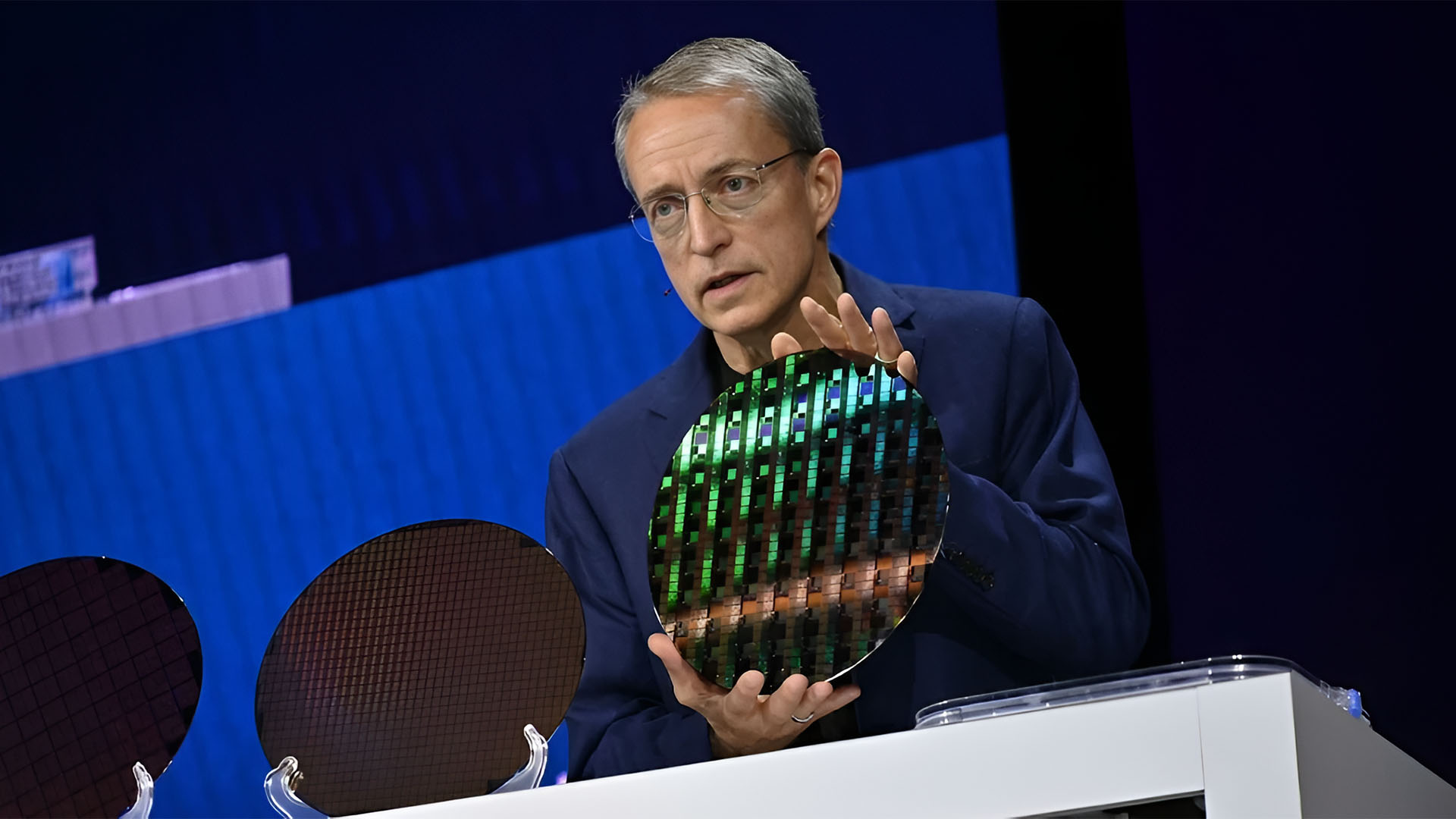
Kissinger made the above statement at the COSM Technology Summit 2026 held in Scottsdale, Arizona, USA. He spoke with technology theorist George Gilder and Heritage Foundation director Brett Swanson in a fireside chat titled "Reality Check: Beyond the Chip." Kissinger wrote on social platform X after the meeting: "Is Moore's Law dead? I think it's time to wake it up."
Kissinger believes that the continued shrinkage of semiconductor manufacturing processes is approaching physical limits and is not valid. He pointed out that the industry is entering a new stage of multidisciplinary innovation. The real breakthrough will not only come from the reduction of transistor size, but must simultaneously advance multiple engineering fields such as light, power, heat dissipation, material composition and packaging.
In Kissinger’s view, one of the biggest constraints facing current AI infrastructure is power supply. He said that in the past decade, U.S. energy production capacity has only achieved low-single-digit growth, which has caused serious bottlenecks in the construction and operation of ultra-large-scale data centers. New gas turbines face a waiting period of up to eight years for supply, while the construction cycle for nuclear power projects often takes about ten years.
Taking Nvidia's Kyber rack using Blackwell NVL72 architecture as an example, he said that the power consumption of this type of AI server system has reached about 600 kilowatts. This amount is enough to supply about 500 households. Meanwhile, a study by Harvard University shows that U.S. data center power consumption may already be equivalent to the electricity consumption of Chile as a whole, although all critical data was not available.
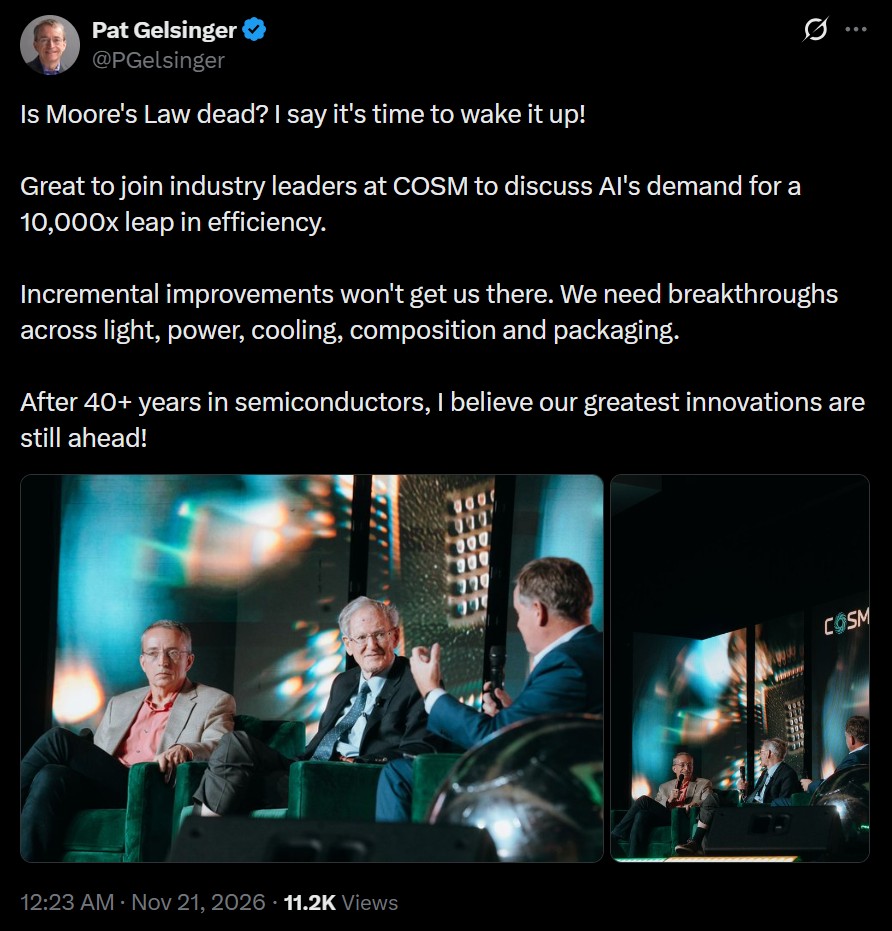
Kissinger pointed out that with major AI basic models released approximately every four weeks, the industry must significantly increase the AI computing power output that can be generated per unit of electricity. He pointed out that if you want to convert 1 gigawatt of electricity into an AI token output equivalent to 10 gigawatts of electricity, scaling down traditional transistors alone is far from enough. He said: "We need breakthroughs in light, electricity, heat dissipation, material composition and packaging."
Since joining venture capital firm Playground Global as a general partner in March 2025, Gelsinger has continued to invest in start-ups targeting the above-mentioned hardware bottlenecks. These include xLight, an advanced lithography company backed by the U.S. government, which hopes to break through the limitations of ASML’s current 13.5-nanometer extreme ultraviolet wavelength; in addition, he has invested in Alva Energy, a nuclear power capability company.
Gelsinger's technology roadmap also points to optical interconnects and silicon photonics. He believes that future data transmission should rely more on light rather than copper wires to reduce energy consumption and increase bandwidth. This direction is seen as an important way to solve the data transmission bottleneck within and between AI data centers.
Although some industry observers believe that Moore's Law in the traditional sense has ended, Gelsinger insists that semiconductor engineering is ushering in a new era driven by cross-field innovation. "After more than 40 years in the semiconductor industry, I believe our greatest innovations are still ahead of us," he said.
Kissinger has also previously expressed his views on the storage bottleneck of AI hardware. He believes that although high-bandwidth memory HBM has problems such as insufficient bit density, high heat dissipation pressure and limited bandwidth, and even calls it "ugly memory", it is still the best solution available in the current industry. He also supports a new storage technology called Z2RAM, believing that it promises to bring better performance in terms of density, performance and power consumption.
Kissinger's remarks reflect that competition in the AI industry is no longer just about chip processes and GPU performance, but has expanded to broader system-level competition in power supply, cooling systems, optical communications, packaging technology and new storage materials. For data center operators and chip manufacturers, how to control energy consumption while expanding computing power is becoming a key issue that determines whether AI infrastructure can continue to expand.
Comments