
Abstract:
According to Reuters, on Thursday local time, the U.S. AI sector suffered a massive sell-off, and the Goldman Sachs trading desk received a large number of calls from investors. John Flood, partner and managing director of Goldman Sachs' global banking and markets business, said clients have been asking about market conditions, but actual buying orders have not appeared.
Affected by this, the Nasdaq 100 Index fell 6.4%, and its market value evaporated by approximately US$2.5 trillion; the Nasdaq Composite Index fell 5.5%, the largest single-day decline since April 2025. Since setting a closing record on October 6, the Nasdaq Composite Index has fallen nearly 12% and entered a technical adjustment range.
Judging from sector performance, the selling was first concentrated in semiconductor and AI infrastructure companies, and then spread to cloud computing, power and equipment suppliers. The Philadelphia Semiconductor Index fell by about 12%, Nvidia fell by 9%, and AMD fell by 17%; AI cloud computing company CoreWeave fell by 10%, and Nebius fell by 15%; data center operators such as Applied Digital, Cipher Digital and IREN all fell by more than 14%. Large technology companies such as Amazon, Alphabet and Microsoft also ended collectively lower.
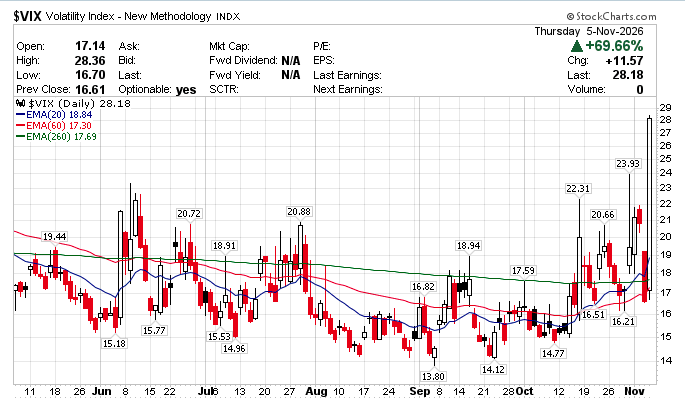
Market sentiment quickly turned to risk aversion. The Chicago Board Options Exchange Volatility Index (VIX) rose to 28.36 points during the session, an eight-month high, and closed at 28.18 points, up 69.66% from the previous trading day. Data from options analysis agency Mercury Alerts shows that the put option premium on index products once rose to about twice the usual level, indicating that investors are concentrating on buying protective instruments.
The direct trigger of this round of decline is investors’ concerns about the prospects of the construction of AI data centers in the United States. After the U.S. midterm elections, the market expects that data center projects may face more stringent policy review. The strain that data centers put on power grids, water systems and local infrastructure has sparked opposition in some U.S. communities in recent years.
UBS analysts estimate that about 30% of the new data center capacity originally planned in the United States in 2028 may be affected by potential construction pause measures. Once data center construction slows down, it will not only affect computing power operators, but may also affect chip, power, server and related equipment suppliers.
However, policy changes are not the only reason for the decline. In the past few weeks, the market has begun to re-examine the valuation, financing costs and investment returns of AI companies. As interest rates rise and financing conditions tighten, investors are becoming more cautious about companies that rely on large-scale borrowing to build computing infrastructure. The market's focus is shifting from whether there is long-term demand for AI computing power to how much money companies need to invest, whether the construction speed can be sustained, and when huge capital expenditures will generate returns.
Among them, the CoreWeave five-year credit default swap spread widened to 1,267.9 basis points, a record high. This indicator is usually used to measure corporate debt default risks, and its rapid rise indicates that the market is more concerned about the financing capabilities of high-investment, high-debt AI infrastructure companies. Intel's five-year credit default swap spread also rose to 149.7 basis points, also a record.
In addition to fundamental concerns, the rapid reversal of capital positions also amplified the market decline. Flood said some institutions had significantly reduced their risk exposure before the midterm elections, but re-entered the market due to Wednesday's market rebound. On Thursday, hedge funds quickly sold some of the stocks of large cloud computing companies they had just bought back the previous trading day, and AI trading turned from chasing gains to retreating in a short period of time.
ETF and quantitative strategies that adjust positions following market fluctuations further increase selling pressure. Nomura Securities predicts that leveraged ETFs, inverse ETFs and some systematic strategies may sell about US$47 billion in stocks near the close of the day, which is the second highest level since statistics began in 2006. Most of the selling comes from technology and AI theme funds.
Retail investors have also changed their previous trading habits of "buying on dips". Vanda Research data shows that as of about an hour before the close, retail investors may have recorded the largest single-day net selling of individual stocks since the market plunge caused by the new crown epidemic. Unlike previous market declines when retail investors actively hunted for the bottom, the ability of individual stocks to undertake this round of selling has been significantly weakened.
The decline shows that Wall Street’s discussion of the AI industry is changing. Investors no longer only focus on whether AI demand can continue to grow, but have also begun to recalculate the policy restrictions, financing costs and investment returns faced by data center expansion.
Comments