
Abstract:
Home appliances are delivered to your home and a master comes to install them, which is a worry-free thing. However, many consumers have discovered that the “free installation” promised by the manufacturer is installed at the end, but they are the ones paying the bill.
Recently, the Shandong Provincial Consumers Association released a guide to avoiding consumer pitfalls, revealing that although many home appliance companies promise to provide consumers with "free services", there are many pitfalls behind the scenes. They appear to be free, but in fact they charge a fee.
For example, the installation fee is free of labor but not the material fee; the big word "free" is used to supplement the vague charging rules in small words; the installation master charges additional door-to-door fees, survey fees, etc.
Behind this, the home appliance industry is facing fierce competition in the first-tier market, and has gradually expanded the focus of competition from price war to service war, trying to gain more customer acquisition chips through a series of value-added services such as free installation and ten-year warranty.
But the problem is, when "free services" are only used as marketing gimmicks, who should pay for the so-called "free"? Perhaps home appliance manufacturers and consumers have to recalculate their calculations.
Free services are “not free”
This guide from the Shandong Provincial Consumers Association clearly dismantles the word game of "free installation".
The first trick is that free installation does not mean that everything is free.
Although some merchants advertise "free installation", in fact they only waive labor fees. There are additional charges for auxiliary materials, accessories, special operations, etc. used in the installation process. These scattered fees can sometimes account for 30 to 40% of the price of home appliances.
On social platforms, many consumers said that when purchasing home appliances, manufacturers clearly provide free installation services, but when the installers arrive at their homes, they often ask consumers to pay for various reasons, such as purchasing installation accessories, such as angle valves needed to install gas water heaters, which generally range from tens of yuan; and drilling holes is more expensive, with one hole costing tens or even hundreds of yuan.
A consumer shared his own case. He said that after installing the air conditioner, he was asked to charge 1,000 yuan by the master. This fee is almost worth the cost of an air conditioner.
Subsequently, the consumer called the brand official to request an invoice. At this time, the installer called the consumer to explain that in order to better protect the copper pipe, he wrapped the copper pipe with aluminum foil without the consumer's consent. The decorator said that the fee can be refunded or invoiced, but not from the brand, but from other service providers.
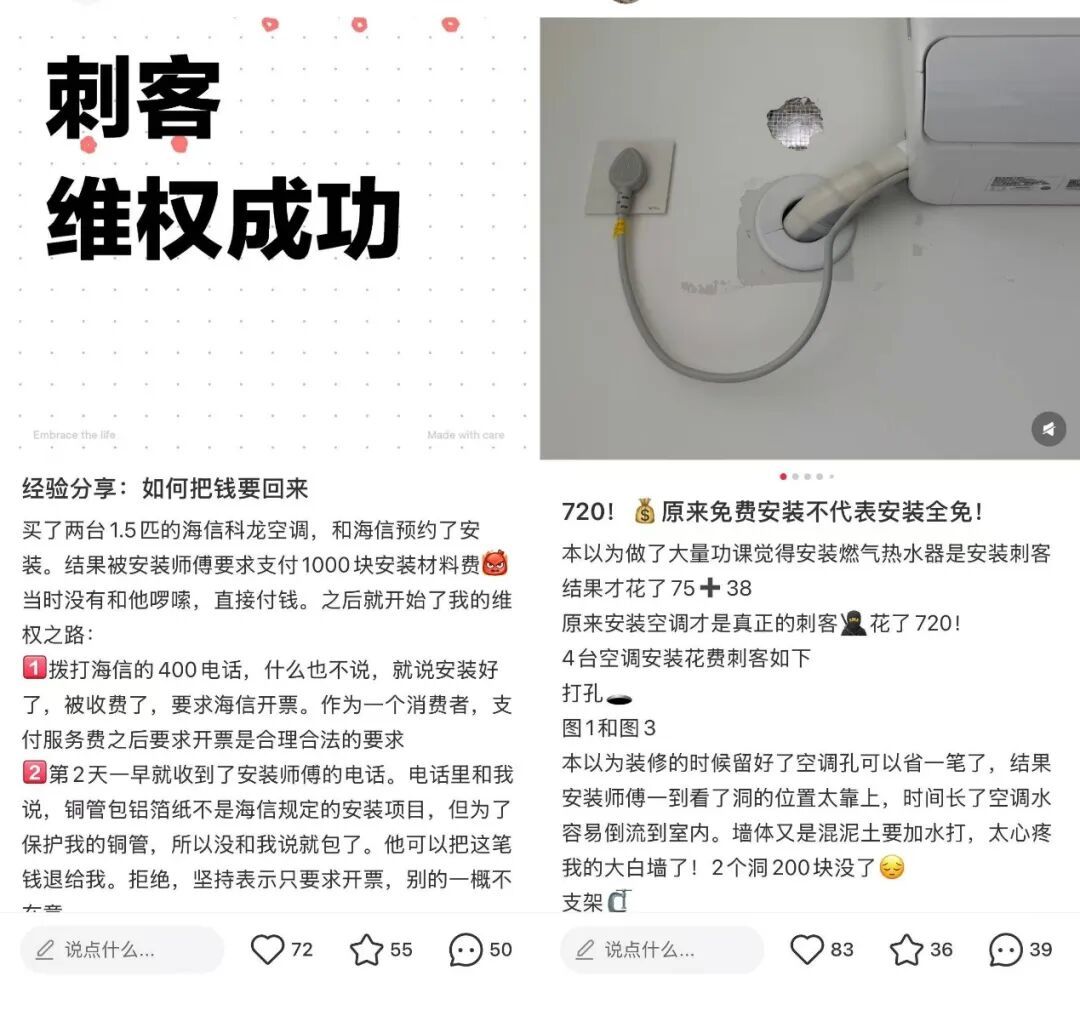
It can be seen that the additional service fees charged by the installation master are not necessarily brand authorization. It is more that the master will privately increase the charging items in order to make more money, or sell accessories to consumers that are much higher than the market price.
The gap between brand slogans and actual experience is the root cause of consumers’ feeling of being “riddled”.
The second method is to play word games.
Ms. Jia had a similar experience. She said she placed an order after seeing an online air-conditioning store that said "transparent charging", but she was still overcharged several hundred yuan for high-altitude work fees. She asked customer service and was told that there were small words at the bottom of the promotion page that said "Charging standards are subject to negotiation based on local and installation environment conditions", but it was easily ignored when placing an order.
The third trick is that the home environment of some consumers is not suitable for installing the home appliances they purchased, but the installation master will still charge "dry running fees" and "survey fees".
Looking through social platforms such as Xiaohongshu and Weibo, similar complaints are not uncommon, especially in categories such as water heaters, air conditioners, and range hoods that need to be reinstalled. "Second charging" has even become the default rule.
According to statistics from the China Consumers Association, a total of about 250,000 complaints about household electronic appliances were received across the country in 2025. Among them, more than 40% were complaints about after-sales service, with the most concentrated problems such as disputes over maintenance fees, opaque installation fees, and difficulties in returns and exchanges.
Some people in the industry pointed out that the reason why "secondary charging" after-sales of home appliances has become a common practice lies in the service outsourcing policy.
Take the air conditioning industry as an example. Most air conditioning brands do not have their own installation teams. Even if leading brands such as Midea and Gree have relatively mature service networks, they may not be able to cope with the explosive installation demand during the summer peak season.
At this time, most brand manufacturers will outsource their services to third-party service providers. The installation masters will take orders on the platform, and the platform will take a commission ranging from 30% to 60%.
Under this model, third-party service providers will inevitably lower their quotations in order to grab orders, and the money received by the installation master will be divided up layer by layer. If they think the quotation is unreasonable, they can only hope to "make up" it from consumers.
Over time, the installation costs that the home appliance companies originally promised to pay were transferred to consumers.
Put the charging standards on the table
The change from free to paid is actually a "sequelae" left by years of fierce competition in the home appliance industry.
In recent years, the price war in the home appliance industry has become increasingly fierce. Companies have focused on price, publicity and other customer acquisition aspects, while repeatedly emphasizing gimmicks such as "free installation" and "0 yuan service". As a result, consumers only know "free" but do not know where the free is.
To change this situation, companies themselves must take action first. At present, most mainstream home appliance companies have begun to take action - turning the vague and uncertain charging items in the past into clear service commitments.
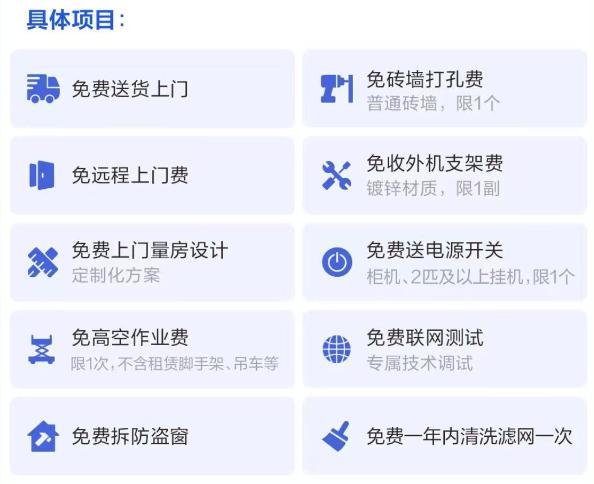
In August this year, Haier's official mall launched the "10-free installation" program. If you clearly purchase a designated model and complete the installation before the specified time, you can enjoy a full set of free benefits. Drilling fees, high-altitude work fees, etc. are all included in the free benefits.
Midea launched a "one-price all-inclusive" model in March this year. When consumers purchase designated series of air conditioners during the event, they only need to pay one price, which covers a series of benefits such as high-altitude operation fees for 4 floors and above, and remote fees for more than 20 kilometers.
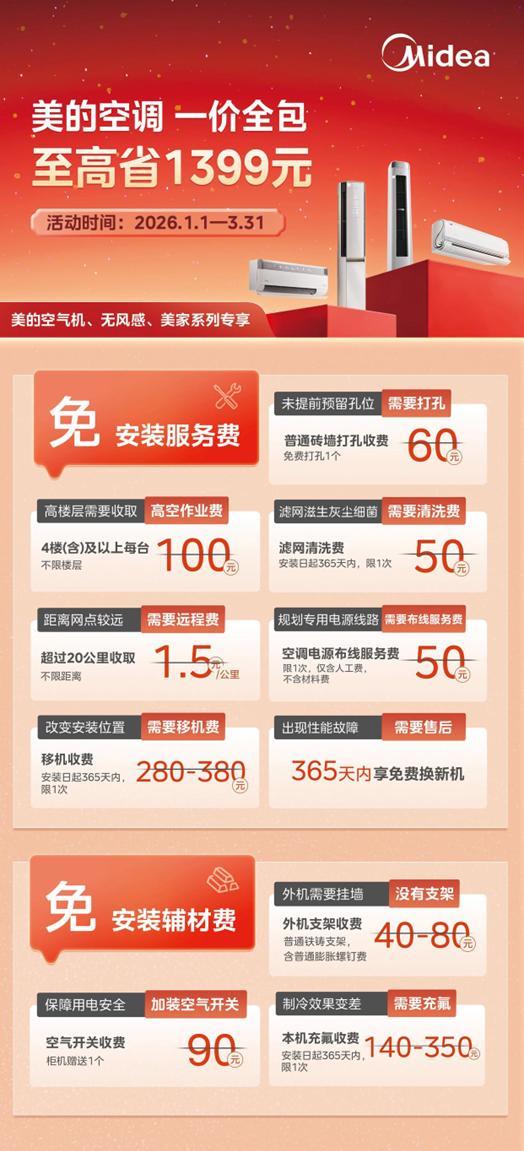
It is worth mentioning that when Haier and Midea released the above two activities, they clearly mentioned that the relevant "free services" were only for designated models and had a clear consumption period.
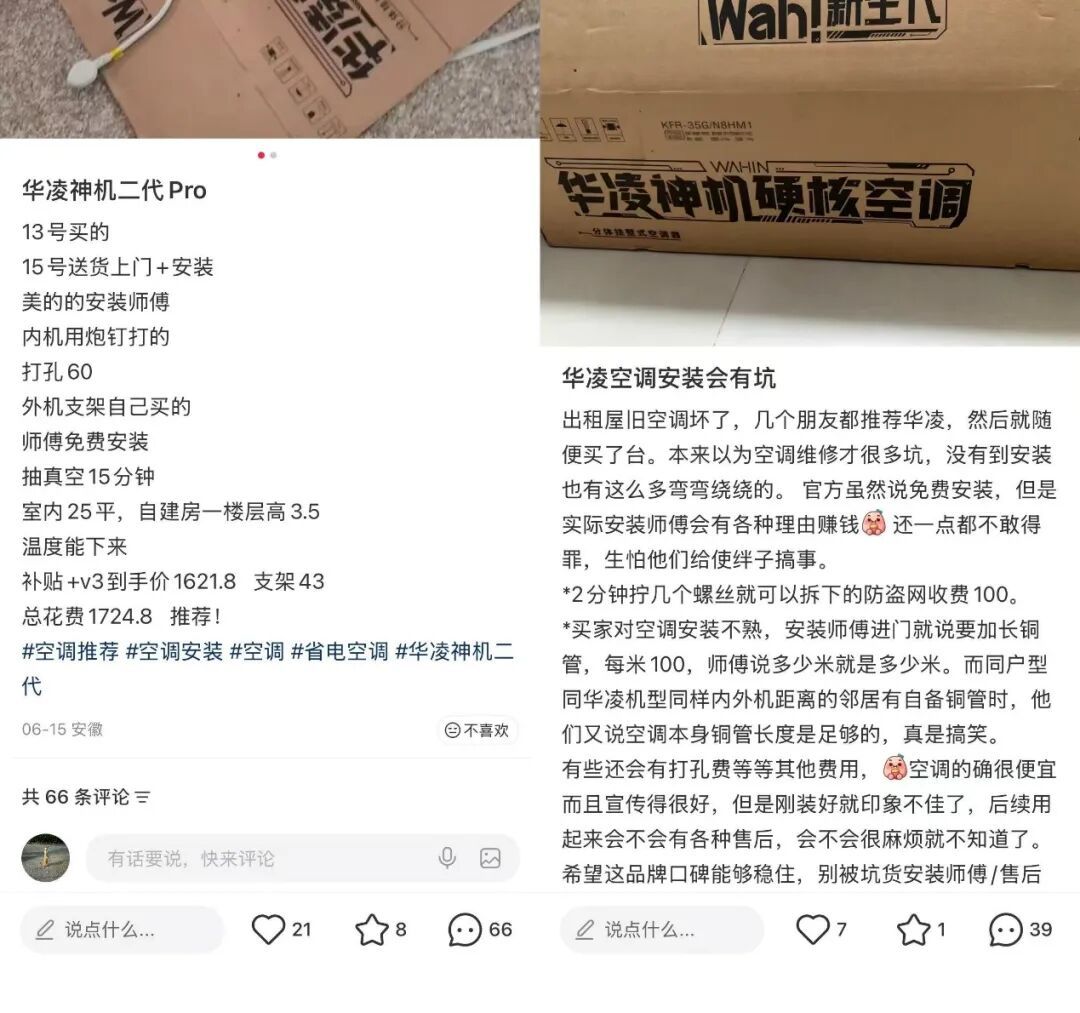
Take Midea as an example. It has not extended the "one-price all-inclusive" service of its parent brand to its sub-brand Hualing. On social platforms, some users said that although Hualing promoted "free installation", in fact, there were still charges for drilling holes and purchasing pipes.
Gree has also launched a completely free installation service in phases, covering ten free items such as installation fees, high-altitude work fees, and wall drilling fees. But in recent years, Gree has begun to focus its publicity on maintenance, and this year launched a "ten-year free repair guarantee" service.

At the same time, a group of home appliance companies also began to put "free" in the field of after-sales service.
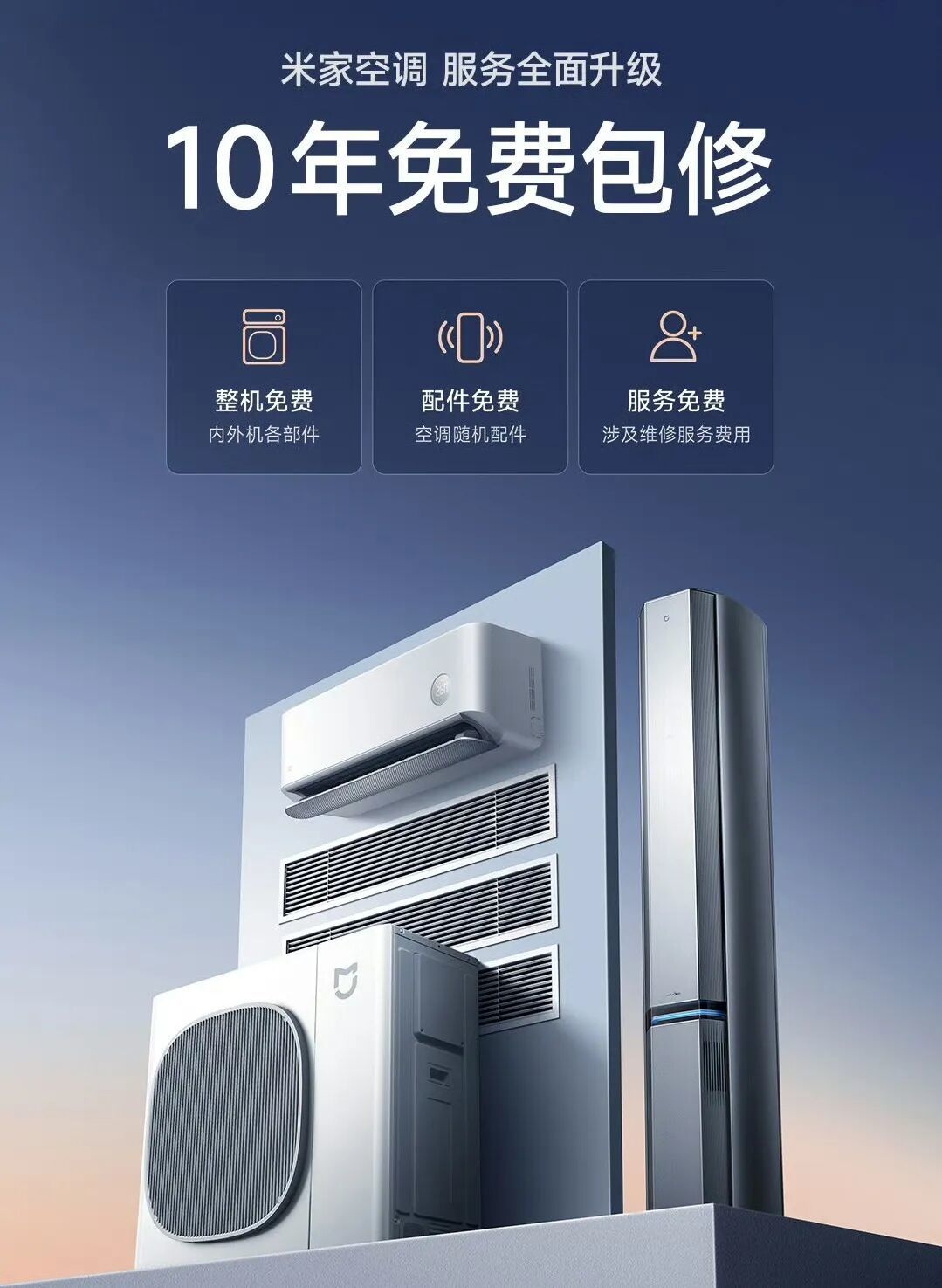
Last year, Xiaomi air conditioners proposed a 10-year free warranty service. Among them, if refrigerant leaks due to product or Xiaomi official installation problems during the warranty period, all Mijia air conditioners support 10 years of free fluoridation;
Hisense Refrigerator launched a "12-year worry-free service" for the brilliant series of refrigerators last year, in which compressors and vacuum pumps can enjoy free 12-year warranty services, which is much higher than the 1-3 year warranty in the refrigerator industry.
The shift from "volume in the present" to "volume in the future" reflects the transformation of the home appliance industry. It no longer just exchanges short-term service commitments for sales, but also attempts to lock in users with long-term service relationships.
After all, if a company dares to promise long-term service, it is a sign of its confidence in product quality. It will also continue to force companies to put efforts into improving product reliability and consistency from the source before leaving the factory, rather than passing on costs to the after-sales link.
It is not difficult to see that although everyone's paths are different, they all point in the same direction: draw the boundaries of charges in advance so that consumers know how much they will spend before placing an order, instead of passively accepting a bill after visiting the door.
Enterprises recalculate "service accounts"
In the final analysis, consumers are not opposed to paying for services, but they want to have choices: charging is okay, but the fees must be clear.
Looking back further, it is not uncommon to charge for the installation of home appliances. In the 1990s, door-to-door fees and high-altitude fees incurred when installing air conditioners were generally borne by consumers. In particular, high-altitude operations are special operations, and the charges are somewhat reasonable.
However, in recent years, against the background of a stalemate in the price war of home appliances, it has become increasingly difficult for companies to "cut prices" on products, and they can only focus on after-sales services - by increasing services without increasing prices, expanding free service projects, and transferring profits to consumers in disguise.
But the service cost will not disappear out of thin air, but will only be transferred from one link to another. This also raises a new question: Can home appliance companies really solve the problem of "secondary charges" if they explain their bills clearly?
In fact, the core of solving this problem lies not in what kind of free services companies launch, but in how they are implemented.
From the perspective of the entire after-sales service chain, the unit price for home appliance after-sales customers is low, service providers are highly mobile, and supervision is difficult. Proper management of each link requires the coordinated efforts of multiple parties.
First of all, we must solve the problem of benefit distribution for after-sales service personnel.
In recent years, after-sales labor and parts costs for home appliances have become higher and higher, but the installation and settlement fees have not increased but decreased. The installation master's efforts and returns have been inverted for a long time, and arbitrary terminal charges have naturally been banned.
Therefore, the "volume service" of home appliance companies should not only focus on the scope of services, but also on who can take the lead in sorting out these intertwined interest relationships, who will be more likely to maximize their own service income and service quality.
Currently, some home appliance companies are already taking action: Midea and Baidu will cooperate to launch the "Safety Maintenance Plan" in 2025, launching digital means such as full maintenance process video and accessory scanning code traceability; Gree will comprehensively and iteratively upgrade the national after-sales service supervision and service system in 2026, ensuring the quality of after-sales service through annual review of service provider qualifications, full-process service traceability control and other means.
Secondly, more unified standards and implementation details should be formulated from the regulatory level.
In 2023, the China Home Appliance Service and Maintenance Association will establish a Home Appliance Repair Service Industry Standardization Technical Committee to further improve home appliance after-sales service standards; third-party service platforms such as Woodpecker and Luban Daojia are also promoting the establishment of a transparent service system.
However, if you look beyond the Chinese market, you may have more ideas for answering questions. For example, in European and American countries, separate charges are generally required for the distribution, installation, and maintenance of home appliance hardware.
Replacing "free" with "charged" and returning the service to its essence is actually another kind of sobriety.
After all, services always have costs. Instead of using "free" to induce orders and then using hidden charges to make up for it, it is better to put every charge on the table and return the choice to consumers.
"Free" can bring temporary orders, but the overdraft bill of trust is long-term. Those companies that only shout slogans but are unable to fulfill their promises will inevitably be criticized by the word "free" in the end.
Comments