
Abstract:
In the summer of 2010, if your computer reported an error or blue screen, there was a high probability that you would open Baidu search and solve the problem with the help of enthusiastic netizens known to Baidu
.
But what now? Shichao briefly tried it and searched for "Tesla Model 3 size". Baidu no longer knew the results on the first page. At the top, that has to be AI.
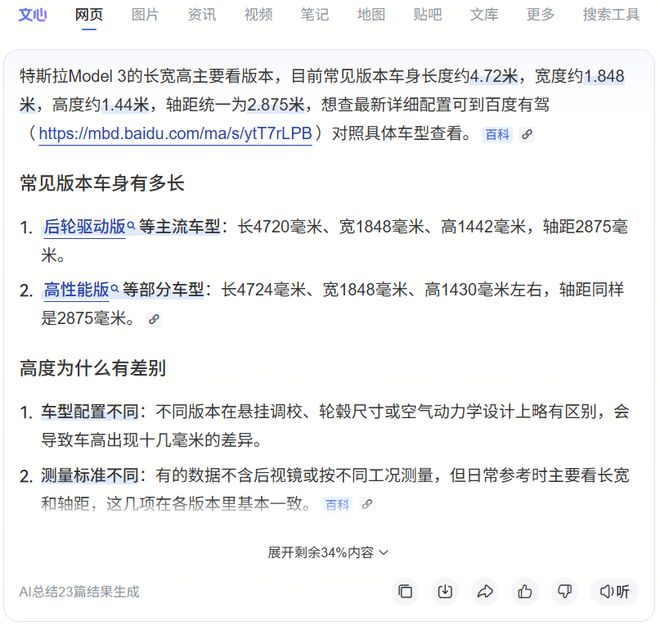
Scroll down further, followed by the official website, Baidu Youjia, Baidu Encyclopedia and various Baijia accounts.

Can you access Baidu Zhi
The frequency of channels is getting lower and lower.
Shichao tried several questions, but Baidu knew that none of them appeared. The strongest one, "How often Word saves files", appeared in the sixth place, but there was only one position.
Some people even posted questions on the Internet. Baidu, which was once very powerful, knew why so few people play it now?
If someone replies, you see, you don’t even go to Baidu to ask. . .
As early as 2016, about 3.5 million questions were generated on Baidu Zhidao every day, and nearly 9,000 people were getting answers every second. It was an undisputed national-level entrance.
Search results page for that year

But now, it seems to be gradually fading out of your and my lives.
From the beginning, the proud man with great ambitions to the unknown now,
Baidu knows that it has fallen from the peak, but how does it move towards mediocrity step by step? Do you know if there are still people who miss Baidu?
Current search results page

First, let’s go back in time.
Don't look at the information on the Internet now. There is so much information that you can't even finish it. In 2003, the Chinese Internet, which was emerging, was far less lively than it is today.
People's thirst for knowledge once exceeded the amount of information existing on the Internet.
This puts search engines into an embarrassing situation. No matter how powerful the search technology is, they can only search for information that already exists on the Internet. What if there is no such content on the Internet at all?
Baidu, which is good at catching up with early market events, soon realized it.
Although there is no ready-made content on the Internet, there is always someone in the world who knows the answer, right? As long as you build a community and bring together people who have the same doubts and knowledge, and let them chat with each other and answer spontaneously, won't there be a steady stream of online content?
As a result, the fairy combinations of Baidu Tieba, Baidu Zhiba, and Baidu Encyclopedia came out one after another.
Baidu calls this combination the communityization of search engines.
At that time, Robin Li and Jack Ma, who had won Yahoo China, were still meeting each other on this track.

The logic that Baidu knows is to turn questions into web pages. Users can ask questions according to their own needs and mobilize other users to create answers through mechanisms such as reward/points.
In the early days, Baidu relied on points and virtual honors.
You can earn points by answering, being accepted, receiving praise, being recommended, etc., and you can win various honors and climb the rankings.
In the mid-term, a points mall was also launched, and points began to be linked to real-world prizes. In 2018, Baidu also introduced a professional team to provide cash incentives and search traffic exposure.
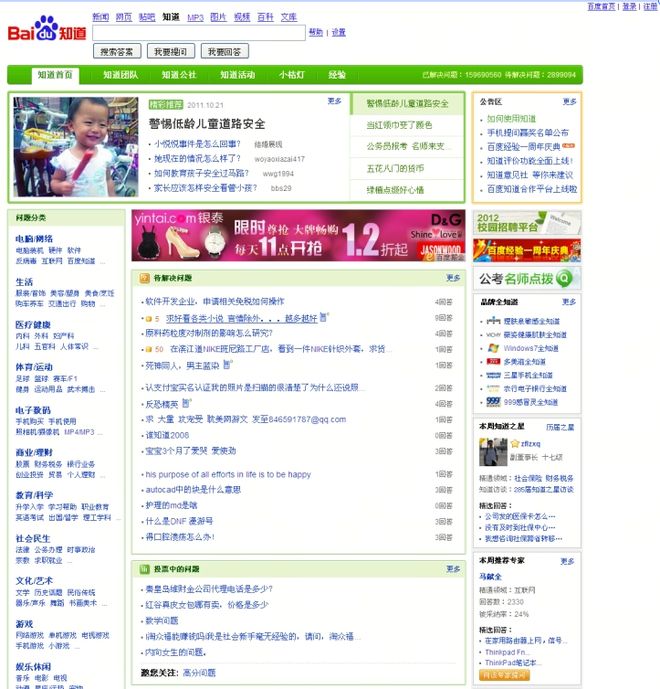
Many people born in the 80s and 90s should have memories of being helped by Baidu, right?

If you don’t know the common sense of life, ask if you know.

Ask about the exercises you don’t know how to do and the frustrations you feel when you can’t finish your homework.

A sudden flash of curiosity, of course. . .

For a long time, Baidu has known that it is the One Hundred Thousand Whys in the New Era. This kind of content spontaneously created by netizens also reflects the changes of the times to a certain extent.
At that time, the country was in the stage of rapid popularization of personal computers. Software, hardware, systems, the Internet itself, and all kinds of computer knowledge were hot topics.
The first question Baidu knew was full of a strong sense of the times. Will the XP system fully utilize the hardware performance than the 98 system?

In 2007, the stock market was booming, and newbies' inquiries about stock concepts and entry-level skills became a hot topic again.
On the second anniversary of Baidu’s launch, it released a report on the usage trends of knowledge search services by Chinese users.
Among all the questions, knowledge accounted for the highest proportion (50.7%), life (26.0%), entertainment (17.6%), and others (5.7%).
I also opened a separate statistics on annoying problems.
As expected, love is always a problem.
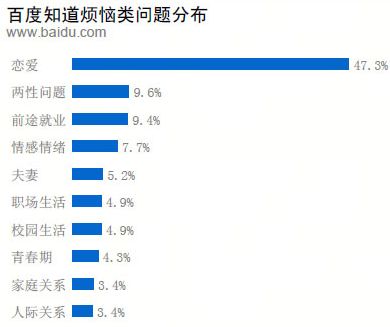
Baidu knows that it is like a 24-hour incurable disease office that caters to almost all the curiosity of the first generation of Internet users.
When did things change?
Most people on the Internet who miss Baidu Knows today will mention around 2012.
In their eyes, this year Baidu Knows ushered in an era of big releases.
A large number of robots automatically copy and paste answers from search engines.
What you post on Baidu Tieba will be automatically captured and sent to Baidu. Eat two for one fish.

Secondly, users also frantically output low-quality answers for rewards, causing the content to further avalanche.
"I heard that XX is very useful, but I have never used it myself."
"I think every software has its own characteristics, and the same goes for XX you mentioned, which has its own advantages."
There are also those who are just passing by to gain experience, and directly ask the other party to choose the best answer.

Some netizens said that they had contacted customer service. When they contacted customer service in the early days, they posted in a special forum, which was very tacky and inconvenient, but there were official personnel to handle it.
But after 2010, the methods of complaint gradually escalated, but fewer people actually dealt with the problem.
It can be said that the deterioration of community atmosphere and the proliferation of low-quality content have indeed poured cold water on Baidu.
But what is more fatal should be attributed to the fact that the times have changed, but it has not changed.
Standing at the crossroads of 2012, the number of Internet users has skyrocketed, and content has exploded. The headache for everyone is no longer not having answers
, but how to find truly effective content in the face of overwhelming answers.
At this juncture, Zhihu was officially launched in 2011 with an invitation system. With the high-quality and long answers from various industry leaders and professionals, it directly gained the popularity and reputation of the knowledge Q&A.
Zhang Xiaolong’s question

At the same time,
a revolution in dimensionality reduction and attack level has also taken place in the information form.
For example, if you want to repair computers, learn carpentry, do sewing, or raise bamboo rats, videos that can teach you step by step will definitely be more intuitive.

Super apps in various vertical fields have also begun to crazily conquer the city.
Eating, drinking and having fun?
Dianping has turned this matter into a quantitative evaluation system using distance, star rating, per capita, menu and user reviews.
The existence of Ctrip, Fliggy, and Mafengwo also better solves the needs from different tool levels.
There are many more. Cooking: go to the kitchen; pick a car: car home.
The most ironic thing is that even the cake of student party homework questions, commonly known as K12, has been divided up by the homework gang that Baidu knows it has hatched internally. . .
On the other hand, Baidu knows that all your needs are abstracted into,
Ask a question and answer a question.
Answers from pure web pages, full of ancient flavor.

When Baidu was born, most of the content on the Internet existed in the form of web pages, and there were still limitations of the era such as "killing cats with too many pictures".
Back then, this system could capture all content, but in the era of mobile Internet and short videos, what was once “advanced” seems to have become “outdated.”
In addition to the unflattering product form, there is also a misalignment of the underlying logic.
Baidu knows that it initially built a community that revolves around issues, and the new generation of content platforms, such as Douyin, Bilibili, Xiaohongshu, official accounts, etc., are all ecosystems that continue to revolve around content, creators, and user interests.
This also led to the failure of Baidu’s incentive system to a certain extent.
Because the upper limit of the value that the platform can give is far less comfortable than retaining influence in a personal account and personally realizing business.
Of course, in 2026,
Baidu didn’t shut down even though it was known, before
A while ago, he launched his own True Knowledge Project with great fanfare.

In addition to answering daily questions, we also launched a marketing campaign that invited everyone to share event posters on Douyin, Kuaishou, Baijiahao, and Xiaohongshu to collect likes.
In this day and age, you should rarely see 100% winning activities. Although it is limited, the number is so large that I am afraid that Baidu will not be able to distribute them all.

Participating in answering questions is worth real money, with tens of thousands of prizes. The top prize is a switch and a Dyson hair dryer. There are still a bunch of JD E-cards on the list.
Unfortunately, in the huge Internet, it did not create much waves.
Out of curiosity, I also went to the homepage of Baidu Knows. Although the page gave me a vague flavor of the BBS era, I can see that the overall content is planned and looks relatively refined.

But these seemingly exquisite plans on the homepage, when you click on them, there is content updated 4 years ago, there is a selected answer hanging at the top, and it is even a dead link.
After browsing a few questions and answers, I feel that although the overall information is valid, compared with the content of other platforms, the depth and details are still lacking.

When Robin Li gave a speech at Zhejiang University in 2006, he said that Baidu was becoming more and more powerful at that time, which was closely related to the direction of search communityization in the past three years.
At that time, Baidu relied on its superb sense of smell to successfully predict the general direction of future content development, and also firmly consolidated its search dominance.
It is a pity that the way people seek to solve their doubts on the Internet has never stopped evolving.
Nowadays, the most convenient search action is: "Hey, AI, help me...".
It is a pity that Baidu Knows, which is gradually disappearing into the dust, is a bit regretful.
A product can be extremely lucky to foresee the general direction of the future, but the cruel thing is that it may not survive to become the final protagonist of that future.
Comments