
Abstract:
The FreeBSD project recently announced its work progress report for the third quarter of 2026, covering many aspects such as artificial intelligence-assisted development, adaptation of EU network security regulations, virtualization management tools, desktop experience optimization, and storage and kernel scheduling. Among them, how to standardize the use of artificial intelligence tools in open source projects has become one of the most watched topics this quarter.
As large language models such as ChatGPT and Claude gradually enter the software development process, the FreeBSD community has also begun to seriously discuss the boundaries of the use of AI-generated code. The project team conducted a survey among developers, and the results showed that 88% of the respondents believed that FreeBSD should formulate a formal AI usage policy.
In terms of specific policy directions, 35% of the respondents hope that developers will disclose whether they use AI-assisted tools when submitting code; 22% believe that code written with AI participation should be reviewed and processed like other codes, without being treated differently; and 16% are clearly opposed to accepting AI-generated code. At the same time, for technical documents generated by AI, 65% of respondents support their adoption after manual review.
The survey results show that FreeBSD developers have not formed a simple stance of full acceptance or total rejection, but are more inclined to establish clear usage specifications, paying particular attention to code source transparency and manual review mechanisms.
To this end, FreeBSD has established an artificial intelligence working group to draft the AI usage policy within the project, and plans to submit a final report in the fourth quarter of 2026. By then, the community will further clarify the scope of application of AI-assisted programming, automatically generated code and technical documents in the project development process.
In addition to artificial intelligence policy, FreeBSD also has a lot of work this quarter surrounding the EU's Cyber Resilience Act (CRA). The regulation puts forward new requirements for software security, vulnerability handling and supply chain transparency of digital products. Open source software projects also need to evaluate the possible responsibilities of themselves and their downstream suppliers.
Among them, the Software Bill of Materials (SBOM) has become an important work direction for FreeBSD to adapt to new regulations. SBOM can record the components, dependencies and version information contained in the software, helping developers and users identify potential vulnerabilities and track security risks in the software supply chain. The FreeBSD community is improving related support to better meet future software security compliance requirements.
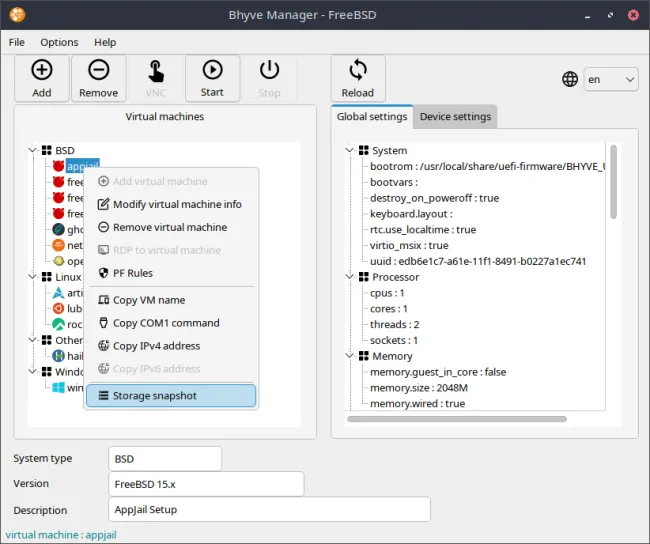
In terms of virtualization, FreeBSD continues to promote the development of virtual machine management tools based on Bhyve. Bhyve is FreeBSD's built-in virtualization hypervisor that can be used to run virtual machines on different operating systems. This quarter developers are developing a graphical management interface called Bhyvemgr. This tool is written using FreePascal and Lazarus development environments. It is designed to allow users to create, manage and maintain Bhyve virtual machines through a graphical interface, reducing dependence on command line operations.
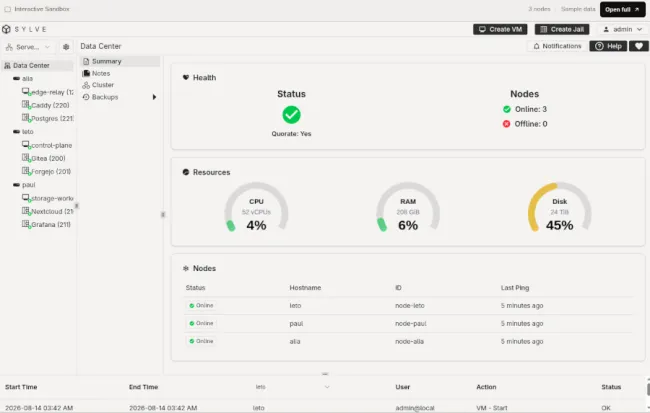
At the same time, Sylve, the FreeBSD system management platform for browsers, has also made progress. It attempts to integrate server management, storage configuration and cluster management into a unified web interface. New features added this quarter include more storage management options, as well as capabilities related to data center and cluster management. Compared with traditional command line management methods, such tools are expected to lower the daily operation and maintenance threshold of FreeBSD servers.
Desktop systems are also the direction of continued investment this quarter. FreeBSD developers are improving the desktop installation process and further polishing the daily use experience. Relevant work includes improvements to system hibernation and recovery functions, and optimization of the audio system. For users who want to use FreeBSD as a personal desktop operating system, these improvements help improve practical usability on laptops and desktops.
In terms of the underlying system, FreeBSD has also advanced work such as zoned storage support, debugging tool enhancements, kernel scheduler optimization, and boot loader improvements. Although these projects are not as intuitive as graphical interfaces or new applications, they are related to the performance and reliability of operating systems in servers, storage devices and other professional environments.
The third quarter work records released by the FreeBSD Foundation show that the development work funded by the foundation completed a total of 530 src submissions, 82 ports submissions, and 19 doc submissions during this quarter, involving operating system core code, software porting and software package systems, and official documents.
Overall, FreeBSD’s work focus in the third quarter of 2026 is not only kernel and driver development in the traditional sense, but also includes open source collaboration specifications in the artificial intelligence era, adaptation of EU network security regulations, and the improvement of virtualization and web management tools. In particular, the result that 88% of developers support the formulation of AI policies reflects that the open source community is facing a new realistic problem: when AI gradually becomes a daily programming tool, how to improve development efficiency while continuing to maintain code quality, transparency, and community review mechanisms.
Comments