
Abstract:
Intrinsic, an intelligent robot software company owned by Google parent company Alphabet, announced on September 22, local time, that it would open source the core components of its industrial robot platform and launch a basic software platform called Intrinsic Core. The project was officially announced at the ROSCon 2026 conference in Toronto, Canada, using the looser Apache 2.0 open source license. The goal is to allow more robot developers to directly use pre-configured basic software to accelerate the development of intelligent robots and "physical AI".
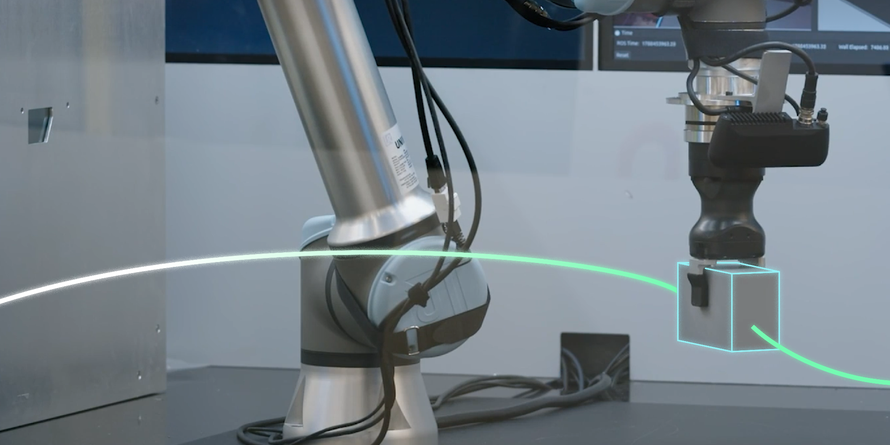
Intrinsic was founded in 2021 and was incorporated into Google’s business system in February this year, responsible for promoting the development of physical AI. Different from traditional artificial intelligence that mainly exists in the digital environment, physical AI needs to perceive the real world through sensors, then use algorithms to reason, and take actual actions through actuators and control systems, so it involves a variety of equipment such as robots, self-driving cars, drones, and smart infrastructure.
Intrinsic believes that an important reason why the development of physical AI is currently limited is that the software system behind intelligent robots is too complex. Developers often need to rewrite a large amount of underlying software, drivers and control logic for different robot hardware, and they also need to solve the problem of training AI models. If each type of robot developed had to be rebuilt from the ground up, the development cycle and cost would be very high.
Intrinsic Core was launched to address this problem. It is a pre-configured software environment compatible with the robot operating system ROS that can run directly on local hardware and provides a series of reusable software components. Developers can combine these components into their own robotic systems without having to build an entire software stack from scratch.
One of the core components is Intrinsic Control. This is a real-time robot control framework that is independent of specific hardware and can dynamically adjust its movement trajectory during the robot's movement based on sensor feedback. This makes it easier for developers to use different types of robotic arms, grippers and other equipment based on the same set of software, without having to rewrite the underlying software and drivers every time the hardware is replaced.
Intrinsic Core also provides posture estimation functions based on NVIDIA FoundationPose technology, which allows robots to dynamically identify and process parts on the production line. Traditional industrial automation often requires the use of fixed, high-cost fixtures to ensure that parts are in a certain position, and this visual positioning capability can reduce the reliance on such rigid physical fixtures.
The platform also includes a motion planning function that can automatically generate motion paths to avoid obstacles. Traditional industrial robots often require developers to program each joint step by step, and Intrinsic hopes to reduce this tedious manual programming work through automated motion planning.
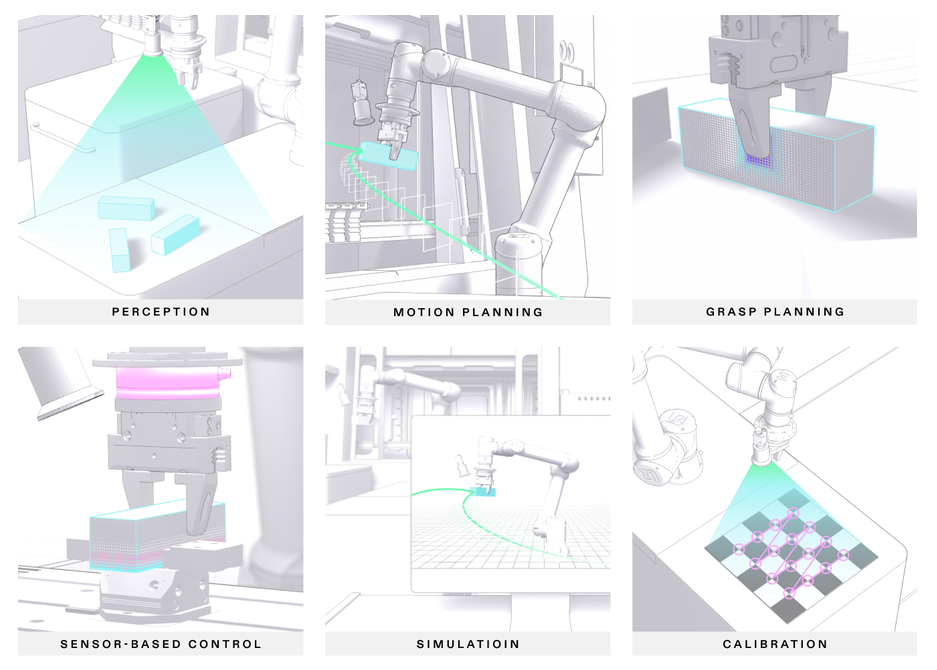
In addition, Intrinsic Core provides a grasping planning function that allows different types of robot grippers to automatically adjust their grasping actions according to the position and direction of the target object, allowing the robot to more flexibly handle objects of different shapes and placements.
During the robot development process, Intrinsic Core also provides simulation and calibration services. Developers can simulate, visualize and troubleshoot robots through a unified interface, while completing calibration of the vision system. The platform also provides Intrinsic-ROS drivers to make it easier for developers to connect sensors with third-party grippers, 3D cameras, and other hardware devices.
To demonstrate the practical use of this infrastructure, Intrinsic also launched the Open Machine Tending Solution. This is an open reference design for AI-driven CNC machine tool loading and unloading tasks, allowing users to make modular adjustments according to different hardware configurations, and supports equipment from major industrial robot manufacturers such as Universal Robots and FANUC.
Intrinsic believes that this set of open reference designs is particularly suitable for the machine manufacturing industry. There are currently tens of thousands of companies in the United States and Europe responsible for producing various complex mechanical parts. However, due to the high cost of automation equipment and high technical barriers, only about 8% of them have adopted some form of automation technology.
Intrinsic hopes to make it easier for smaller manufacturing companies to automate low-value, repetitive tasks by providing a starting point that can be directly modified and expanded, thereby lowering the threshold for robot deployment and further promoting the automation of the entire manufacturing industry.
On a larger scale, Intrinsic hopes to build a broader developer ecosystem through shared open source robotics tools. The company believes that if robot developers no longer need to repeatedly build a large amount of basic software, they can devote more energy to specific applications and AI capabilities themselves, thereby accelerating the implementation of physical AI in different industries.
The significance of this open source is not only to provide several robot software tools for free, but also to further popularize the concept of "basic software platform" in the field of robots. Current industrial robot hardware has long-term differences between brands, models and control systems, and developers often need to adapt to equipment from different manufacturers. Intrinsic hopes to reduce the development costs caused by this fragmentation through common components such as hardware-independent control framework, ROS driver, visual positioning, motion planning and grabbing planning.
Intrinsic’s choice to announce Intrinsic Core during ROSCon 2026 is also obviously targeted. ROS has become one of the widely used open source software frameworks in the field of robot research and development, and a huge developer and hardware ecosystem has formed around ROS. Intrinsic Core directly provides a ROS-compatible environment, making it easier for developers to combine existing ROS robot systems with the capabilities provided by Intrinsic.
From the perspective of Google's overall strategy, this is also an important step for the company to further extend artificial intelligence from the digital world to the physical world. Google has continued to promote the combination of robots and AI models in recent years, and Intrinsic is not responsible for simply manufacturing a certain type of robot, but trying to provide a common software infrastructure so that different types of industrial robots can obtain more flexible perception, planning, control and operation capabilities.
If this model can take shape, the way robots are developed in the future may become more and more similar to software development: developers do not need to reinvent the wheel starting from the bottom control, visual recognition and motion planning, but directly use mature basic components, and then combine and train them for specific industry tasks. Intrinsic has opened its core infrastructure under the Apache 2.0 license, which also means that external developers and enterprises can study, modify and expand these software under relatively relaxed conditions.
However, open source software alone cannot solve all the problems faced by robot commercialization. Robots in real industrial environments still require reliable hardware, sensors, actuators, motor control systems, and extensive task-specific data and testing. Intrinsic Core can lower the threshold for software development, but companies still need to solve issues such as hardware deployment, security and actual operation reliability based on their own production processes.
The core goal of Intrinsic's action is therefore not to directly launch an intelligent robot for consumers, but to become a basic software supplier in the physical AI era and attract more developers and robot manufacturers to join its ecosystem through open and universal software components. If more and more industrial robots can share similar basic software capabilities, the cost of robot development and deployment is expected to be further reduced, and AI-driven automation may therefore gradually expand from a few large manufacturing companies to more small and medium-sized enterprises.
Comments