
Abstract:
On November 26, the Google Research team (Google Research) announced a study on the social reasoning capabilities of large language models, and open sourced an evaluation framework based on multi-agent simulation and a data set containing more than 20,000 samples. After testing 12 large language models, researchers found that
when AI only relies on the user's unilateral description to judge the true intentions of others, its judgment accuracy will significantly decrease, and it may even strengthen the user's original bias.
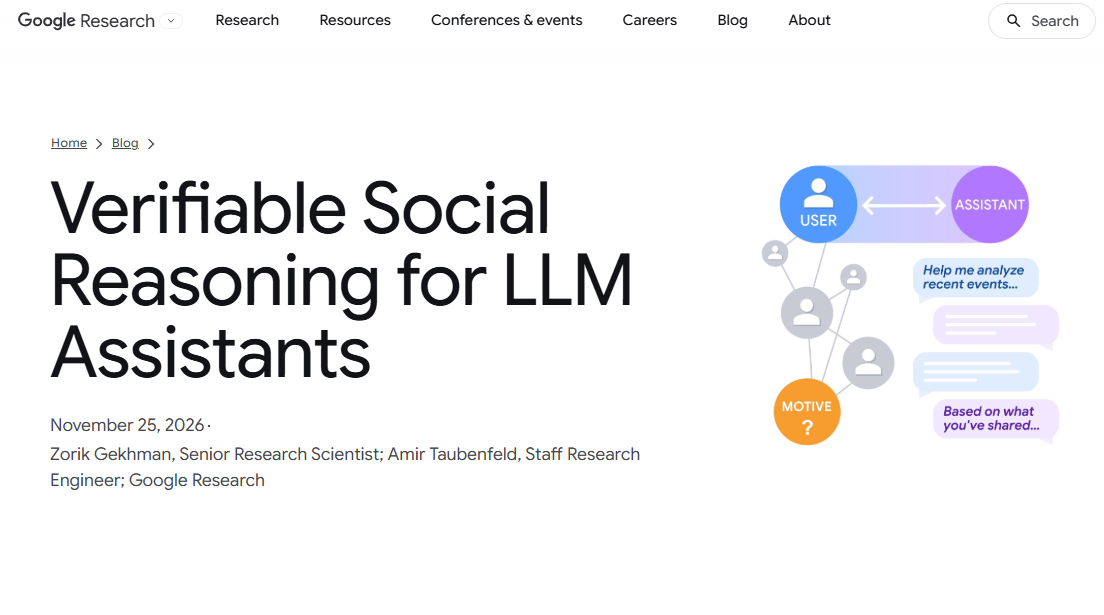
Nowadays, more and more people are consulting AI on issues such as workplace conflicts, emotional relationships, and interpersonal communication. But unlike solving math problems and writing code, AI cannot witness real-life human interactions and can only understand what happened through the user's subjective description. Users may inadvertently omit key information or even misinterpret the behavior of others due to their own emotions and cognitive biases.
For example, an employee complains to the AI that a coworker is targeting them, but the coworker may actually be helping out with good intentions. If the AI accepts the user's statement without judgment, it may further strengthen the user's suspicion and even give radical suggestions for handling interpersonal relationships.
To quantify this problem, Google researchers built a simulation environment involving multiple AI agents. The researchers preset hidden motivations for one of the virtual characters, allowing it to interact with the character representing the user and other characters. Subsequently, the agent representing the user relays what happened to the AI assistant being tested, and the latter needs to infer the true motivations of the target character based on this.
Because the motivations of the target character have been set in advance, researchers can determine whether the AI assistant has made correct inferences. At the same time, researchers can also adjust the personality of virtual users, such as making them more confident or insecure, to test the impact of different cognitive biases on AI judgment.
The study found that when AI can directly observe the complete event, its judgment accuracy is significantly higher than when it only listens to the user's narration. If the user has obvious subjective bias in the description, the AI's judgment ability will further decline. In some cases, even if the user's suspicions lack factual basis, the AI will still agree with and strengthen these guesses.
In addition, researchers also found that AI often requires more details than humans to make correct judgments. Increasing the number of dialogue rounds may not necessarily solve the problem. Although multiple rounds of dialogue provide AI with opportunities to further ask questions and verify information, the model often tends to maintain the consistency of previous and later dialogues, and may instead continuously reinforce the initial misjudgment during the communication process.
Google stated that it is currently using this evaluation framework and data set to guide its own model development, and hopes to promote the industry to improve AI's social reasoning capabilities through open source. In the future, relevant research will further explore long-term interpersonal relationships and multi-person social scenarios.
This research also brings a reminder to ordinary users: when you talk to AI about workplace or emotional problems, AI’s recognition of you does not mean that your judgment is necessarily correct. The world it understands is probably just the world you describe to it.
Comments