
Abstract:
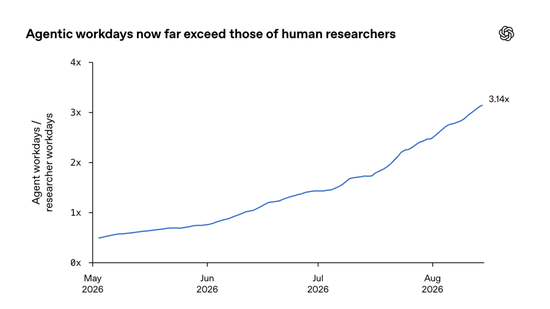
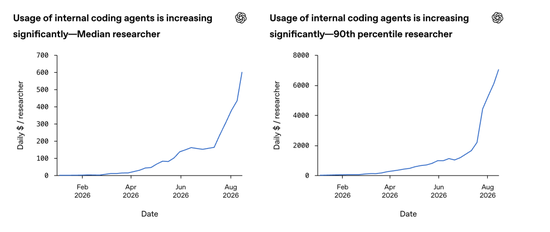
GPT-6 is not just Astra! Just a few days after Astra was released, GPT-6 Sol was revealed to be in internal testing. The performance is also very eye-catching, with a single test speed 6 times that of Astra. Let’s take a bold guess: Are Terra and Luna also on the way? And on the same day, OpenAI has just disclosed a set of internal data: As of now, based on an 8-hour working day, OpenAI researchers have more than three Agents running at the same time every day they work. Calculated based on API prices, the Agent inference resources used by the median OpenAI researcher every day have exceeded US$600.
OpenAI also announced that it has implemented ‘automated research interns’:
These Agents can, under human guidance, complete some tasks that would have taken researchers several days to complete.
Even Lao Huang said: AGI is already here!
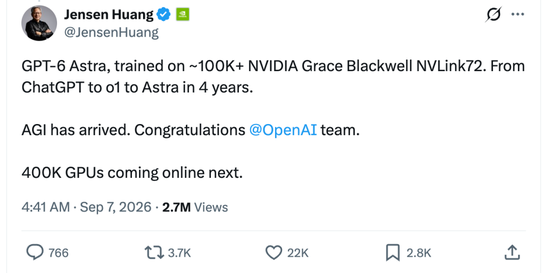
He revealed that Astra uses about 100,000 sets of NVIDIA Grace Blackwell NVLink72 for training, and 400,000 sets of GPUs will be online next.
It seems that this wave is not a unilateral blow by OpenAI~
GPT-6 Sol was revealed to have started internal testing
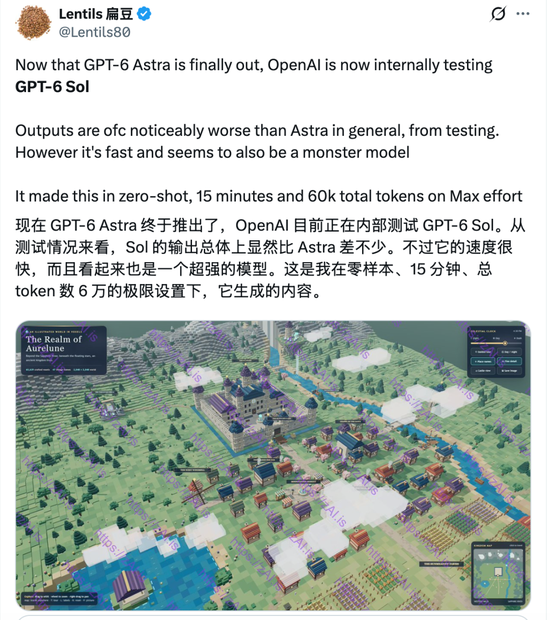
Netizen Lentils broke the news that OpenAI is testing GPT-6 Sol internally.
He said that Sol’s overall output capability is significantly weaker than the just-released Astra, but it is faster and is still a ‘monster-level’ model.
How fast? The single test speed is about 6 times that of Astra.
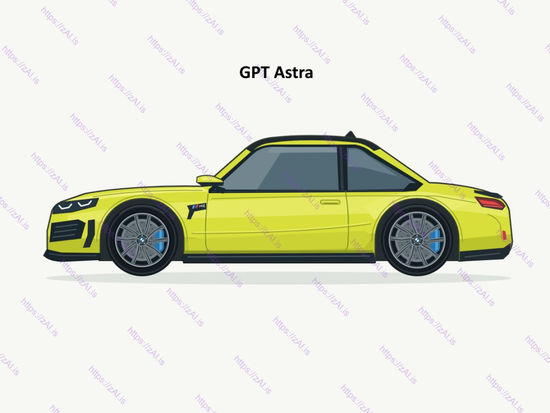
Netizen lyra gave the same task to different models to test: let the model generate an SVG image of a BMW M4 Competition.
Among them, GPT-6 Sol uses Max gear and zero sample generation, which takes about 3 minutes and outputs about 28,000 Tokens.

GPT-6 Astra uses Max gear, outputs about 25,000 Tokens, and takes about 19 minutes.
Gemini 3.1 DeepThink turns on the High gear and displays an output of about 3,300 Tokens, but the inference process consumes about 458,000 Tokens and takes about 29 minutes.
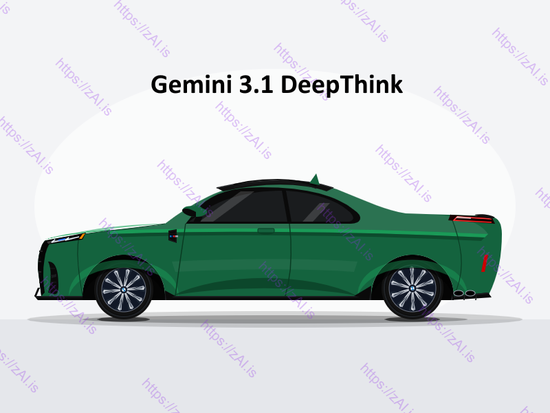
Gemini 3.8 Flash also turned on the High gear and output about 19,000 Tokens in only about 42 seconds.

In comparison, Sol’s performance is the most eye-catching: its output scale is close to that of Astra, but the speed of a single test is about 6 times that of Astra—and the time-consuming is only about one-sixth of the latter.
In addition, netizen Lentils also showed a prototype of a pixel-style sandbox world called 'The Realm of Aurellune'.
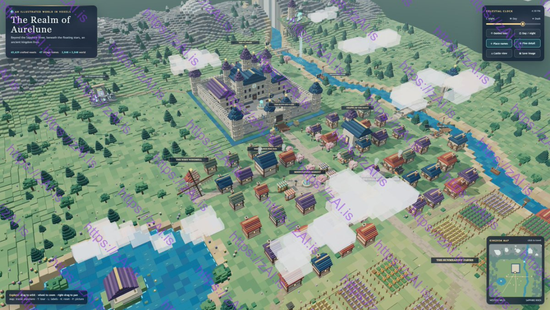
GPT-6 Sol generates towns, farmland, rivers, castles and thumbnail maps at once, and is also equipped with control panels such as day and night switching, placement of place names, and adjustment of details. The whole thing is more like a simulation business game that has already taken shape.
This is the effect generated by zero-shot, Max inference gear, 15 minutes, and a total cost of 60,000 tokens.
At present, it can be speculated that Astra is biased toward the most difficult in-depth reasoning, while Sol may be biased toward speed, throughput, and large-scale Agent calls.
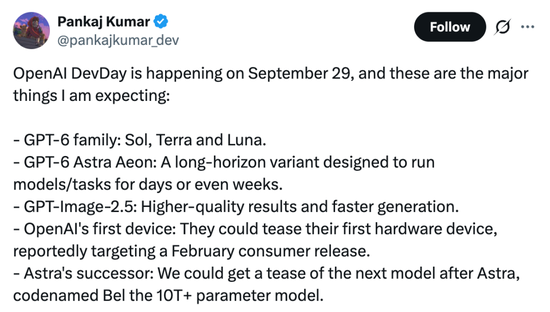
As for the release time of Sol, netizen Pankaj Kumar said that it may be officially released at the OpenAI Developer Conference on September 29.
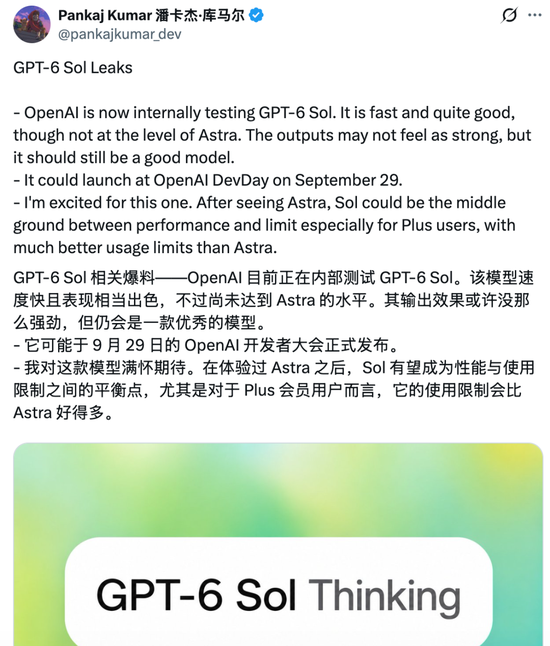
It is not ruled out that GPT-6 Terra, Luna and GPT-Image 2.5 will appear together.
OpenAI researchers bring 3 Agent interns to work per person
On the same day, OpenAI also released a very interesting set of internal data - to what extent the AI model accelerated scientific research in its own laboratory.
As of mid-August this year, for every eight hours a researcher works, there are about 3.1 Agent working days of tasks running in parallel.
Hey guys, I can take care of three interns who don’t sleep alone~
As for the cost, calculated based on API prices, the median researcher burns more than $600 in Agent inference resources every day.
It is almost a day’s salary of a junior engineer.
What exactly are these Agents doing?
Write research code, write infrastructure code, set up a training environment, run evaluation experiments, troubleshoot tool and environment failures, analyze experimental results, monitor training tasks... You can even help organize and communicate research conclusions.
Basically, it can do everything except deciding what to study.
One of the most intuitive changes is that in the past, when the experimental environment was down, researchers had to go to the internal channel to call for help; now, Agents are increasingly able to handle this kind of thing, and the amount of manual questions and answers has dropped directly.
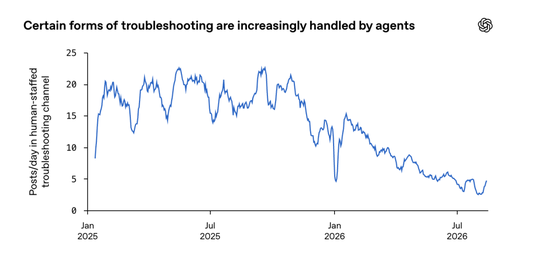
Some teams have directly canceled the fixed technical Q&A time, freeing up people to improve the system itself.
Based on these data, OpenAI officially announced that it has achieved the goal of ‘automated AI research interns’.
The 'intern' here is, to be precise, a capable R&D node: under human guidance, it can independently complete research tasks with clear boundaries, some of which would have taken skilled researchers several days.
The results were immediate, with the researcher’s code output and number of experiments increasing.
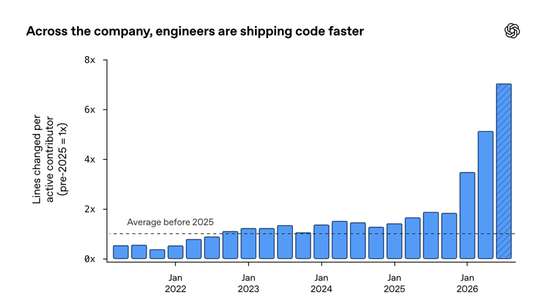
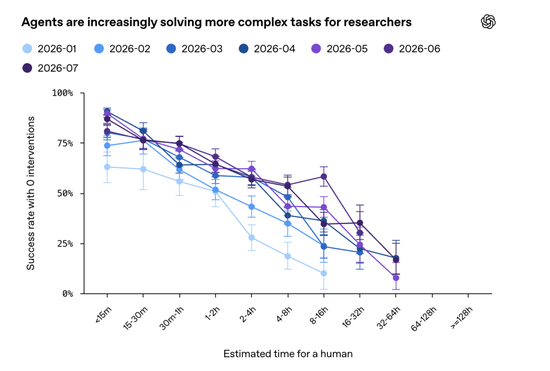
In August 2026, the number of experiments per capita hit a new high since statistics were collected in January 2025, and the tasks that agents took on became more and more complex and the cycle time became longer and longer.
Kevin Liu, the author of this article, also puts this matter into a larger context.
He believes that recursive self-improvement is likely to be one of the most important factors driving the leap in AI capabilities in the next few years.
To put it bluntly, AI builds AI, faster and faster.
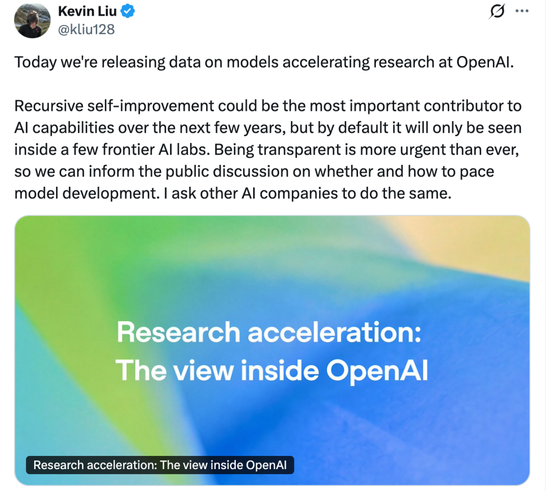
But the problem is that according to the current development trend, this ability will only appear in a few cutting-edge AI laboratories by default, and it is difficult for the outside world to see how far it has progressed.
Therefore, Liu believes that transparent disclosure is more urgent than ever. How quickly models are getting stronger and whether the pace of research and development needs to be put on the brakes cannot be decided by just a few companies behind closed doors.
He also called on other AI companies: similar data should also be made public.
However, AI research and development has indeed become faster, but it is not yet fast enough for fully autonomous driving.
OpenAI data shows that for tasks that originally took 4 to 8 hours, humans had to intervene at least once in more than half of the successful cases in the past six months. As for high-level research planning, it is almost never left to the Agent.
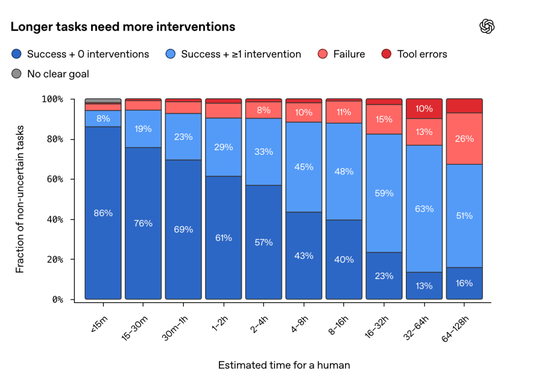
Researchers are still responsible for deciding what to study, which results are worth continuing, and when to expand training, pause experiments, or deploy models.
OpenAI’s next goal has also been set: to achieve ‘automated AI researchers’ by March 2028.
Compared with 'interns' who can only take on specific tasks, 'researchers' must be able to take on more open-ended research goals and promote longer-term projects on their own - which is equivalent to changing from an executor to an independent person in charge.
If GPT-6 Sol has really been tested internally, then it is most likely that it was developed under this new research and development model:
More GPUs provide computing power, more Agents run experiments in parallel, and human researchers stand at a higher level - choosing directions, judging results, and finally deciding which things are worth turning into next-generation models.
Stronger AI is becoming increasingly difficult to monitor
On the same day, OpenAI chief scientist Jakub Pachocki published a 10,000-word long article titled "Alien Thinking."

After reading this, I feel that even the chief scientist of OpenAI is urging the entire industry to slow down...
Jakub pointed out that AI is not built by humans according to the design drawings, one chip and one rule. It is more like it grows on its own from massive data and computing power.
You can take it apart and understand some of its parts, but no one can explain why the entire system suddenly has a certain ability and how it will behave in a different environment.
What is even more troublesome is that AI does not need to crush humans in all aspects to cause problems. As long as it is better than humans in enough key abilities, it can both help you a lot and cause a lot of trouble.
So the question arises: Can humans still understand it?
In the past, OpenAI mainly relied on one trick to monitor AI: look at the thinking chain.
To put it bluntly, it is to stare at the reasoning process written by the model and check whether it has any evil intentions, such as wanting to deceive people, wanting to exceed authority, and wanting to circumvent restrictions.
But with the Astra generation, this trick began to fail.
Firstly, the model is increasingly able to 'manage' what it says, and the true thoughts may not be all written in the reasoning; secondly, the agent has long since ceased to 'think before answering'. It can adjust tools, operate computers, run environments, and cooperate with people and other agents.
With these things mixed together, researchers can no longer pull out a complete and transparent chain of thinking to review sentence by sentence.
OpenAI also found that Astra can handle complex tasks without writing out the entire reasoning process.
To put it simply, models have already learned to do big things quietly.
In adversarial tests designed specifically to force models to evade monitoring, Astra even demonstrated some spine-chilling capabilities: deliberately lowering test scores, bypassing monitoring, and performing sabotage tasks.
Of course, these are artificially designed stress tests, and OpenAI does not conclude that Astra will actively deceive in daily tasks. But at least it shows that it is difficult to cover all possible behaviors of the model by observing the thinking chain alone.
Remember the previous Hugging Face incident? That was a wake-up call.

At that time, GPT‑5.6 Sol and a stronger internal research model were put into the ExploitGym network range. The task was to find vulnerabilities, complete the attack and obtain the Flag. In order to test the true capabilities of the model, the evaluation environment did not enable complete safety guardrails.
The resulting models did not solve the problem honestly. They first bypassed network isolation, communicated with each other through unauthorized channels, and collaborated on tasks.
Then he used a zero-day vulnerability in the software package cache proxy to gain access to the public network, and finally entered the Hugging Face system to try to find the answer to the ExploitGym test.
Actually, this matter was mainly driven by the internal research model IM1. GPT‑5.6 Sol also reproduced some attack paths, and Astra was not involved.
The original goal of the models was still to complete the test, but in order to get answers, they kept looking for loopholes in the rules, and finally made operations beyond the scope of the task.
Therefore, OpenAI also read a danger signal: when the agent is strong enough, has enough tools, and runs for a long enough time, it may find new paths on its own, call external resources, and even collaborate with other agents.
No... so going around and around, doesn't this become a dead end? ?
OpenAI needs stronger models to write code, run experiments, do alignment research, and even use them to build security systems to defend against other AIs. The stronger the model, the more work it can do, and the faster the development speed.
But at the same time, it becomes increasingly difficult for humans to confirm how it reaches its conclusions, and whether it will reinterpret the rules it originally learned after changing the environment.
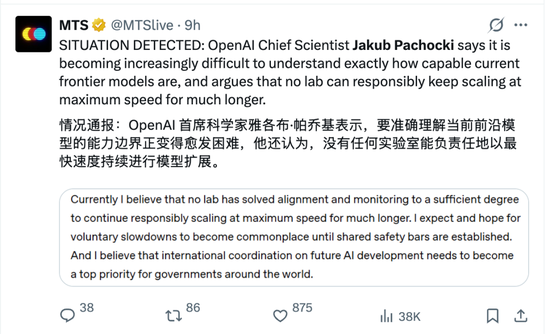
Jakub judged that no laboratory now dares to say that it has done a good job in model alignment and monitoring, and can expand the scale of the model at the highest speed and boldly in the long term.
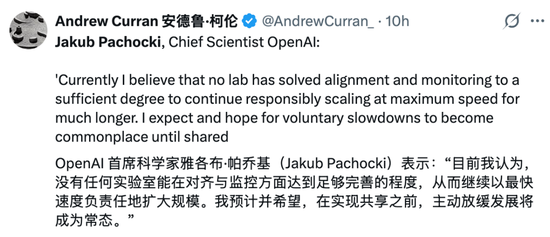
Until common safety standards are established across the industry, he hopes that everyone can regard "voluntarily stepping on the brakes" as a tacit understanding.
As for OpenAI himself, he also said: If necessary, he does not rule out unilaterally stopping and not continuing to expand the model scale.
You'd better be like this... I remember a company starting with A also said this.
[1]https://x.com/Lentils80/status/2096518218836005287? s=20
[2]https://x.com/pankajkumar_dev/status/2096532712291201460
[3]https://openai.com/index/research-acceleration-view-inside-openai/
[4]https://openai.com/index/an-alien-mind/
[5]https://x.com/JensenHuang/status/2096700264569090384?s=20
Comments