
Abstract:
The Linux kernel development team recently released the Linux 7.3-rc2 test version, marking that the 7.3 development cycle has officially entered the regular candidate version stage. As the merge window ended last week, development work has shifted from merging new features to problem fixes and stability verification, and the latest rc2 version shows a busy rhythm that is different from the past.
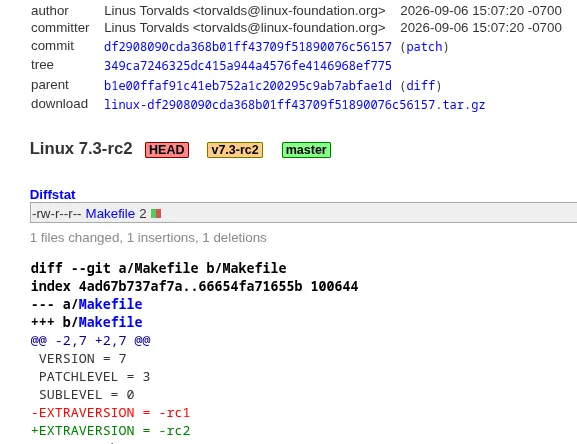
According to Linux kernel convention, the rc2 phase is usually a relatively quiet week in the entire development cycle. Developers often slow down briefly after a large amount of code integration during the merge window, waiting for more test feedback to come in. However, in this Linux 7.3 development cycle, the situation is obviously different. Developers not only need to deal with various problems exposed in the first test version, but also continue to receive a large number of new submissions, making the rc2 version still highly active.
The release of Linux 7.3-rc2 brings a number of noteworthy corrections and improvements. These include fixes to the cache-aware scheduling mechanism for hybrid architecture processors to improve task scheduling efficiency and improve performance. For processor platforms that have widely adopted large and small core designs in recent years, this type of optimization helps to make more reasonable use of different types of core resources.
The kernel memory management part also received a wide-ranging code cleanup. The development team migrated a large number of traditional kmalloc calls to the updated kmalloc_obj interface family to further optimize the object allocation mechanism and improve code quality. This work involved the entire kernel source tree, thus resulting in a considerable scale of code changes.
In terms of graphics drivers, Linux 7.3-rc2 adds a series of display output fixes to the open source Nouveau driver for NVIDIA Blackwell architecture graphics cards. As the new generation of GPUs gradually becomes more popular, these improvements are expected to improve the compatibility and stability of the Linux platform with the latest hardware.
In terms of security and Rust language support, this update adjusts the default behavior of the RandStruct random structure layout security mechanism. When the system has Rust kernel support and the corresponding compilation tool chain enabled, RandStruct will be turned off by default. The developers believe that this adjustment will help reduce compatibility issues that may arise between the two sets of mechanisms.
In addition, some EDAC (Error Detection and Correction) subsystem updates that were originally planned to enter Linux 7.3 but missed the merge window due to time reasons have also been included in this candidate version. At the same time, there are a number of fixes in the kernel source tree involving different architectures, drivers, and infrastructure components.
It is worth noting that this development cycle is also accompanied by a topic that has received increasing attention in recent years-artificial intelligence generated code. Greg Kroah-Hartman, one of the leaders of the Linux kernel stable version, has previously publicly stated that a large amount of AI and large language model-generated content is entering the development process, which puts review, verification and maintenance work under greater pressure. He believes that the Linux 7.3 development cycle may therefore become a particularly difficult version cycle.
Although there have been no major problems affecting the overall development process, more and more developers are worried that the rapid growth in the amount of AI-generated code is changing the long-term collaboration model of the open source community. How to maintain code quality and maintainability while improving development efficiency has become a new challenge that the Linux community is facing.
According to the current plan, the stable version of Linux 7.3 is expected to be officially released in the second half of October this year. In the coming weeks, the development team will continue to launch more candidate versions to further test and improve new features and existing fixes to ensure that the final version meets stable release requirements.
Learn more:
https://lore.kernel.org/lkml/CAHk-=wjzW9f50_ETY+23zP=8RHf2ZxdQVkUYhi9tWA6V8Ci4vQ@mail.gmail.com/T/#u
Comments