
Abstract:
At 06:00 on September 16, the Orient Space Gravity-1 (Yao-3) Qianfan Transit carrier rocket was ignited and lifted off in the East China Sea of my country. It successfully sent the eight Qianfan constellation networking satellites and one EUHT technology test satellite into the predetermined orbit. The launch mission was a complete success.
China Business News reporter learned from Oriental Space that this mission is the company’s first launch mission for a giant low-orbit satellite Internet constellation. The net payload weighs more than 3 tons and the orbital height reaches 800 kilometers. The payload of this mission is a combination of stacked satellite assembly and flat-plate satellite, which puts forward higher requirements for multiple separation control technology.
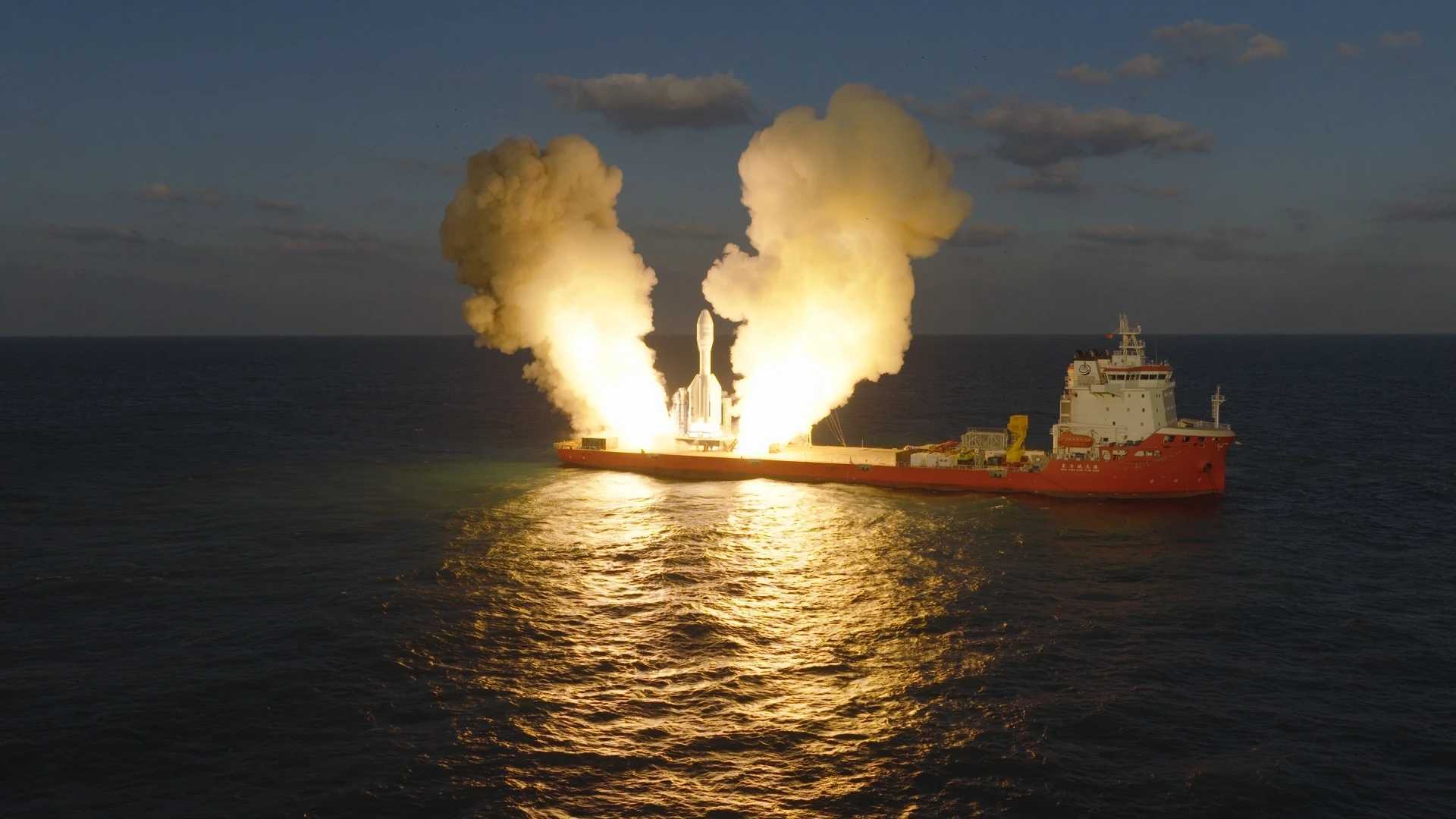
Gravity-1 (Y3) launch Picture source: Oriental Space
Bu Xiangwei, co-founder and CEO of Oriental Space, said in an interview with China Business News that the biggest advantage of sea launch is the flexibility of location, but location selection is a complex system engineering, and the core element is to match the satellite target orbit requirements. In addition, factors such as the safety of the landing zone, sea and meteorological conditions, launch windows, launch ship navigation scheduling, and maritime coordination must be comprehensively evaluated.
"Different constellations and different satellites have different target orbits, and the optimal launch points for adaptation will be different. In the future, we will gradually solidify the launch points of typical orbits. At the same time, we will also explore more maritime launch points according to mission requirements, give full play to the advantages of maritime launch maneuvers, and better match the batch network launch of low-orbit constellations." Bu Xiangwei said.
Bu Xiangwei also said that at this stage, there is a supply-demand contradiction of "more stars and fewer arrows" in China and even the global commercial aerospace industry. The reasons are complicated: First, there are limited domestic rocket models that can stably provide commercial launch services, and large-capacity rockets that can meet large-scale constellation networking are particularly scarce. Secondly, the frequency of launches is insufficient, the cost of launches is high, and there is a time lag in the fact that a new model of rocket needs 2-3 flight verifications from its first flight to real trust by customers. Gravity-1 already has the capability to launch 200- to 400-kilogram satellites from "ten stars in one arrow" to "eighteen stars in one orbit." Judging from our schedule, launch demand is being released rapidly - three satellite batch launch missions are planned to be implemented within the year. As more commercial rocket models mature, launch frequency increases, and costs decrease, supply and demand will gradually reach a balance.
At present, Oriental Space has established a full industrial chain layout including R&D, testing, production, and launch. According to the company's co-founder and vice president Peng Haomin, the company's core business is launch vehicle services, but it also makes moderate collaborative arrangements in downstream industries and participates in investments in two satellite operating companies, which is essentially to open up the "rocket-satellite application" industry linkage. On the one hand, it can feed back the load requirements, orbit requirements, and batch launch demands of constellation customers into the launch plan in advance, optimizing carpool launch and batch network launch services; on the other hand, it can also deeply participate in the ecological construction of low-orbit Internet and remote sensing constellations to better serve different types of satellites and different networking modes.
Peng Haomin told China Business News that since the beginning of 2026, Oriental Space has completed Pre-C and C rounds of financing, with a total financing of more than billions of yuan. This round of funds will focus on the research and development and production of the Gravity 2 large liquid recyclable rocket.
"The company has officially launched the C++ round of financing, which will help support the development of the Gravity 2 recyclable rocket. According to the overall plan, we will start work related to shareholding reform in the near future, and then start listing guidance at an appropriate time. We will use the power of the capital market to accelerate R&D investment and improve the full-chain production capacity such as rocket mass production and engine manufacturing to better respond to the launch demand for large-scale domestic low-orbit constellation networking." Peng Haomin said.
Comments