
Abstract:
IBM recently released the new generation quantum processor Nighthawk r3 and announced its future quantum computing development plan. This new processor is designed to perform up to 10,000 quantum operations, handling more complex large-scale computing tasks while maintaining operational quality and speed, marking an important step towards IBM's goal of fault-tolerant quantum computing.
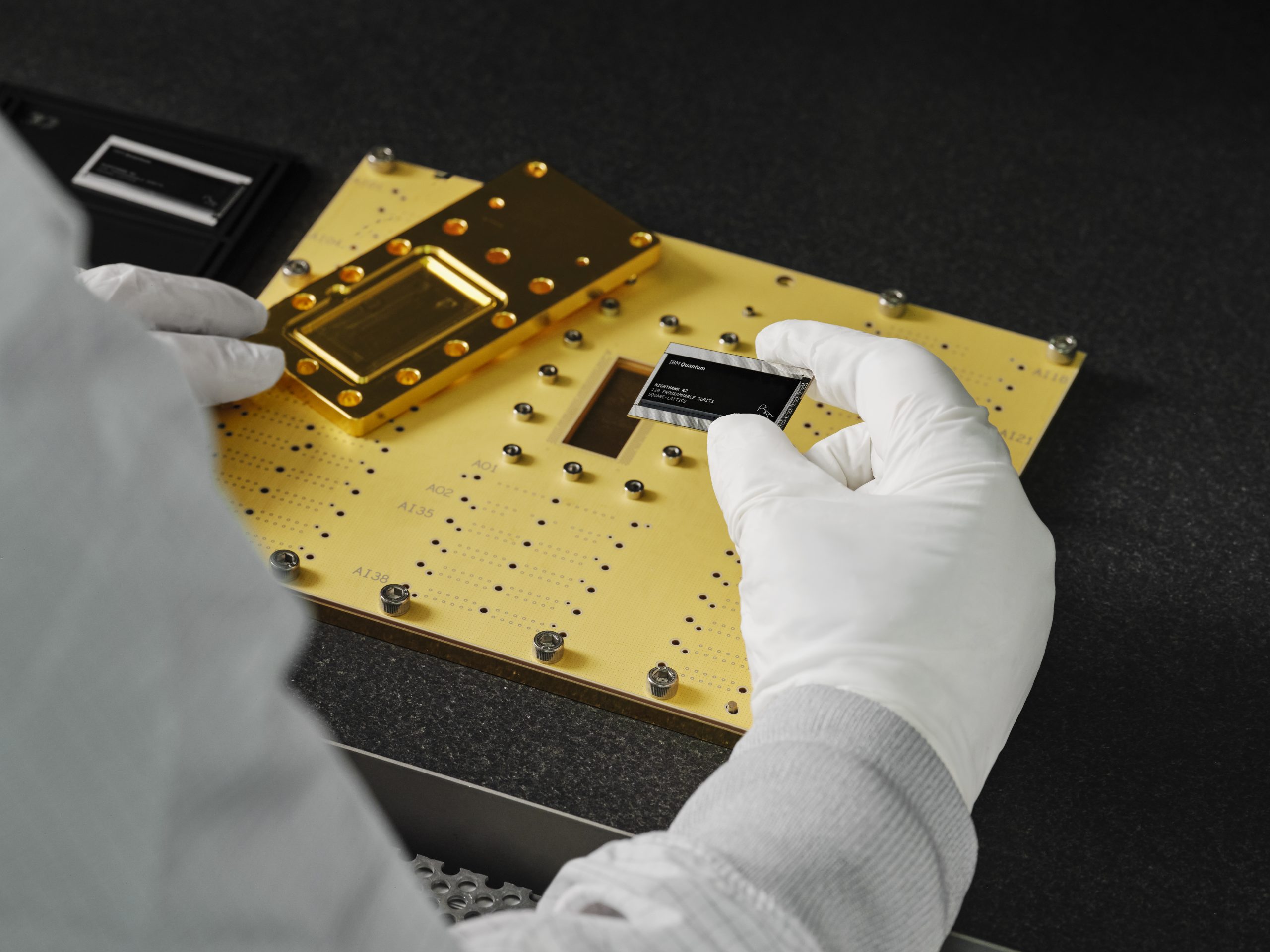
According to information disclosed by IBM, Nighthawk r3 will be equipped with 520 programmable qubits and 2034 physical quantum components, with the goal of stably running 10,000 quantum operations on a single processor. At the same time, IBM also plans to connect two Nighthawk r3 processors into a unified system in 2027 to build a quantum computing platform with more than 1,000 qubits.
Jay Gambetta, head of IBM Research, said that truly valuable quantum computing requires not only accuracy, but also speed. As the scale of quantum systems continues to expand, quantum computing can only solve practical problems in the real world by taking into account both computational quality and processing efficiency.
The Nighthawk r3 released this time is based on the Nighthawk r2 launched in September this year. The previous r2 processor has been able to perform more than 7,500 quantum operations on 120 qubits and achieve processing capabilities of up to 100,000 samples per second. IBM believes that this platform has proven that quantum computing has begun to have the potential to solve real industry problems.
Qubits are the basic information units of quantum computers, similar to the "bits" in traditional computers. But unlike traditional bits, which can only represent 0 or 1, qubits can be in a superposition state of 0 and 1 at the same time, allowing quantum computers to process extremely complex computing tasks in parallel. This is one of the reasons why quantum computing is regarded as an important tool for solving problems in materials science, chemical simulation, drug development and optimization in the future.
One of the most important innovations of Nighthawk r2 is the introduction of a high-speed qubit reset architecture. In the traditional quantum computing process, after each operation, the qubits must return to the ground state before starting the next round of calculations, and this process may take hundreds of milliseconds, causing the processor to spend most of its time in a waiting state.
New technology developed by IBM has greatly shortened this waiting process. According to reports, the qubit reset time has been compressed from about 200 milliseconds to about 25 nanoseconds without disturbing the operation of surrounding qubits. This enables quantum systems to perform calculations more frequently, significantly improving overall efficiency.
Based on these technical achievements, IBM plans to extend the same architecture to Nighthawk r3 and further enhance the system scale and computing power. The company believes that future applications will need to perform thousands or even tens of thousands of quantum operations on hundreds of qubits and generate millions or even billions of calculation samples at the same time, so speed and scale are indispensable.
To achieve the goal of more than 1,000 qubits, IBM also demonstrated the latest progress in multi-chip interconnection technology. Earlier this year, the research team successfully used four long-distance quantum couplers to connect two Nighthawk r1 processors together. These quantum interconnect structures act as "high-speed bridges" between quantum computers, allowing multiple processors to work together.
Experimental data shows that this long-distance quantum connection has achieved 99.4% information transmission fidelity, which is gradually approaching the 99.9% goal set by IBM. Once the relevant technology matures, multiple quantum processors will be able to form a larger-scale unified quantum system, thereby breaking through the single-chip scale limit.
IBM also revealed that a number of partners and customers, including E.ON, Algorithmiq and Q-CTRL, are currently running more than 34 billion quantum circuits on the Nighthawk r2 platform. In some application scenarios, system performance has been improved by up to 19 times compared to IBM's previous quantum platform.
In terms of practical applications, energy company E.ON uses Nighthawk r2 to conduct quantum machine learning research related to grid optimization, achieving approximately 15 times performance improvement. The magnetic materials simulation experiment carried out by IBM in cooperation with the Oak Ridge National Laboratory in the United States also achieved approximately 12 times performance acceleration. These results indicate that quantum computing is gradually moving from laboratory research to practical industrial applications.
Analysts believe that the release of Nighthawk r3 is not only a further upgrade in the performance of IBM's quantum hardware, but more importantly, it demonstrates a development path from hundreds of qubits to a thousand-qubit level system. As high-speed reset architectures, multi-chip quantum interconnects, and fault-tolerant technologies continue to mature, quantum computing is getting closer and closer to solving complex scientific and industrial problems in the real world.
Comments