
Abstract:
The Osaka University research team in Japan recently made a progress in materials science: the researchers used the relatively common metal cobalt to construct a local cobalt honeycomb structure in an oxide film with an existing honeycomb crystal structure, and observed special magnetism related to Kitaev-type quantum materials. This achievement provides a new material system that does not rely on rare metals such as ruthenium and iridium for studying exotic quantum states such as quantum spin liquids.
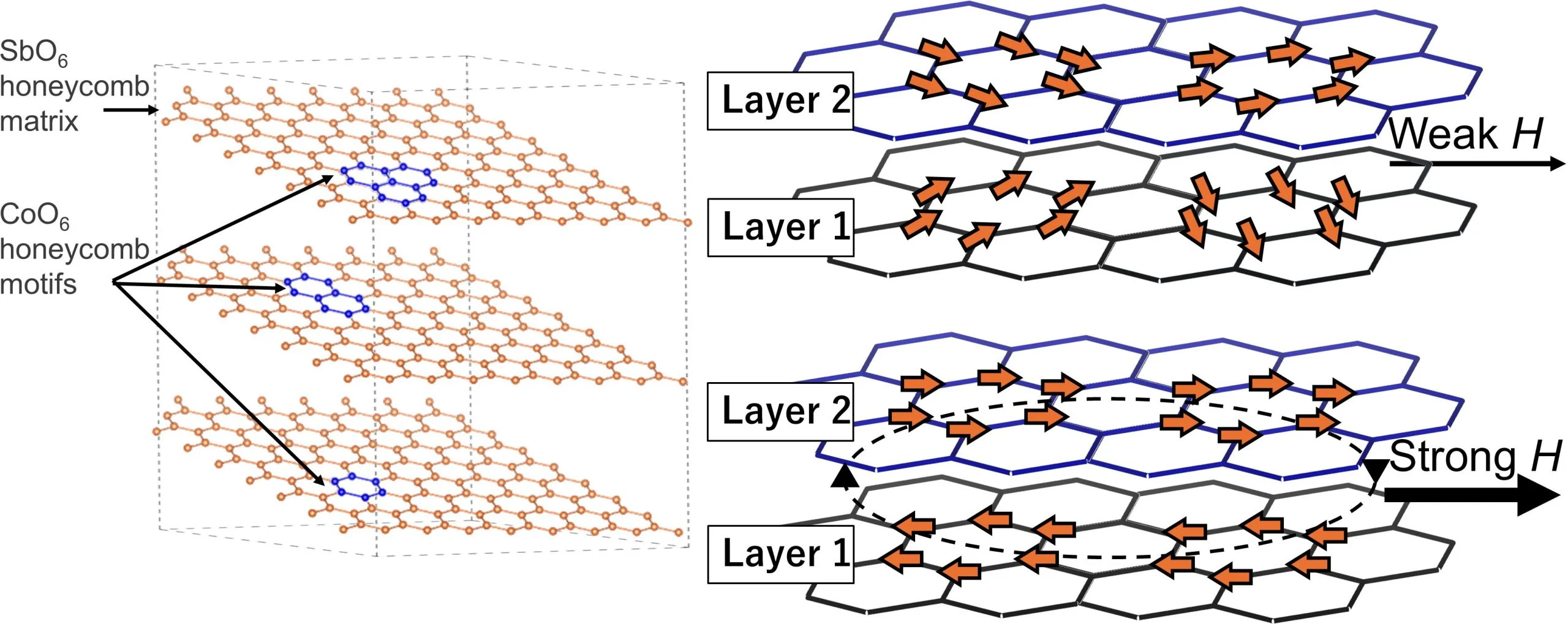
The base material chosen by the researchers is sodium antimonate (NaSbO₃), which itself has a layered honeycomb structure. The research team added about 4% cobalt to it, allowing the cobalt atoms to locally form a CoO₆ honeycomb structure without destroying the original large-scale crystal structure.
The researchers then used microscopic analysis to confirm that the cobalt atoms were indeed aggregated into a local honeycomb structure as predicted by theory, and no obvious undesired second phase was formed. This is important because to create a material with specific quantum magnetism, it is not enough to simply add one element to another crystal. The doping atoms must also form a sufficiently stable local structure with a specific geometric arrangement.
The key to this research lies in the honeycomb arrangement itself. Kitaev materials are valued by physicists because specific honeycomb lattice and magnetic interactions may produce very special quantum states, the most interesting of which are quantum spin liquids.
In ordinary magnetic materials, the spins of a large number of atoms tend to eventually arrange themselves according to certain rules, such as forming a ferromagnetic or antiferromagnetic structure. But in quantum spin liquids, even if the temperature is reduced to very low levels, the spins may not be able to form long-range magnetic order in the traditional sense due to quantum fluctuations, but maintain a highly entangled dynamic state.
This type of material has always been an important object of quantum physics research. Theoretically, some quantum spin liquids may have very special quasiparticle excitations and topological properties, and are therefore considered to be potentially relevant to future quantum computing and new quantum device research. However, this type of material is still far away from being actually used in quantum computing.
Previously, a large number of Kitaev materials research focused on compounds containing ruthenium and iridium, because these elements can provide properties such as strong spin-orbit coupling required for research. However, both ruthenium and iridium are relatively rare and expensive elements, which to a certain extent limits the large-scale preparation and further application exploration of related materials.
This is why cobalt is of concern to researchers. Cobalt is a relatively common transition metal that has been widely used in batteries, alloys, semiconductor manufacturing and other fields. Its cost and supply are generally more conducive to large-scale use than ruthenium and iridium. The research team hopes to verify a key question: whether cobalt can be made to form a honeycomb structure similar to that in Kitaev's material, and thus obtain magnetic properties with research value.
Experimental results show that this idea is indeed feasible. Magnetic measurements found that the material appears in a ferromagnetic state near about 88 Kelvin, which is about minus 185 degrees Celsius. Theoretical calculations show that this magnetic behavior is closely related to the arrangement of cobalt atoms in the local honeycomb structure of CoO₆.
The study also found that the material exhibits interlayer antiferromagnetic coupling, that is, although the local structure exhibits ferromagnetic-like magnetic characteristics, the directions of magnetic interactions between different layers are different. This complex magnetic interaction is an important basis for studying new quantum magnetic materials.
However, the researchers also clearly emphasized that there is currently no evidence that this cobalt-based material has formed a quantum spin liquid. Therefore, it is not accurate to directly call this achievement "the discovery of a quantum spin liquid that can be used for quantum computing." A more accurate statement at this stage is that the research team has established a new material platform with Kitaev-type magnetic characteristics and based on the more common cobalt element.
Another important significance of this work is that the researchers did not forcibly create a honeycomb structure through extremely complex artificial atomic arrangement technology. Instead, they incorporated cobalt into NaSbO₃, which already has a honeycomb lattice, and allowed the cobalt atoms to form a local CoO₆ honeycomb structure on their own.
The researchers said that the ability of these cobalt honeycomb structures to form naturally and produce the obvious magnetic signals predicted by theory is an exciting result of this work. This means that similar material design ideas may be used in the future, by selecting ordinary materials with specific lattice structures as "templates" and then adding appropriate magnetic elements to construct quantum materials that could only rely on rare elements in the past.
The research team is currently further tweaking the material's structure and testing its quantum properties in more detail. Important questions in the next stage include whether the relevant magnetic interactions can be further enhanced and controlled, and whether the material can enter a quantum state closer to the theoretical Kitaev model by changing the concentration, crystal structure and interlayer coupling of cobalt.
Therefore, the significance of this research is temporarily more reflected in the fields of basic materials science and quantum magnetism research, rather than the immediate creation of a new quantum computer chip. What it really provides is a new material design route: using cobalt, which is relatively abundant in reserves and relatively low-cost, to build local special magnetic structures in existing honeycomb lattice materials, thereby reducing reliance on rare elements such as ruthenium and iridium.
If follow-up research can further prove that this cobalt-based system has stronger quantum entanglement, topological excitation or other Kitaev-type quantum characteristics, then it may become an important experimental platform for studying quantum spin liquids and new quantum materials, and may also provide new directions for the future exploration of quantum materials that are easier to manufacture on a large scale.
Comments