
Abstract:
HOMOLAB, a well-known testing agency, conducted an actual measurement of the storage performance of the 1TB iPhone 18 Pro Max. The results showed that the flash memory speed of this model dropped significantly under sustained high-load writing scenarios, even lower than some entry-level microSD cards.
The 1TB version of iPhone 18 Pro Max uses QLC flash memory, and each storage unit can save 4 bits of data.
Compared to the TLC flash memory used in most mobile phones (3 bits per cell), QLC provides higher capacity in the same physical space, but is generally not as fast and durable as TLC. HOMOLAB compared it with the iPhone 18 Pro equipped with 512GB TLC flash memory.
In the weighted 4K reading test, the two models performed similarly, with the QLC version scoring 46045 and the TLC version scoring 51282. The gap widens significantly under mixed read and write loads: the TLC version leads by about 38% when the queue depth is low, and the gap shrinks to about 12% under high load scenarios.
Tests show that iPhone 18 Pro Max, like most modern mobile phones, is equipped with a high-speed SLC cache to cope with burst data writes. When the cache space is sufficient, the speed can exceed 3000MB/s. Once the cache is exhausted, the phone will fall back to a secondary buffer that simulates TLC, and the average write speed is 578MB/s, but it fluctuates widely.
When the secondary buffer is also full, the data will be written directly to the QLC flash memory. At this time, the sustained writing speed is only 79.4MB/s on average and as low as 25.6MB/s, which is not as good as many cheap microSD cards.
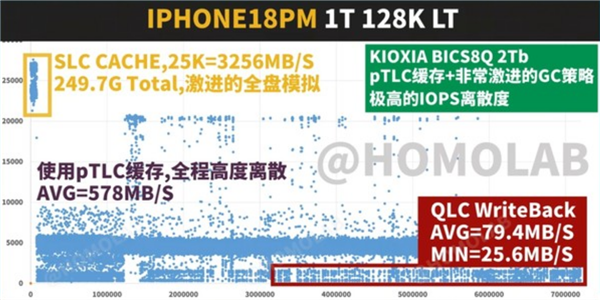
As storage space usage increases, performance degradation further intensifies. When 60% of the capacity is used, the available SLC cache drops from about 250GB when the disk is empty to 58GB. The average speed of the simulated TLC buffer drops to 396MB/s. The average speed of the original QLC write stage is only 45MB/s, with the lowest falling to 1.1MB/s, which is obviously behind the TLC UFS 4.0 storage used by other flagship models.
Foreign media analysis said that for daily use scenarios, such as sending messages, browsing the web and taking ordinary photos, this performance difference is usually difficult to perceive. However, users will notice a significant speed drop when performing sustained high-write operations such as long-term 4K or ProRes video recording, large file transfers, or backup and recovery. These scenarios are exactly what users of the large-capacity version may frequently encounter.
Comments