
Abstract:
Apple this week officially released the new generation iPad mini (2026) equipped with an OLED display and A20 Pro chip. The product will begin shipping to the first consumers on November 6. Before the official launch, a new machine has appeared in the Geekbench 7 database, and its performance has also been exposed.
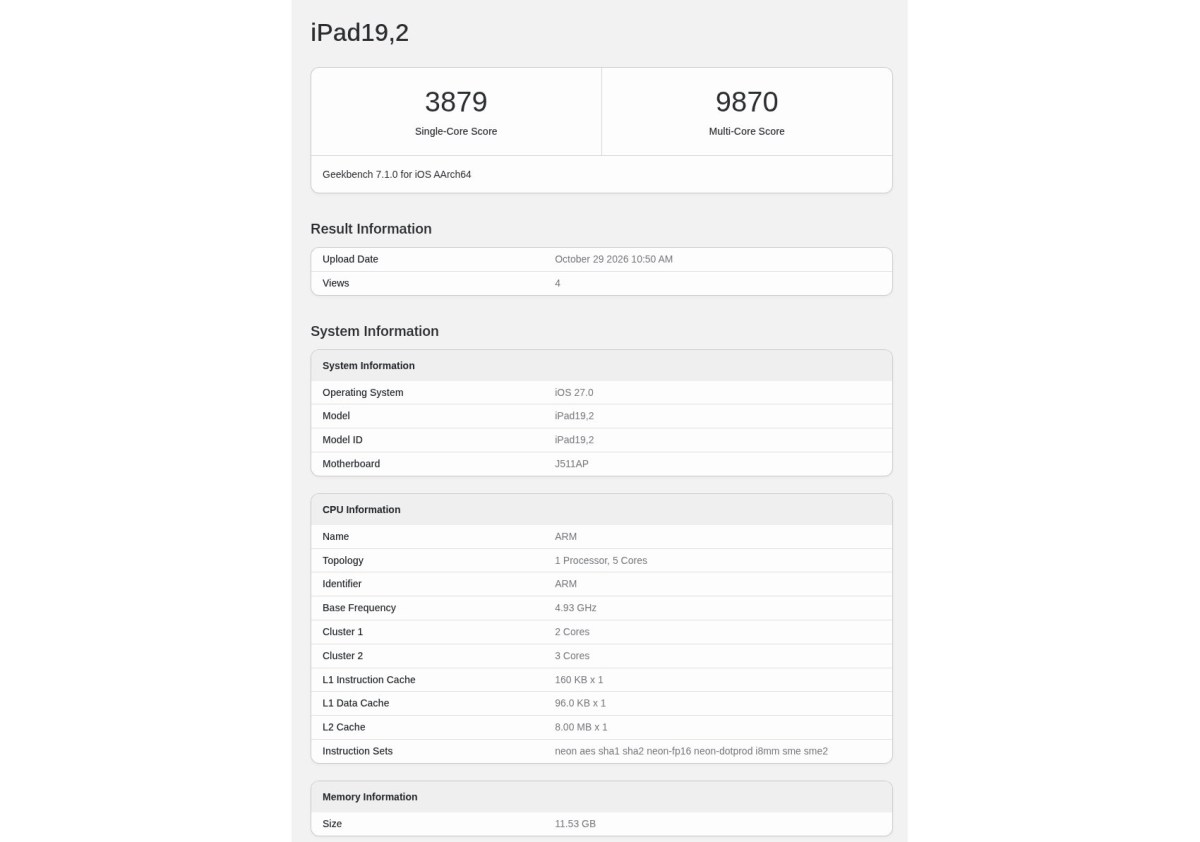
The model of the device tested this time is iPad19, 2, which corresponds to the cellular network version (Wi‑Fi + Cellular) model. Geekbench 7 test results show that its single-core score reached 3879 points and multi-core score was 9870 points. Database information shows that this processor adopts a five-core CPU design, including two performance cores and three energy efficiency cores, of which the maximum frequency of the performance core reaches 4.93GHz.
Judging from the configuration characteristics, the devices participating in the test should be 128GB or 256GB storage versions. Apple uses a streamlined A20 Pro chip in these capacity versions, shielding one energy-efficiency core, so the total CPU core count is five. Only the 512GB version comes with a full six-core A20 Pro processor. This is not the first time Apple has adopted a similar strategy. The A17 Pro equipped with the previous generation iPad mini is also a cropped version.
Benchmark information also shows that the new iPad mini is equipped with 12GB of memory. However, consistent with Apple's usual practice, this specification does not appear in official marketing materials.
For comparison, the iPhone 18 Pro Max, equipped with a complete six-core A20 Pro chip, scored approximately 4024 points in Geekbench 7 for single-core and 11424 points for multi-core. This means that the new iPad mini lags only about 4% in single-core performance and about 14% in multi-core performance. This gap is basically consistent with its lack of a CPU core.
Compared with the previous generation products, the new phone has achieved significant improvements. The Geekbench 7 scores of the previous generation iPad mini were approximately 2638 points in single-core and 7103 points in multi-core. Calculated based on this data, the single-core performance of the new model is improved by about 47%, and the multi-core performance is improved by about 39%. The performance jump is very obvious.
The results are even more interesting if you compare it to Apple's larger tablet. The 13-inch iPad Pro equipped with the M5 chip scored approximately 3580 points in single-core and 15126 points in multi-core in Geekbench 7. The single-core score of the new iPad mini is about 8% higher, but in terms of multi-core performance, the iPad Pro still leads by about 53%.
Faced with the 13-inch iPad Air equipped with an M4 chip, its Geekbench 7 score is approximately 3206 points for single-core and 12686 points for multi-core. The new iPad mini leads by about 21% in single-core performance, while the iPad Air leads by about 29% in multi-core testing.
These results show that although Apple's latest small-size tablet is already quite competitive in terms of single-thread performance and can even surpass some higher-positioned iPad products, in multi-threaded tasks that require a large amount of parallel computing, M-series processors with more cores still maintain a clear advantage.
In terms of price, the iPad mini (2026) starts at $699, 749 euros, or 699 pounds, and pre-orders are currently open.
Comments