
Abstract:
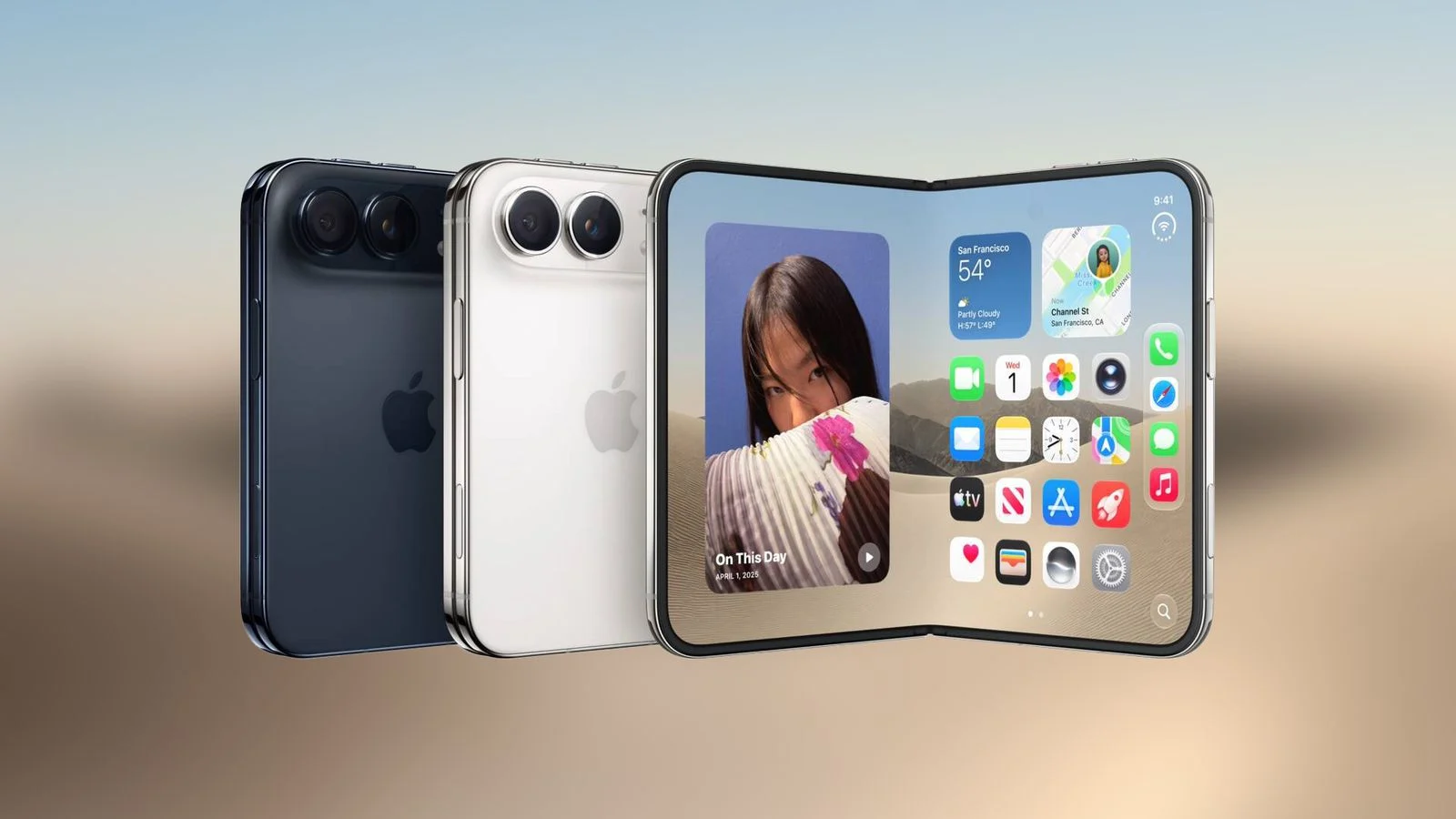
Apple’s first foldable screen phone iPhone Duo will be officially launched soon. Before product pre-orders were launched, this new machine had already appeared in the Geekbench 7 performance test database.
Preliminary running scores show that the CPU performance of iPhone Duo is basically at the same level as the iPhone 18 Pro series equipped with the same A20 Pro chip, with a single-core score of 3986 points and a multi-core score of 11067 points.
In addition, the test information also shows that the machine is equipped with 12GB of running memory and runs iOS 27.1 system.
This means that Apple has not significantly reduced its processor configuration because the iPhone Duo adopts a folding screen design. Judging from the test results published so far, this phone can reach the level of Apple's flagship candy bar phone in terms of CPU computing power. However, since there is currently only one set of test results, it is not enough to fully judge its continuous performance, graphics processing capabilities, and actual performance when running large games for a long time.
The device model that appears in the Geekbench database this time is iPhone19, 4, and the running system is iOS 27.1. The test results show that its single-core score is 3986 points and multi-core score is 11067 points. The relevant results are generally consistent with the test results of multiple sets of iPhone 18 Pro and iPhone 18 Pro Max that have appeared previously.
iPhone Duo uses Apple’s latest A20 Pro processor. This chip uses a 2nm manufacturing process and is equipped with a six-core CPU and a seven-core GPU. Since the iPhone 18 Pro series also uses A20 Pro, the two products remain consistent in the basic configuration of the processor.
Judging from the CPU frequency information, test records show that its processor frequency is approximately 4.93GHz, which is consistent with the frequency information that appeared in the previous iPhone 18 Pro series running scores. This further shows that the iPhone Duo does not use a special version of the chip that has been significantly downclocked.
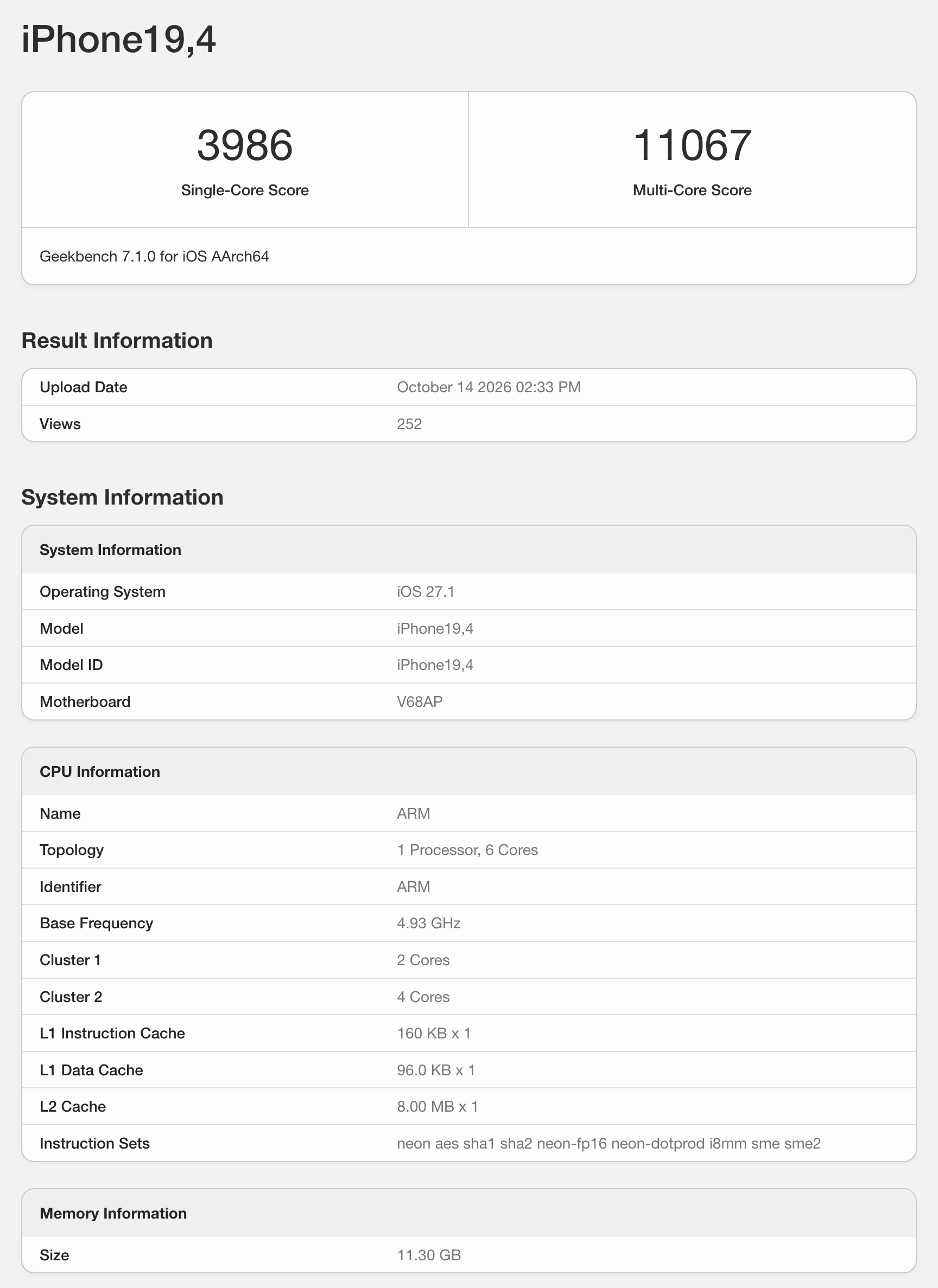
In terms of memory, Geekbench records show that the device has approximately 11.30GB of available memory, and the corresponding nominal running memory capacity is 12GB. For a folding screen phone with a dual-screen design, a larger memory capacity helps the system maintain the running status of multiple applications at the same time and provides space for multi-tasking.
The dual-screen design of iPhone Duo is an important feature that distinguishes it from traditional iPhones. According to information previously released by Apple, the machine is equipped with a 5.4-inch external screen, which can be used to use a 7.6-inch internal screen when unfolded. A larger display area can provide more space for split-screen operations, multi-window applications, videos and games, but may also increase the system's resource requirements in certain usage scenarios.
The performance targets set by Apple for the A20 Pro are also quite aggressive. The company said that compared with the previous generation A19 Pro, the CPU performance of the A20 Pro has been improved by up to 20%, and the GPU performance has been improved by up to 40%. However, this Geekbench test mainly measures CPU performance and does not provide GPU running scores. Therefore, this set of data alone cannot be used to verify Apple's claim that graphics performance has been improved by 40%.
Geekbench's single-core test mainly reflects the processor's ability to perform single-threaded tasks, while the multi-core test focuses more on the performance of multiple CPU cores co-processing tasks. These indicators can help users initially understand the computing power of the chip, but they do not fully represent the overall performance of the mobile phone.
For example, when a mobile phone runs a large-scale game, in addition to CPU performance, it will also be affected by GPU computing power, memory bandwidth, game optimization, and cooling system. For folding screen devices, the screen size, display content and running time may also change the power consumption and temperature performance of the entire machine. Therefore, even if iPhone Duo and iPhone 18 Pro achieve similar results in short-term CPU tests, the two phones may still perform differently when running under high load for a long time.
Heat dissipation is one factor worth paying attention to. iPhone Duo adopts a dual-screen folding structure, and its internal space layout is different from traditional candy bar phones. When the device runs high-load applications for a long time, the heat generated by the processor needs to be conducted and released through the internal heat dissipation structure. If the temperature reaches the limit set by the system, the device may reduce the processor frequency to control heating and power consumption. This is often called thermal throttling.
However, Apple has previously designed a special heat dissipation solution for the iPhone Duo, so it cannot be concluded that its heat dissipation capability is inferior to the iPhone 18 Pro based on the folding screen structure alone. To judge the actual difference between the two under sustained load, we need to wait for more complete tests, including long-term CPU stress test, GPU test, game frame rate, temperature change and other data.
There is another noteworthy aspect of this running score: although the iPhone Duo's results are close to those of the iPhone 18 Pro series, they do not reach the highest level that this series has ever seen in the Geekbench database. This does not necessarily mean that the performance of the new machine is weaker, as different tests may be affected by factors such as device temperature, power status, background processes, and software versions. Currently there is only one set of iPhone Duo test results, and it is impossible to judge its performance upper limit based on this.
From the perspective of product positioning, Apple obviously hopes that iPhone Duo will not only be a mobile phone with a new form, but also maintain flagship-level computing performance. The advantages brought by the folding screen are not only the increase in screen area, but also the ability to run two applications, process documents, browse the web, and perform more complex multitasking operations on the same device. If the processor and memory configuration lag significantly behind the flagship candy bar machine, it will limit the performance of these functions.
Apple has previously confirmed that iPhone Duo will start pre-orders on October 16 and will be officially launched on October 23. As the launch date approaches, more retail device performance tests are expected to appear one after another, and only then can a more comprehensive judgment be made on the actual performance of this phone.
Overall, this Geekbench score at least shows that iPhone Duo does not deviate significantly from the iPhone 18 Pro series in terms of CPU configuration and preliminary computing performance. The A20 Pro chip, six-core CPU, seven-core GPU and 12GB of running memory provide a strong hardware foundation for multi-tasking and large-scale application running.
But a single run is still just the starting point for performance evaluation. For consumers, what really deserves attention include the smoothness of dual-screen use at the same time, gaming performance, heat dissipation performance, battery life, and whether the folding screen software ecosystem is mature enough. As the iPhone Duo is officially launched, these issues will determine whether it can become a successful flagship folding screen phone more than a single benchmark number.
Comments