
Abstract:
British Reuters reported on October 21, local time, that eBay’s chief executive officer (CEO) announced through an internal memorandum that it would lay off 9% of its employees globally, involving about 1,000 positions. According to other news, eBay China launched a new round of personnel adjustment plan this week. The proportion of layoffs in major offices in Shanghai and other China areas may have reached 80%. Many employees have begun to look for new job opportunities through recruitment platforms.

On the 22nd, the relevant person in charge of eBay responded to Blue Whale News, saying that the company did make global personnel adjustments yesterday, and China was part of it. However, the statement online that "80% of layoffs in China" is speculation. eBay’s CEO has announced that the latest personnel adjustments will affect about 9% of employees worldwide.
The person in charge said that there is a lot of relevant news on the Internet, but what is certain is that eBay has not closed its Chinese R&D center, nor has it withdrawn from the Chinese market. At present, related activities for sellers are still advancing steadily, and the annual auto parts sellers event will be held in December.
Qichacha data shows that in 2025, the number of employees of Shanghai Yibei Network Information Services Co., Ltd. will be 118, the number of employees of Yibei Software Engineering (Shanghai) Co., Ltd. will be 611, and the number of employees of Yibei Management (Shanghai) Co., Ltd. will be 87. SignalHire estimates that the size of eBay's China R&D center is about 500 to 1,000 people.
The relationship between eBay and the Chinese market can be traced back to 1999. At that time, Shao Yibo and Tan Haiyin, both graduates of Harvard Business School, founded eBay in Shanghai and became one of the earliest C2C (consumer-to-consumer) e-commerce platforms in China. In 2002, eBay of the United States invested US$30 million in eBay and began to enter the Chinese market.
In 2003, eBay spent another US$150 million to fully acquire the remaining shares of eBay, and eBay changed its name to "eBay eBay". At that time, its share in the domestic C2C market was close to 80% to 90%, and it was in an absolute leading position. However, after Taobao went online in 2003, eBay's market share declined until it announced in 2006 that it would withdraw from direct C2C operations in mainland China.
After abandoning China’s local C2C market, eBay discovered that a large number of foreign trade sellers in China sell goods overseas through the platform. As a result, eBay has fully shifted to the positioning of "China's cross-border export e-commerce" to connect Chinese sellers and overseas buyers.
However, as the global e-commerce industry chain becomes increasingly complete, eBay is gradually losing out in competition with e-commerce platforms such as Amazon due to its lack of infrastructure such as logistics systems.
In recent years, eBay has laid off employees many times around the world. In February 2023, about 500 people were laid off; in January 2024, about 1,000 people were laid off; in February this year, the company laid off another 6.5%. According to its latest annual report, the company had 12,300 employees as of the end of 2025.
On October 21 this year, eBay announced through an internal memo that it would lay off approximately 9% of its employees worldwide, involving approximately 1,000 jobs. Calculating the two rounds of layoffs since this year, the global employee size has been reduced by approximately 15%.
However, eBay's revenue has grown in recent quarters. In the second quarter of 2026, the company's total merchandise volume (GMV) reached US$22.4 billion, revenue was US$3.13 billion, and non-GAAP earnings per share were US$1.60, both exceeding market expectations.
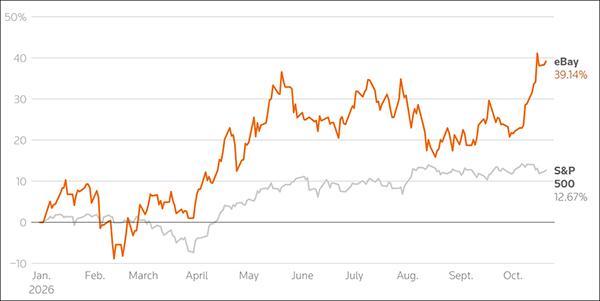
Since this year, eBay’s stock price has been compared with the S&P 500 index. Reuters Chart
Some analysts pointed out that eBay continues to reduce personnel despite acceptable performance. One of its core purposes is to refocus resources on artificial intelligence (AI) and businesses with higher growth potential.
Earlier this year, eBay acquired second-hand fashion platform Depop for $1.2 billion. The platform's target users are mainly Generation Z consumers. This acquisition not only expands its influence among young consumers, but also consolidates eBay's position in the growing second-hand goods trading market.
EBay management expects that Depop will drag down the company's profit margin by about 2 percentage points in the short term, but it is expected to contribute to profits starting in 2028.
At the same time, eBay plans to increase investment in AI and focus its resources on core categories such as collectibles and fashion, as well as live streaming shopping services such as eBay Live.
In August, eBay raised its full-year performance forecast and plans to release its latest quarterly financial report next week.
Comments