
Abstract:
Meta announced that starting from November 6, its personal intelligent assistant application Muse and Meta AI platform will fully enable a batch of new dedicated models trained based on the flagship model Muse Wonder. In the meantime, the more powerful Muse Wonder model will remain available to paying subscribers for handling more complex and difficult tasks.

According to Meta, these new models are "specialized versions" of the existing model system and are trained through Muse Wonder. Although Meta has not disclosed the specific names of these models, they inherit the two core capabilities first introduced in the Wonder series, namely "Active Memory" and "Active Focus".
Muse Wonder and the more powerful Wonder Full were initially released in October 2026. Among them, Wonder has been integrated into the Meta Model API and Muse Code programming assistant, while Wonder Full is currently only open to high-end paying users of Muse Code.
Meta launched Muse, a personal intelligent assistant application, in September this year. Unlike many competing products, Muse offers a free usage tier, which significantly lowers the threshold for users to try personal AI agents. In contrast, similar products from some competitors are only available to premium subscribers.
In terms of technical implementation, Meta did not simply launch a reduced version of the Wonder model this time, but retrained the model for consumer application scenarios. The company said the new model focuses on learning key behavioral patterns of personal assistants in actual use, such as determining when a task should be performed autonomously, when confirmation from the user is needed, and how to maintain context continuity after receiving user corrections during task execution.
The industry generally adopts the method of training small models with large models to promote cutting-edge capabilities to large-scale users at a lower cost. However, Meta did not disclose specific training methods in detail. The company emphasizes that the new model is specifically optimized to meet the specific needs of personal intelligent assistants, rather than purely pursuing general knowledge coverage.
Meta believes that an excellent personal agent needs to be able to complete practical tasks such as making restaurant reservations and managing mailboxes, without having to master all the knowledge reserves possessed by cutting-edge models. Rather, it involves remembering information a user mentioned a week ago and continuing to work when a site error occurs or the task is interrupted.
The "active memory" feature is designed to help models preserve and utilize user-related information over the long term. Meta said that after training, the model can distinguish which information is temporary content and which content needs to be retained for a long time. It can also reason across the time dimension and determine which information is still relevant and which is outdated.
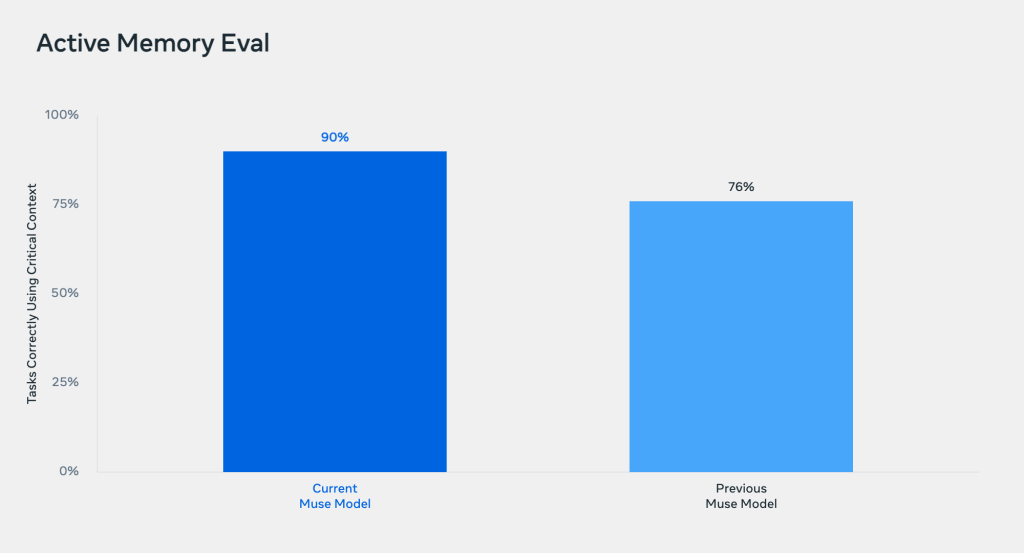
In Meta’s internal testing, the new model’s success rate in correctly utilizing key contextual information during task execution reached 90%, which is significantly improved compared to the 76% rate of the previous generation model.
Another "Active Focus" feature focuses on handling emergencies during task execution. Meta said that the model was trained on a large number of real-world obstacle scenarios, so it can proactively try more solutions when encountering difficulties, resume the process on its own or find alternative paths, rather than just stopping working after encountering a problem.
Meta revealed that in the Muse application, when the new model encountered unexpected problems, its ability to complete routine tasks increased by 67%. Although the company did not release specific benchmark data, it said these models showed significant improvements in autonomous decision-making, handling mid-stream modifications, and continuous advancement of tasks.
At the commercial level, Muse Wonder currently provides services to developers through Meta’s model interface and charges based on input and output Tokens. At the same time, Meta AI has been widely integrated into platforms such as WhatsApp, Instagram, Facebook and Messenger. For Meta, using lightweight dedicated models trained by Wonder to serve a large number of users is undoubtedly more cost-effective and efficient than letting all users directly call the flagship model.
This update also shows that Meta is advancing a new AI development strategy, which is to use the most advanced cutting-edge models to train professional models optimized for specific scenarios, and deploy these capabilities into products for ordinary consumers at a lower cost and on a larger scale.
Comments