
Abstract:
Microsoft announced that it will officially end the Edge browser’s support for native XSLT (Extensible Stylesheet Language Transformation) and announced a detailed retirement schedule. This web technology, which is more than two decades old, will be phased out over the next few versions and eventually removed from Edge entirely.
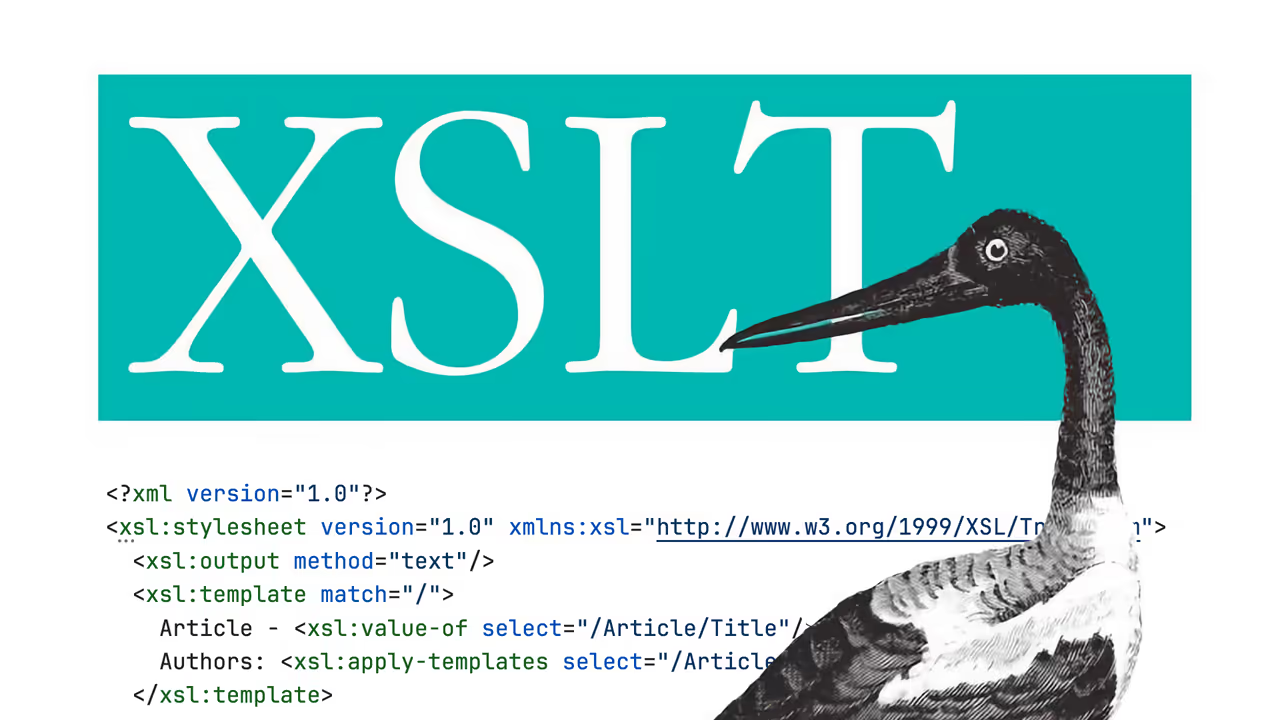
In fact, Microsoft had earlier added relevant policies to Edge to allow users to manually turn off XSLT functions. The reasons given by the company at the time were that the technology had extremely low usage and also had security risks. Today, Microsoft is further advancing this plan and officially launching a comprehensive elimination process.
According to a notice issued by Microsoft to IT administrators, browser native XSLT functionality is expected to be disabled by default by mid-December 2026. XSLT was recommended by the World Wide Web Consortium (W3C) in 1999 and is mainly used to convert XML documents into other formats such as HTML. However, with the development of modern Web technology, this solution has gradually lost its market base.
Microsoft data shows that currently only about 0.02% of website pages still involve XSLT, and the proportion of web pages that actually use the XSLT conversion function is even less than 0.001%. In addition to extremely low usage, Microsoft also emphasized that the technology carries high security risks and that modern development environments already provide more advanced and safer alternatives.
According to the plan, the Edge 159 version released later this year will turn off the XSLTProcessor JavaScript API by default, as well as the ability to call XSLT style sheets through XML processing instructions. If an enterprise's internal system or external website relies on the browser's native XSLT functionality, it may be affected. However, the XML processing method that references CSS style sheets will not be affected by this adjustment.
Microsoft recommends that enterprise administrators use the Lighthouse tool in the Edge browser to audit the websites being used within the organization to confirm whether they rely on the browser's native XSLT. If an affected website is discovered, the organization with control should migrate it to a modern technology solution as soon as possible; for third-party websites, the corresponding developer or supplier should be contacted to promote the upgrade.
To buy more time for enterprise migration, Microsoft will maintain a temporary measure after the release of Edge 159. Administrators can continue to enable XSLT support by manually setting the "XSLTEnabled" policy to True. However, Microsoft has made it clear that this is only a transitional solution, not a long-term solution.
According to the roadmap, the policy itself will be removed by the Edge 176 release in summer 2027. By then, native XSLT support in Edge will be completely removed, and users will no longer be able to re-enable this feature through any official means.
This means that a network technology that was born at the end of the last century and was widely used for the display and conversion of XML documents is officially withdrawing from the Microsoft browser ecosystem. For businesses and organizations that still rely on related functions, the next few months will be a critical window to complete system upgrades and technology migrations.
Comments