
Abstract:
Researchers at the University of California, Los Angeles (UCLA) and the University of Michigan have developed a compact bionic robot. It can jump like a frog, move on complex surfaces such as grass and sand, cross small steps, and even swim in the water after installing special fins. Unlike traditional robots that rely on motors to continuously drive leg movements, this device stores energy by twisting elastic rods and then uses the sudden deformation of the material to generate instant thrust, allowing it to bounce quickly.
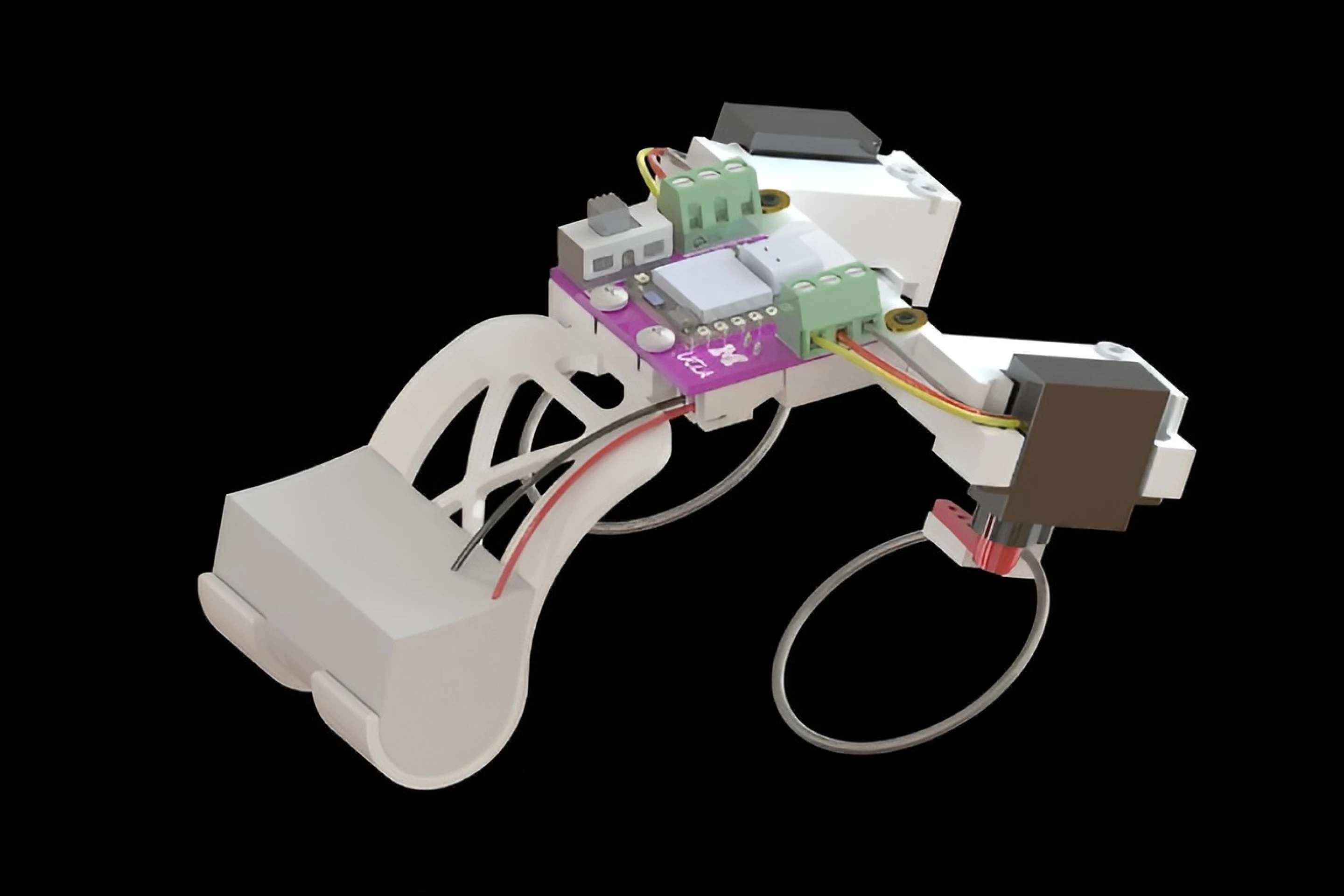
This research demonstrates a new locomotion mechanism suitable for microrobots. Researchers hope that by improving the mechanical structure, small robots can generate strong enough instantaneous power without using larger motors. Relevant results were published in the journal Science Advances.
For smaller robots, moving is not as simple as it seems. Blades of grass, loose sand, folds of fabric, and small obstacles on the ground can all pose serious obstacles. When the height of the obstacle is close to the size of the robot itself, it is often difficult to pass it smoothly by relying solely on wheels or ordinary mechanical legs.
Jumping is one solution, but it places special demands on power output. Robots not only need enough energy, but also must release the energy in a very short time to obtain strong upward or forward thrust. However, small motors are often good at providing sustained, smooth power, but struggle to directly produce such strong instantaneous output.
Engineers have previously tried to solve this problem with springs: first let the motor slowly compress or stretch the spring, store the energy in the form of elastic potential energy, and then quickly release the spring to achieve ejection. However, how to make elastic materials in three-dimensional structures deform suddenly and stably, reproducibly, and recover quickly after each movement is still a challenging technical problem.
This time the research team used an elastic rod structure similar to a coil spring. The researchers first used a computer model to analyze the deformation rules of the elastic rod under different bending and torsion conditions, and then used a robotic arm to conduct bending and torsion experiments on real materials to compare the model predictions with actual results.
Through these experiments, the researchers gradually determined which geometries and loading methods caused the elastic rod to undergo sudden morphological transformations, rather than slowly deforming. After mastering these conditions, they can design corresponding elastic limbs according to the robot's movement needs.
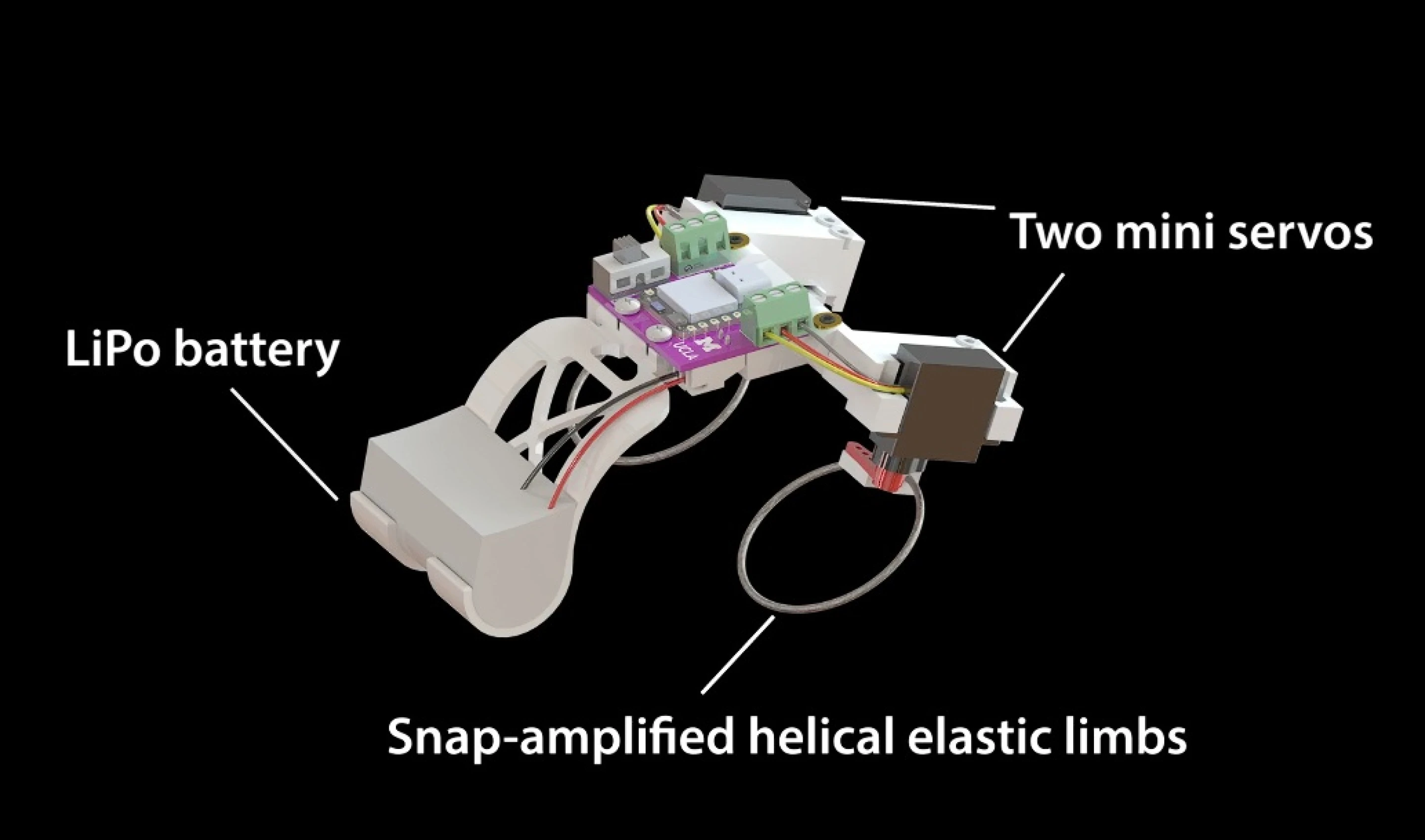
The elastic rod used by the robot is made of nickel-titanium alloy. The researchers bent the originally straight rod into a spiral shape, fixed one end to the bracket, and connected the other end to a small servo motor. When the motor rotates, the elastic rod will bend and twist at the same time, and gradually store elastic potential energy.
As the deformation continues to increase, the rod eventually reaches an unstable critical state and then suddenly flips to another configuration. This rapid change in form creates a noticeable instantaneous motion, catapulting the robot upward and forward.
The whole process is similar to compressing a spring and then suddenly releasing it. The motor does not have to directly output all the power required for jumping in a very short time, but can slowly accumulate energy over a longer period of time and then release it concentratedly through the elastic structure.
After completing a jump, the motor rotates in the opposite direction, returning the elastic rod to the initial state required for the next jump. Since part of the reset process can be completed while the robot is in the air, the robot can quickly prepare for the next bounce after landing.
However, the design of the elastic rod needs to strike a balance between jumping force and return speed. Although some structures can release more energy, they require the motor to rotate through a larger angle to recover, resulting in longer intervals between consecutive jumps. The researchers ultimately chose a design that could generate stronger thrust and complete reset in a shorter time.
To verify whether this mechanism is truly applicable to a complete robot, the research team built a prototype that is about 11 centimeters long and weighs 98.2 grams. Its back is equipped with two elastic limbs that can suddenly deform, and its overall movement method is somewhat similar to that of a frog.
The researchers also built a control robot with a rigid leg structure. The two robots have the same motor power, but the main difference is how the power is used: the control robot relies on rigid legs to continuously output motion, while the new robot first stores energy and then releases it through sudden deformation of elastic rods.
The test covers six surfaces: wood, cloth, acrylic, leather, grass and sand. Results showed that the new bouncing robot moved faster than the rigid-legged version on all tested surfaces.
On a wooden board, the new robot reached a speed of 3.21 body lengths per second. Combining the test results of the six surfaces, the average speed is 2.46 body lengths per second, while the average speed of the rigid-legged robot is only 0.79 body lengths per second. In other words, in this set of control experiments, the bouncing robot moved on average about 3.1 times faster than the rigid-legged version.
On cloth and grass, the performance gap between the two robots is particularly obvious. Rigid-legged robots can hardly move smoothly on these surfaces that are prone to obstruction or slippage, while bouncing robots can use instantaneous thrust to overcome some of the resistance and continue to move forward.
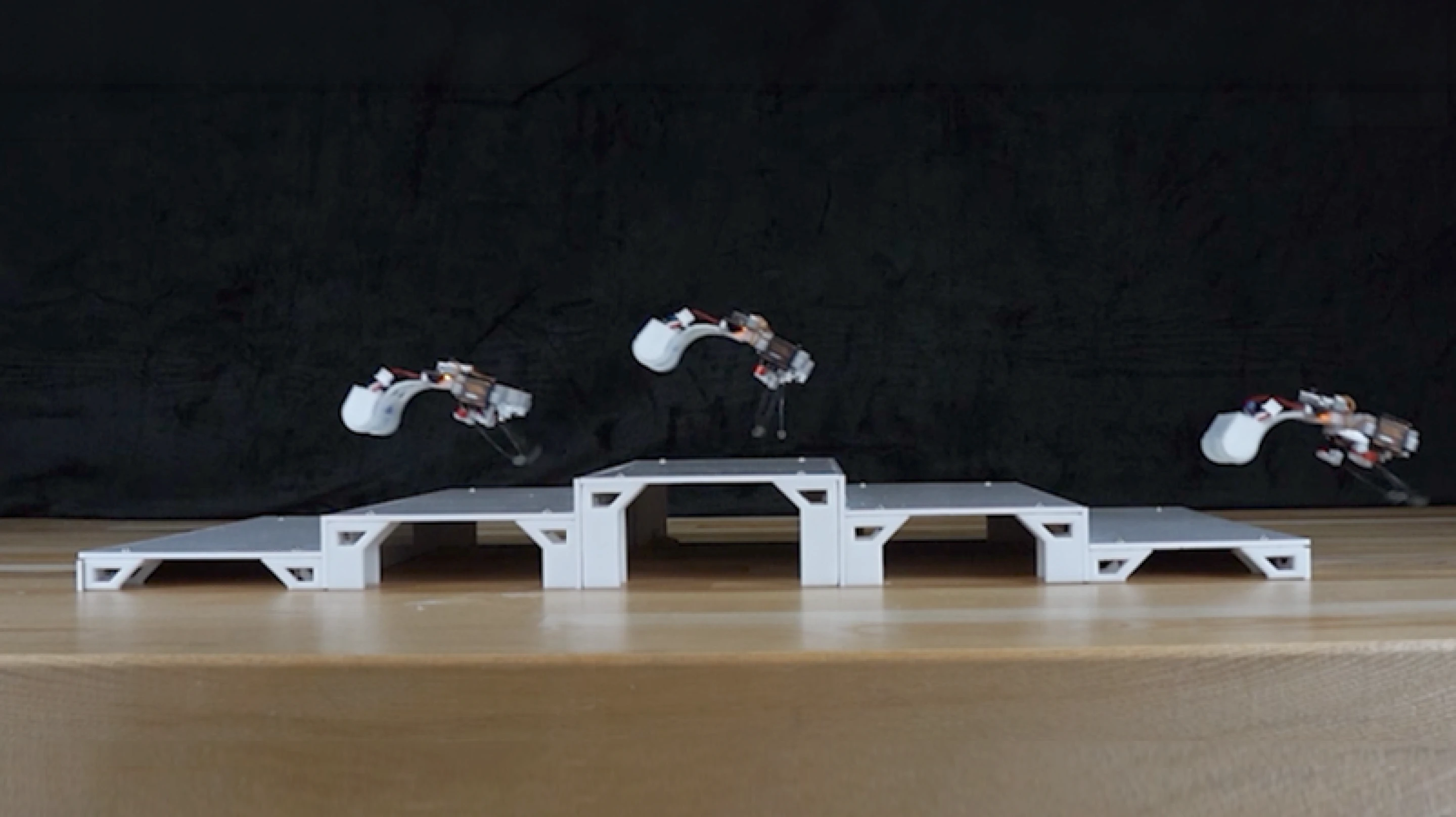
In addition to jumping on flat surfaces, the robot also demonstrated the ability to cross small steps and complete backflips continuously. These actions show that the elastic rod can not only help the robot generate forward thrust, but also achieve more complex body movements under specific structure and control conditions.
The researchers also equipped the robot with thin, flexible fins to allow it to swim in the water. At this time, the elastic limbs originally used for jumping can be used with the fins to push the water body, allowing the robot to move at a speed of about 0.5 body lengths per second.
The robot can not only move forward in the water, but also change the direction of movement and avoid obstacles in test conditions with wind disturbances. On land, the researchers controlled the two elastic limbs to move at different frequencies to make the robot change its direction.
In a land navigation demonstration, researchers remotely piloted a robot through a rock-strewn sandbox to demonstrate its ability to move in a complex environment. In addition, the team also used light sensors to allow the robot to demonstrate its ability to autonomously turn in the direction of the light source.
This means that the device already has some basic environmental response capabilities. However, the autonomous navigation currently demonstrated is still relatively simple and is still far from a mature robot system that can independently identify complex environments, plan routes and complete tasks.
Researchers believe that this movement mechanism may be suitable for disaster site search and rescue, equipment inspection, and other tasks that require crossing complex terrain. For example, at the site of an earthquake or building collapse, microrobots may need to navigate rubble, loose materials, and tight spaces. When traditional wheeled robots encounter obstacles, they often need to go around or find a passable route, while robots that can jump have the opportunity to directly overcome some obstacles.
If the same mechanical structure can bounce on land and push fins in water, then the robot may not need to install two completely independent propulsion systems when switching between different environments. This design is expected to reduce the complexity of some devices and provide new options for microrobots that need to work in humid environments, waterlogged areas, or complex terrain.
The technology has implications beyond jumping robots, either. The researchers point out that using the mechanical structure itself to store and release energy could reduce reliance on large motors or complex control systems. This idea may also be used for devices such as robot grippers that require fast movements. For example, some mechanical grippers need to close in a very short time. If energy can be stored first and then released quickly, there is an opportunity to achieve faster action speeds without significantly increasing the size of the motor.
The research team also believes that this set of design principles may be used to create robots that are only a few millimeters in size in the future. The key lies in the relationship between the geometry of the elastic rod and the sudden deformation behavior, rather than having to rely on a specific size of motor or large drive. However, whether it can truly be reduced to the millimeter level still requires further research and experimental verification.
At present, this robot is still a scientific research prototype. Existing tests have proven that it moves faster than a control version with rigid legs, but the team has yet to demonstrate that it can outperform other jumping robots that use springs or elastic structures. Different designs have differences in jumping height, movement speed, energy efficiency, control accuracy and reset time, and they still need to be compared under uniform conditions.
In addition, the prototype currently only demonstrates basic navigation, obstacle crossing and swimming capabilities. To be truly used in search and rescue or industrial inspection missions, it is necessary to further improve endurance, environmental perception, motion stability and complex terrain adaptability, and verify whether the elastic structure can remain reliable after long-term repeated deformation.
This research shows an engineering idea worthy of attention: robots do not necessarily need to rely on more powerful motors to obtain stronger instantaneous action capabilities. They can also accumulate energy through mechanical structures and then quickly release it in an appropriate manner. This approach is particularly attractive for microrobots where both size and energy are severely constrained.
As researchers further understand the laws of sudden deformation of elastic structures, this design that uses the material itself to achieve rapid movement is expected to be applied to smaller and more flexible robot systems in the future. However, issues such as durability, control and energy management still need to be addressed to move from prototypes in the laboratory to products capable of performing real-world missions over long periods of time.
Comments