
Abstract:
The construction of housing and workplaces is often a project that is costly, energy-intensive, polluting and associated with safety risks. Metal nails, metal connectors, and chemical adhesives have long been used to join wood. In the United States alone, the construction industry uses approximately 100 billion nails each year. However, these traditional materials also bring many problems.
When metal parts are embedded in wood, it will increase the difficulty of maintenance, rust prevention, recycling and reuse of both wood and metal materials, and will also increase the risk of injury to construction workers. About 40% of U.S. residential carpenters will suffer a nail gun injury within a four-year period. In addition to the dangers posed by nails, epoxies and adhesives may increase the risk of miscarriage, stillbirth, and birth defects.
Despite the emergence of new technologies in recent years such as wood that can bend like metal, wood panels that are as strong as reinforced concrete, and iron-infiltrated wood that can replace steel beams, most buildings still rely heavily on metal nails, metal connectors, and industrial resins and epoxy glues to join wood. Therefore, any innovation that can reduce these costs and environmental burdens is of great significance.
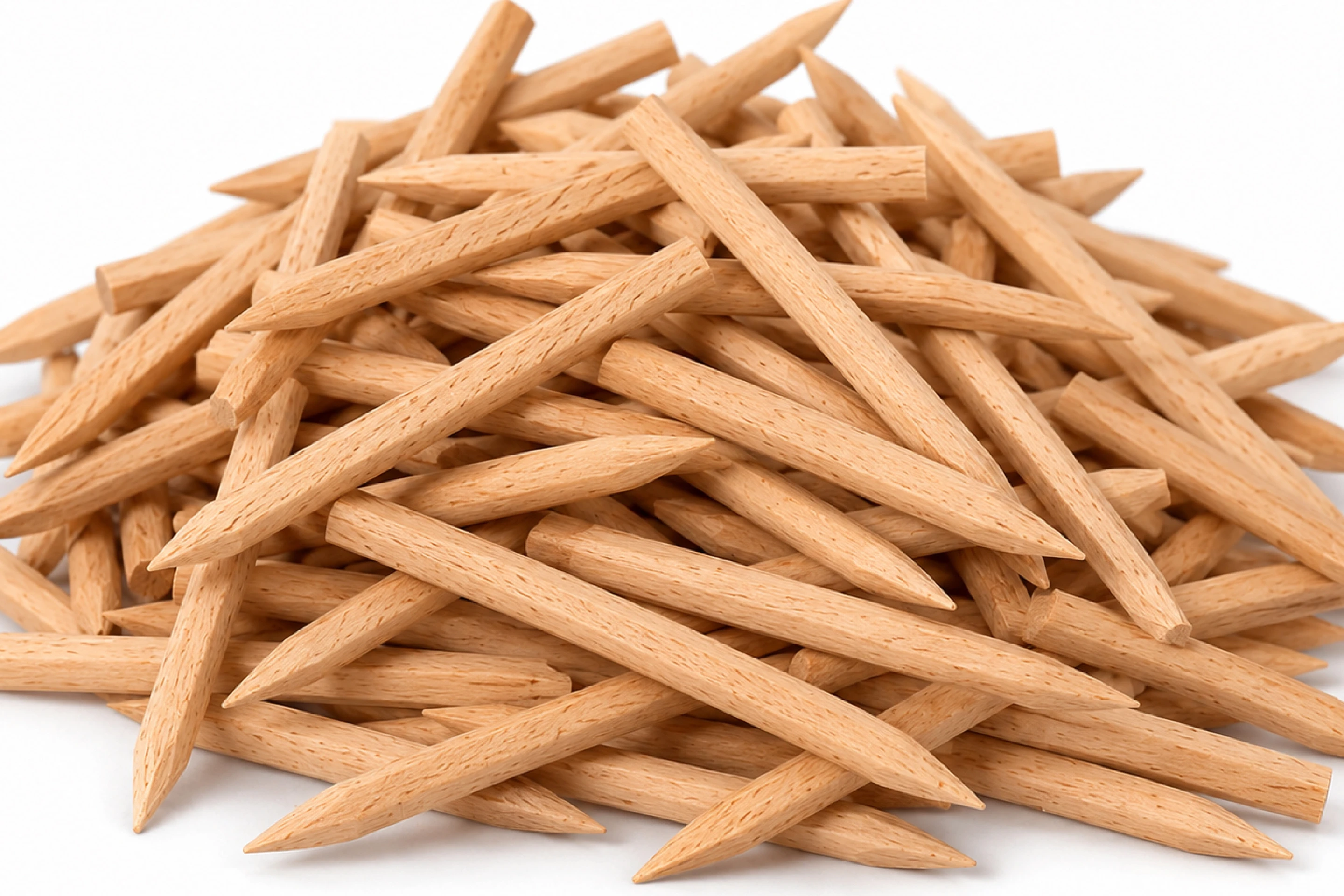
In their paper, Zhang Shang, Li Xuanlei and colleagues from Southwest Forestry University, Yunnan Forestry Vocational and Technical College, and Fujian University of Technology introduced the successful preparation of engineered wood nails and their application as construction fasteners. By densifying wood cell walls, the research team created extremely strong and durable wooden fasteners that can be used to assemble cross-laminated timber. Cross-laminated timber is made from multiple layers of wood glued together in alternating grain directions for added stability. When inserted, the dowels mechanically interlock with the wood at a microscopic level, completely eliminating the need for steel connectors or glue.
Previously, most cross-laminated timber required glue and sometimes metal connectors to connect the layers, which created new problems. Because each material has different compositions, mechanical properties and environmental effects, such as nails that rust and glue that hinders separation during recycling, the combination requires sophisticated means to remain stable. In addition, ordinary wood nails are full of pores inside and can swell, deform or even fail when exposed to water, requiring expensive and time-consuming maintenance and possibly causing structural damage.
To overcome these difficulties, the researchers used a method similar to how a blacksmith forges a sword: the steel is repeatedly heated, folded and hammered to make it hard. While controlling the pressure and densifying the nail-making wood, the research team impregnated the melamine-urea-formaldehyde resin into the internal pores and cell walls of the wood, then compressed it and heated it to about 135 degrees Celsius. While this means that the method is not completely resin-free, ultimately only the wooden nails contain resin and the wooden beams used in construction do not.
This treatment destroys the open cell structure of the wood and compacts the cellulose microfibrils. The volume of the birch wood sample in the experiment shrank by about 50%, and its density increased from 0.69 grams per cubic centimeter to 1.33 grams per cubic centimeter. The mechanical properties of the treated wooden nails have been greatly improved, with the flexural strength reaching 150.89 MPa, the compressive strength reaching 88.48 MPa, and the Janka hardness rising to 18.84 kN, which is approximately 5.1 times that of untreated beech wood.
In addition to being more resistant to water damage, this wood also performs well in CNC machining. The thickness expansion rate of untreated wood is 37.6%, while that of treated wood is only 5.31%. Researchers created engineered wood nails 5 millimeters in diameter with tips sharp enough to retain their shape after being driven into the wood by a nail gun, and to mechanically interlock with the wood at a microscopic level.
However, engineered wood nails are not a perfect replacement, at least yet. They can currently withstand loads of up to 900 Newtons, while steel stud construction can withstand around 1,200 Newtons. Still, future construction and recycling could benefit from this technology, as it reduces the mixing of different materials and lowers the construction industry's carbon footprint.
Comments