
Abstract:
Today's job market is so magical. Some people went to 6 interviews and didn't meet a single live person. Because of this year’s autumn recruitment, major companies have invariably replaced interviewers with AI. You know, AI interviews are no longer a small-scale test. Banks and car companies almost regard this thing as a standard for preliminary screening.
These days, finding a job is harder than finding a partner. Before meeting, you have to go through a "fully automated and unmanned interrogation."
Actually, the process is not complicated. Once the resume is submitted, HR will directly send a link or QR code.
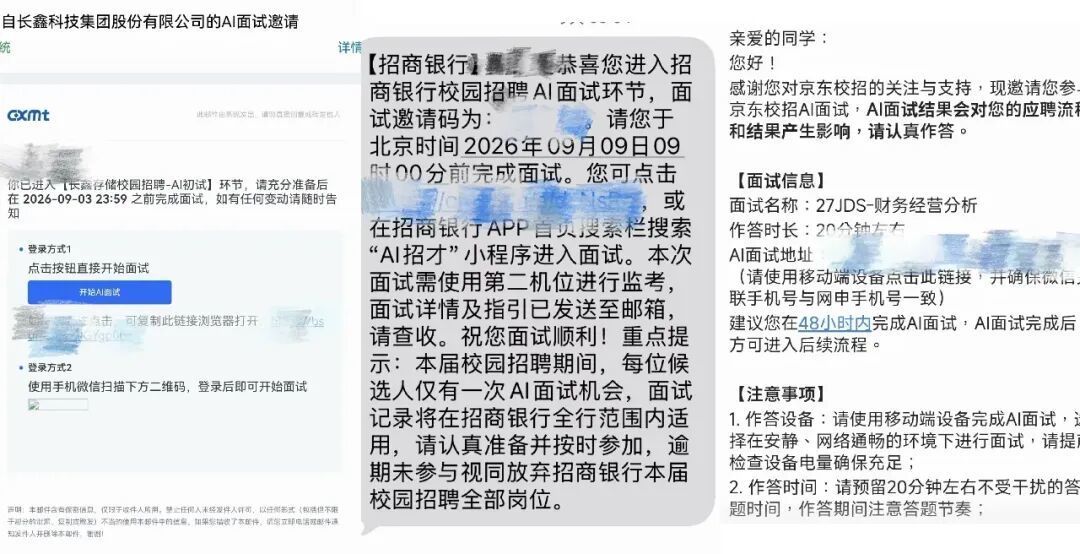
Click in, and a digital person will appear on the screen, blinking and talking, and always smiling.
Then the programmed question-answering session begins. The entire interview lasts about 30 to 40 minutes, usually 5 to 7 questions. Each question takes 30 seconds to 1 minute to prepare and 2 to 3 minutes to answer.
The countdown is forced to end immediately after it runs out. Even if you haven’t finished speaking or the key points, the system will cut it off directly.

The most suffocating thing is the AI’s mechanical questioning. It doesn't understand your overall logic and will only capture keyword matches.
As long as you determine that a certain type of information is not in place and the data is not specific enough, the same question will be asked repeatedly. Even if you have already explained it, you will have to answer it again and again.
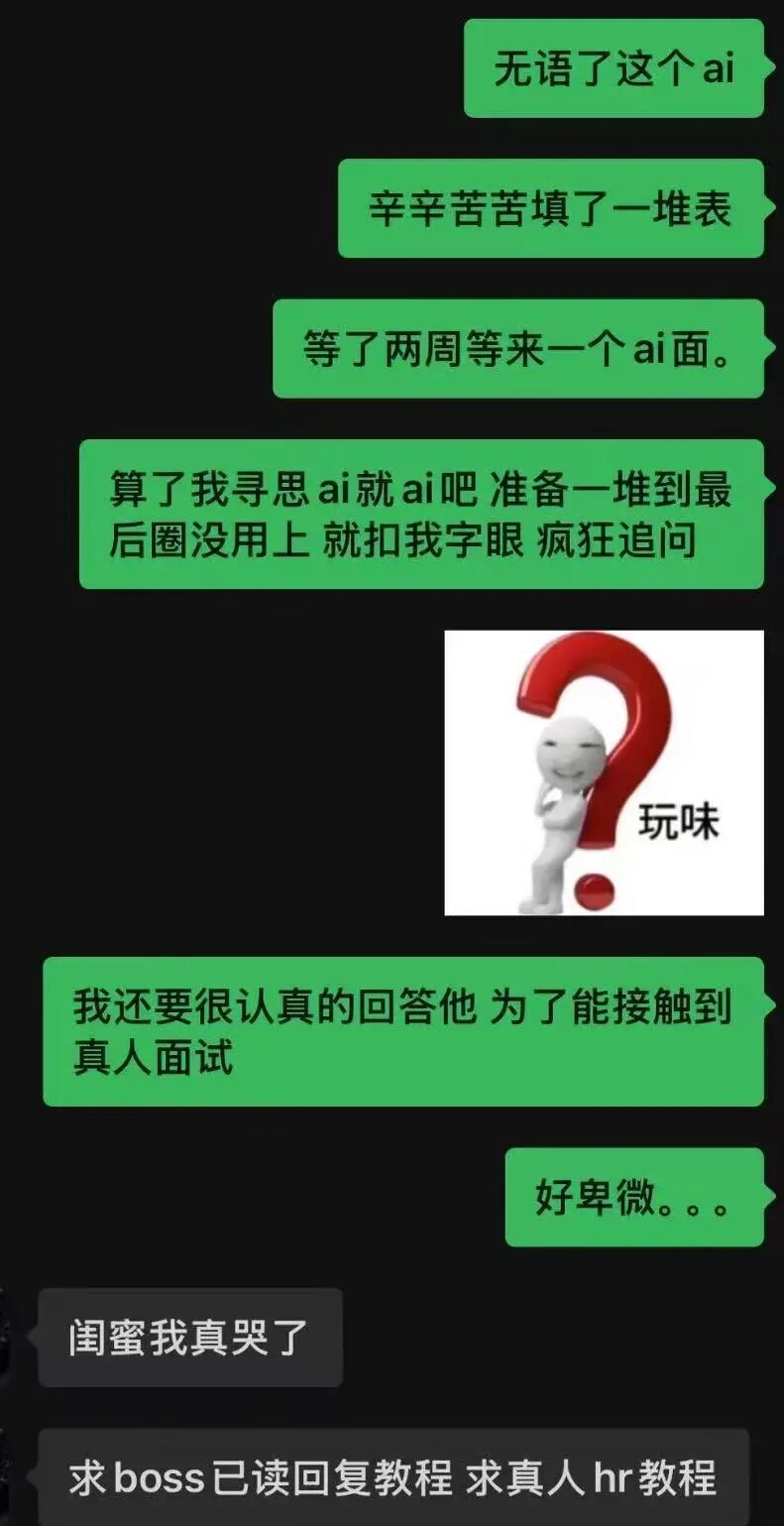
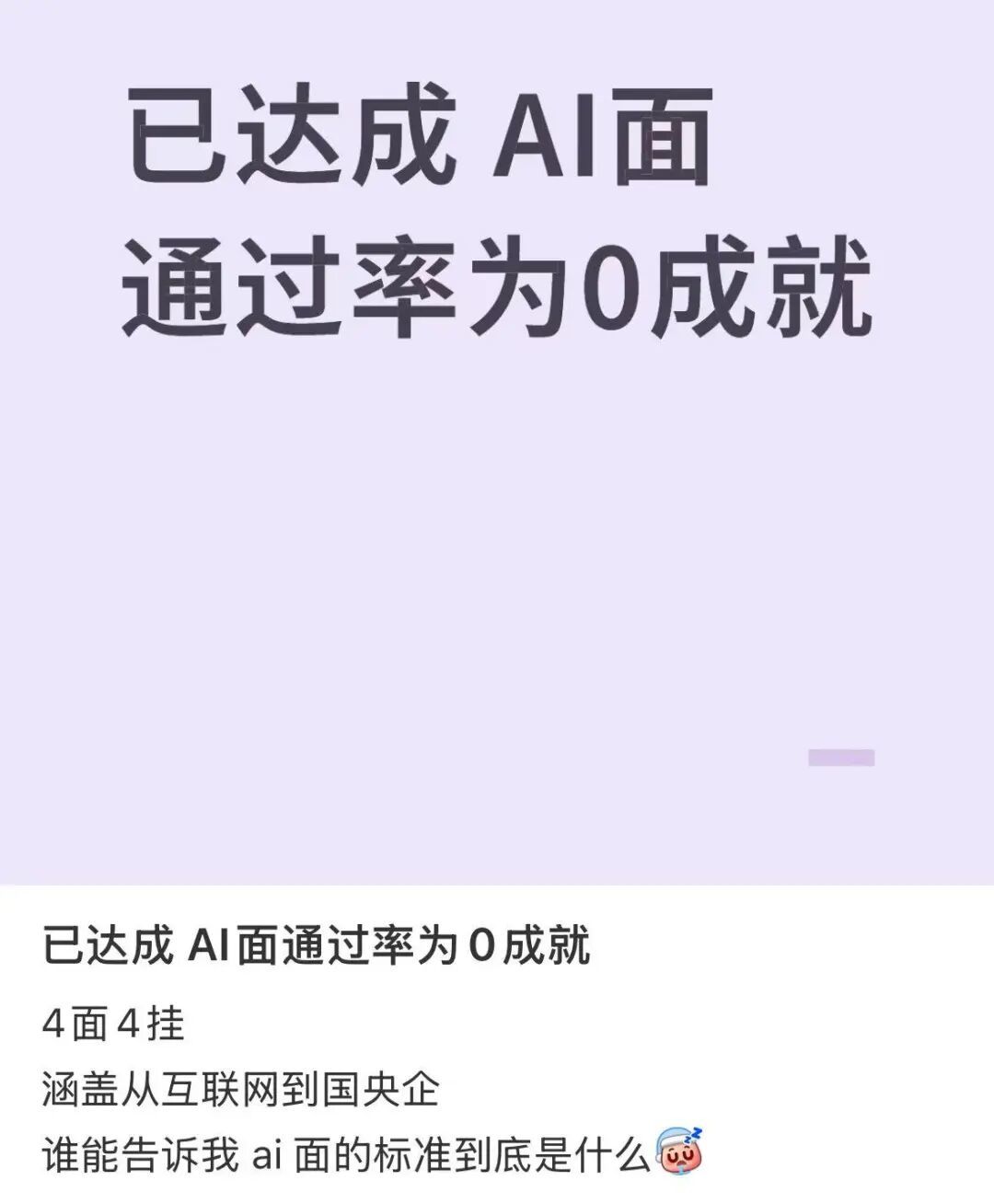
Many students were confused after the interview and had no idea why they failed.
Because the scoring logic of AI is completely different from that of human HR.
The real-person interview will look at your conversational temperament, on-the-spot reactions, logical thinking, and even tolerate the youthfulness of fresh graduates. But AI doesn’t do this, it’s all about naked quantitative indicators.
First look at semantic keyword matching. When you answer questions, does it contain their preset industry jargon and core technical vocabulary.
There are also non-verbal manifestations, such as eyes, sitting posture, expressions, and body language. Specifically, where you look with your eyes when you speak, whether your body sways, how fast you speak, etc.
As long as your micro-expressions are slightly off, or your speech is stuck for two seconds, the algorithm may directly label you as "insufficient in stress tolerance" or "unsmooth communication."

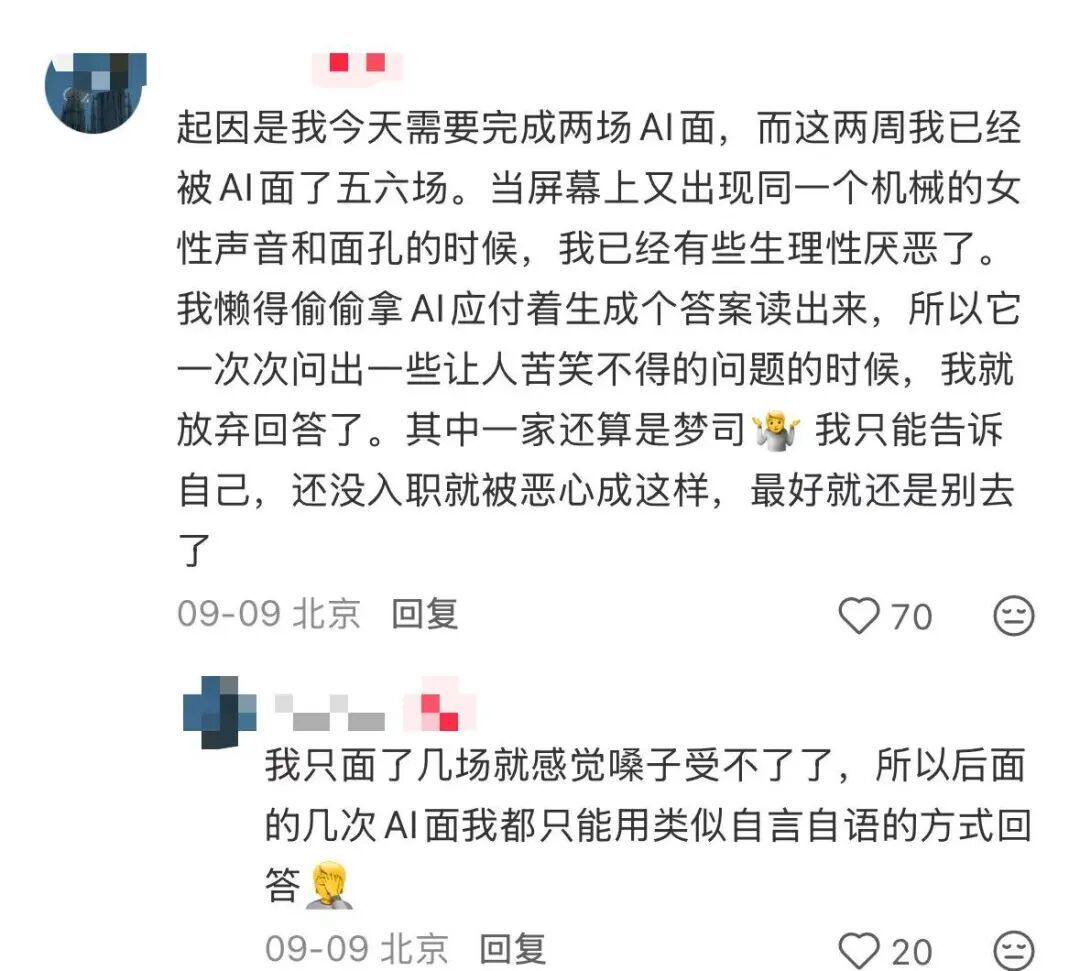
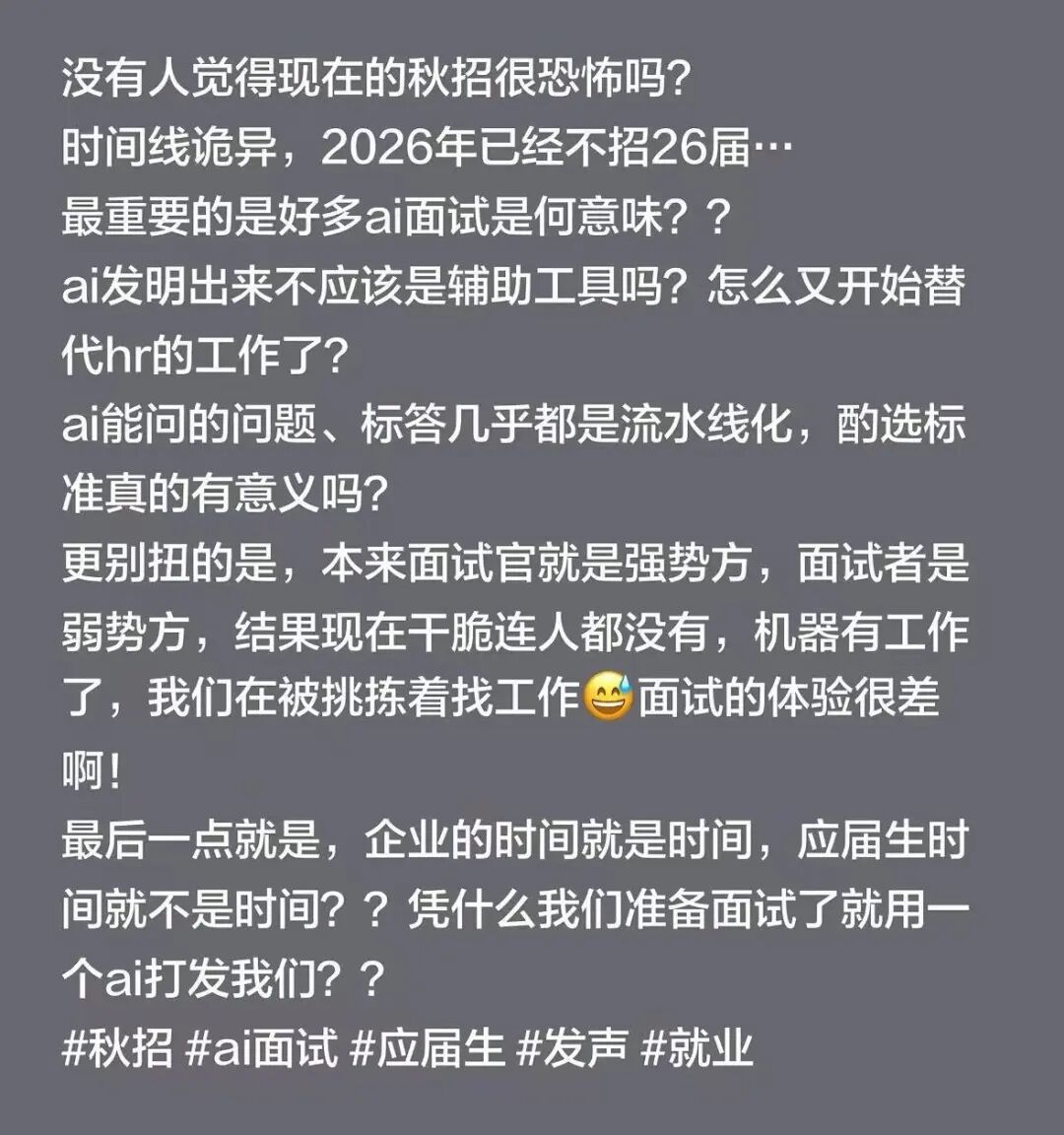
As a result, many job seekers have complained wildly on social platforms, saying that this kind of interview is simply an extreme abuse of psychological endurance.
During the interview, there was no feedback on the demeanor and tone of a real person communicating. The feeling of silence and weirdness was even more uncomfortable than being executed. So much so that the term “AI Interview Uncanny Valley” became a hot search topic.

Obviously there was something in mind, but when facing the camera, my mind went blank and the rhythm was completely messed up.
This reminded Fox Girl of the essay on the last question of the Mandarin exam. Although she had prepared the questions in advance, she still got stuck when speaking to the computer.
What’s even more outrageous is that sometimes, if the Internet speed is slow or the light is dim, the system will directly determine that your eyes are evasive and your attitude is perfunctory, and you will be voted out. Where can I go to reason?
The entire interview is one-way, it can examine you, but you cannot question it. Therefore, some people call AI interviews “obedience tests”.
It not only creates huge job-hunting anxiety, but also turns job-hunting, which should have been a two-way process, into an undignified machine domestication.
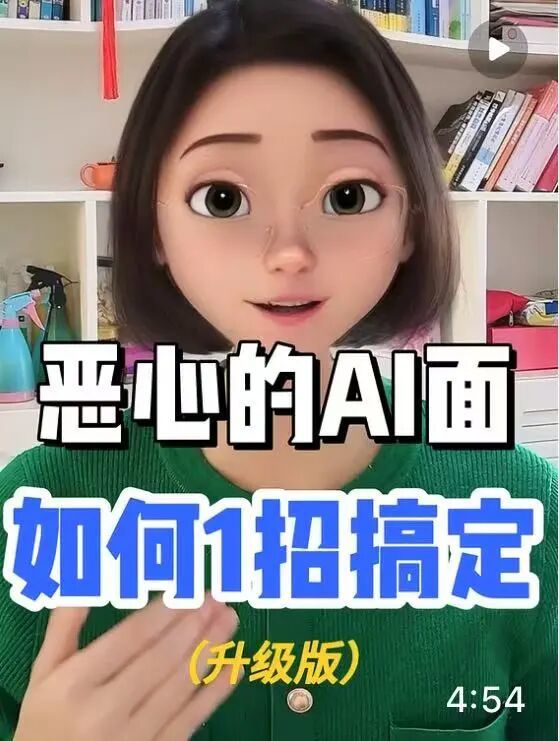
So, everyone began to use magic to defeat magic.
The “AI interview assistant” on the e-commerce platform is selling like crazy. It monitors test questions in real time, generates answers in milliseconds, and also has eye correction functions. You can buy it for tens of dollars to hundreds of dollars.
Then the company upgraded its anti-cheating system, including eye tracking, dual-camera recording, and screen monitoring.
Nowadays, the content and data shared on social platforms on how to deal with AI interviews are very good. It can be seen that everyone is forced to run out of tricks. Save whatever you see, just in case it is useful.
Since so many people are complaining, why do companies have to forcefully popularize AI interviews?
The core reason is to save money.
The number of job seekers has skyrocketed this autumn. For any position in the leading companies, there are tens of thousands or hundreds of thousands of resumes. If you rely on manual initial interviews, you will need to invest a lot of HR manpower.
Now an AI interviewer can conduct 2,500 interviews in 24 hours, and the initial screening process has been reduced from one or two weeks to two or three days.
According to data, China’s AI interview market has increased from 600 million in 2020 to 4.3 billion in 2025, and is expected to reach 20.8 billion in 2030.
The huge market demand has also directly ignited the entire AI interview service industry. The value of new contracts signed by Beisen for its AI products in fiscal year 2026 surged 10 times year-on-year, with the renewal rate for its AI interviewer product reaching as high as 120%.
That is to say, old customers not only renewed their contracts, but also made additional purchases.
There is nothing wrong with technology improving efficiency, but the question is, when the algorithm becomes the gatekeeper, can it really hold on?
Recruitment is never about selecting parts in an assembly line, nor are people products of uniform specifications.
The most magical thing about the AI interview is that it attempts to use a set of standardized codes to frame the diverse and creative young souls.
But the problem is that the talented people who can really change the world and promote industry innovation are often those who are full of thorns, do not take the usual path, and even have a bit of social fear.
Mei Hu believes that real recruitment is to discover the shining points of each person and match them to suitable positions, rather than using a fixed algorithm to polish everyone into a standard template.
AI interviewing will definitely become a mainstream trend in future recruitment. This is an inevitable development of the industry and we cannot reverse it.
But I always hope that technology is a tool to serve people, not a shackles to screen people.
Rather than quickly screening out a group of young people, what companies should do is not to let outstanding people be buried by cold algorithms.
Comments