
Abstract:
The latest third-quarter financial report released by Alphabet, Google’s parent company, shows that driven by artificial intelligence technology, Google’s search business has ushered in the fastest query growth rate in the past five years. However, although user usage continues to rise, search business revenue growth has slowed down, which has led investors to re-examine the business prospects of Google's AI strategy.
Alphabet CEO Sundar Pichai said on the earnings call that the company's investment in artificial intelligence is effectively promoting the development of the search business, and the overall search query volume, including commercial searches, has increased significantly. He pointed out that Google's current search query year-on-year growth rate has reached the highest level in the past five years.
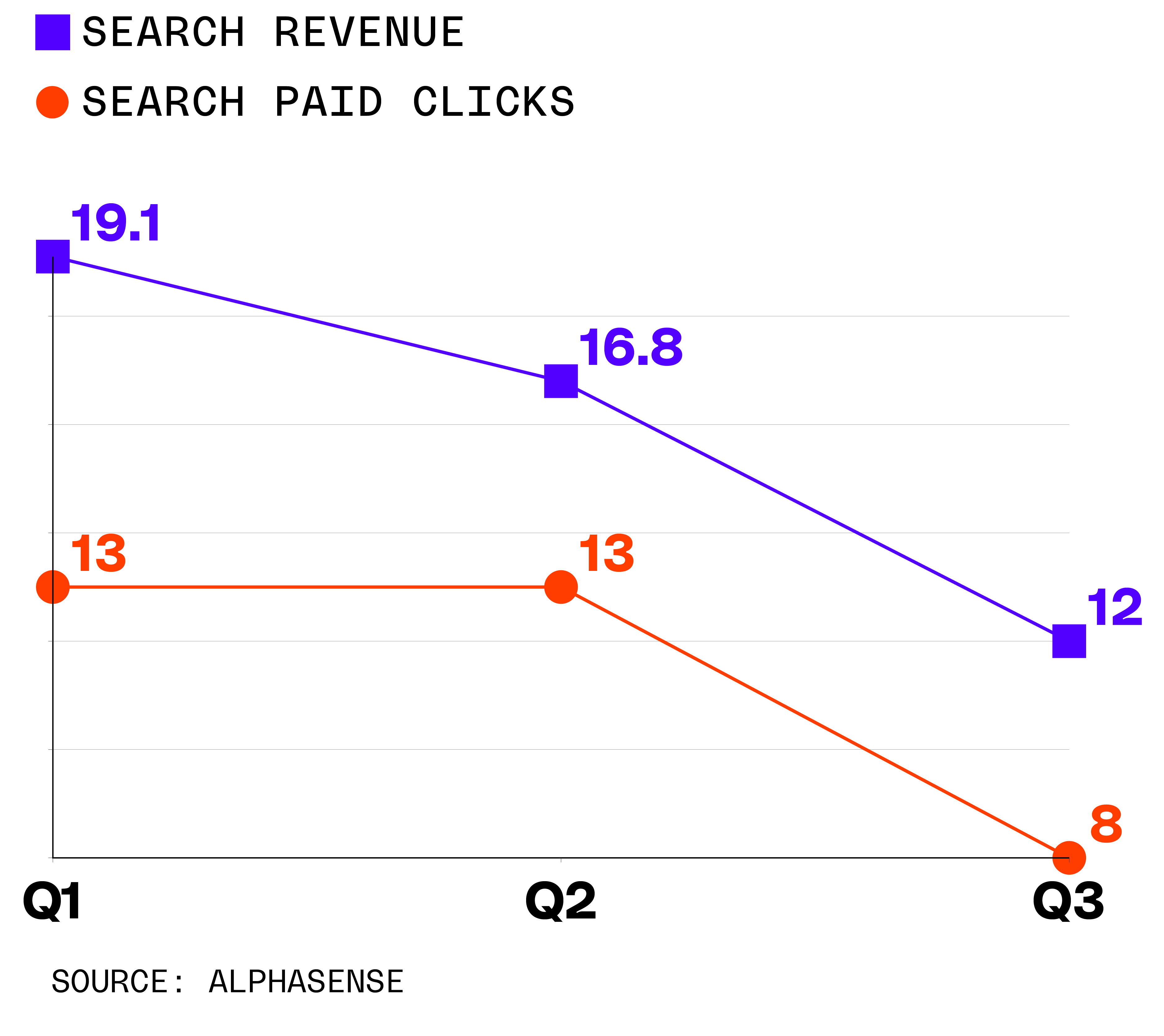
Financial report data shows that third-quarter revenue from Google search and other related businesses increased by 12% year-on-year. Although this number is still growing, it is down from the growth rate of about 17% in the previous quarter. At the same time, the growth rate of paid advertising clicks, one of the core indicators of Google's advertising business, also dropped from 13% in the previous quarter to 8%.
This situation has attracted the attention of the capital market. Since Alphabet is planning to invest approximately US$200 billion in infrastructure this year, most of which will be used to support the development of its artificial intelligence business, investors are paying more attention to when these huge investments can be converted into corresponding returns.
Google Chief Commercial Officer Philip Schindler explained that exchange rate factors and adjustments to advertiser spending in some industries are one of the important reasons for the slowdown in revenue growth. However, he also admitted that the development of AI search products has also brought new impacts.
According to information disclosed by Google, the use of AI Mode is growing rapidly, but its commercialization efficiency is still lower than that of traditional search mode. In other words, although more and more users are beginning to obtain information through AI, these queries are not yet able to generate the same level of advertising revenue as traditional searches.
Over the past year, Google has continued to integrate generative artificial intelligence into the search experience. Among them, AI Overviews automatically generates content summaries at the top of the search results page, while AI Mode further transforms traditional search into a chatbot-like interactive experience, allowing users to continue multiple rounds of conversations around the same topic.
Google believes that these AI functions do not replace the original search needs, but create new search scenarios. Schindler said most of the AI Mode queries the company observes are "incremental queries," where users ask new questions they wouldn't otherwise search for, resulting in additional search activity.
However, industry analysts point out that artificial intelligence is changing the way users obtain information, and this change may ultimately affect the advertising business model that Google has long relied on.
Nate Elliott, an analyst at eMarketer, a market research firm, said that this is the first time in decades that Google has faced a major transformation that may impact its core business model. In the past, users usually clicked on websites and ads through search results, but generative AI can directly generate answers. It remains to be seen whether this model will weaken the value of advertising.
Andy Taylor, director of research at digital marketing agency Tinuiti, believes that different search scenarios are affected differently. If users just want to know the answer to a question, AI-generated content may be enough; but when users search for a product with clear shopping needs, traditional advertising and shopping displays still have obvious advantages.
Faced with profitability challenges, Google has begun testing new advertising formats in AI Mode and AI Overviews. The company said the experimental results are encouraging and plans to gradually expand advertising coverage. However, Google has not publicly stated whether these new ads will be able to reach the profitability level of traditional search ads in the future.
In fact, since ChatGPT set off a wave of generative artificial intelligence, the outside world has been worried that AI chat assistants may weaken the importance of traditional search engines. Today, Google not only needs to deal with challenges from competitors such as OpenAI and Anthropic, but also needs to prove that it can continue to maintain the strong profitability of its search business in the AI era.
Pichai said that the company's primary goal is still to create the best search experience, and commercialization will be gradually advanced at an established pace. He compared this stage to Google's transformation from desktop Internet to mobile Internet more than ten years ago.
From the perspective of overall business performance, artificial intelligence has successfully driven Google search usage to a new high in recent years. But for Wall Street, the more important question remains unanswered: whether Google can eventually grow AI search into a profit engine as powerful as traditional search.
As AI capabilities continue to be deeply integrated into search products, Google is undergoing the most important business model transformation since the birth of the search engine. Whether this transformation will further consolidate its Internet dominance or pose a long-term challenge to its core advertising business may be answered by its performance in the next few quarters.
Comments